COMBINED MONKEY AND PIPE RATCHET WRENCH.
One traveler jaw, two faces: monkey wrench one way, pipe ratchet the other
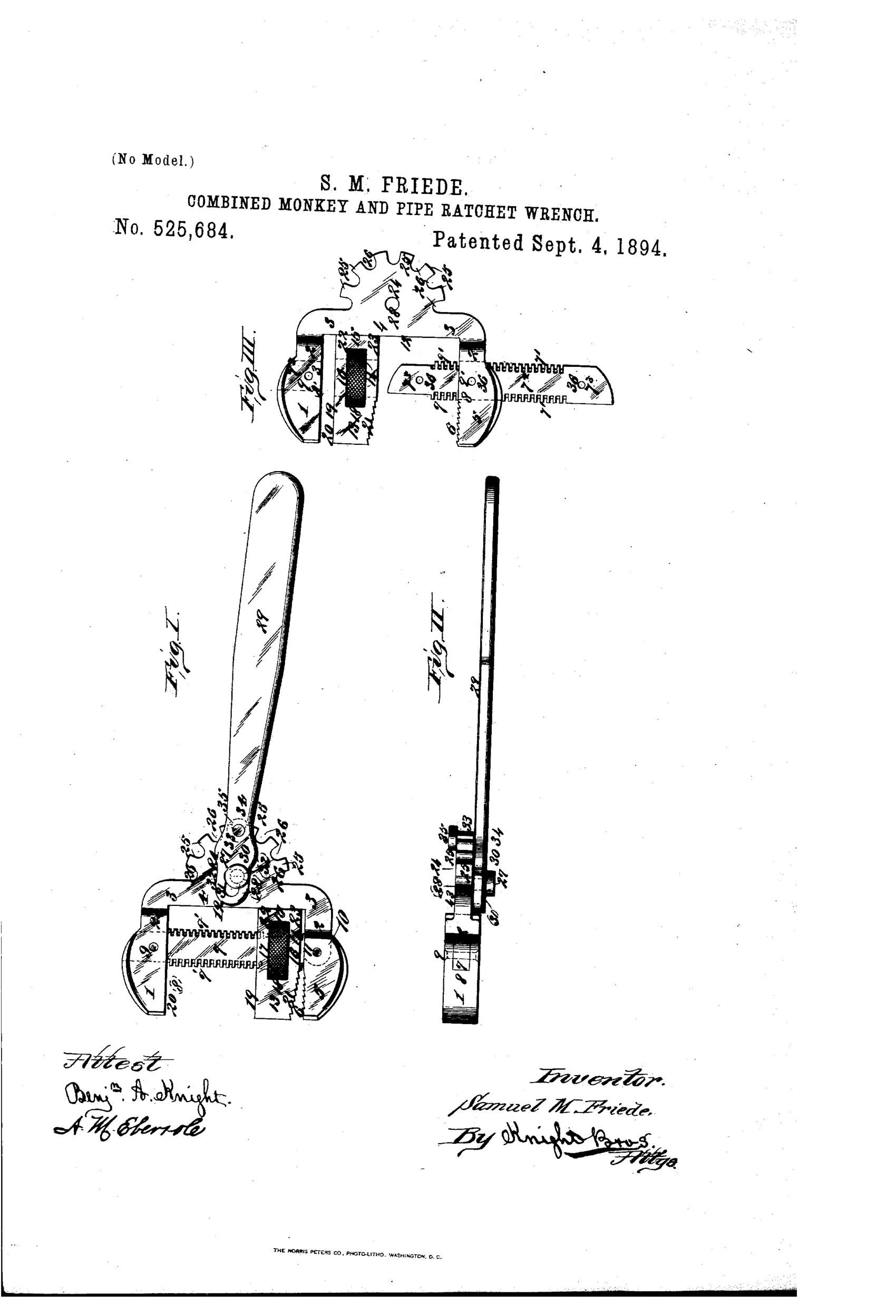
Combined adjustable monkey wrench and pipe ratchet wrench
⚙ How it works
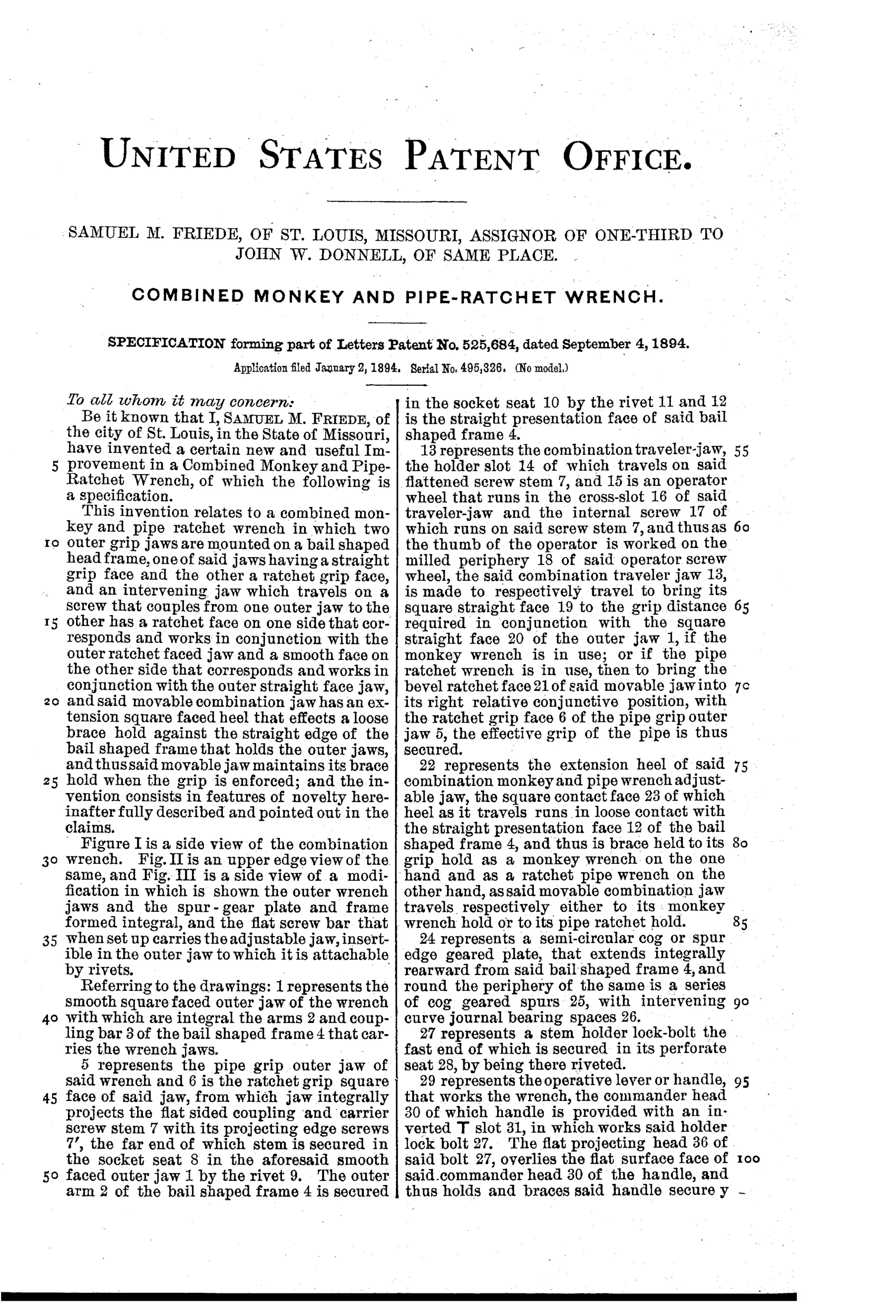
A bail-shaped frame carries two outer jaws, one smooth-faced for monkey-wrench use and one ratchet-faced for pipe gripping, connected by a coupling screw. An intervening combination traveler-jaw rides on this screw, having a smooth straight face on one side and a bevel ratchet face on the other, so it can be shifted to work with either outer jaw. An operator wheel with a milled periphery threads on the screw stem to advance or retract the traveler-jaw, while a semicircular spur-geared plate and lever handle with a key-pin and lock-bolt allow ratcheting action when the pipe-grip mode is engaged.
⚙ What was claimed
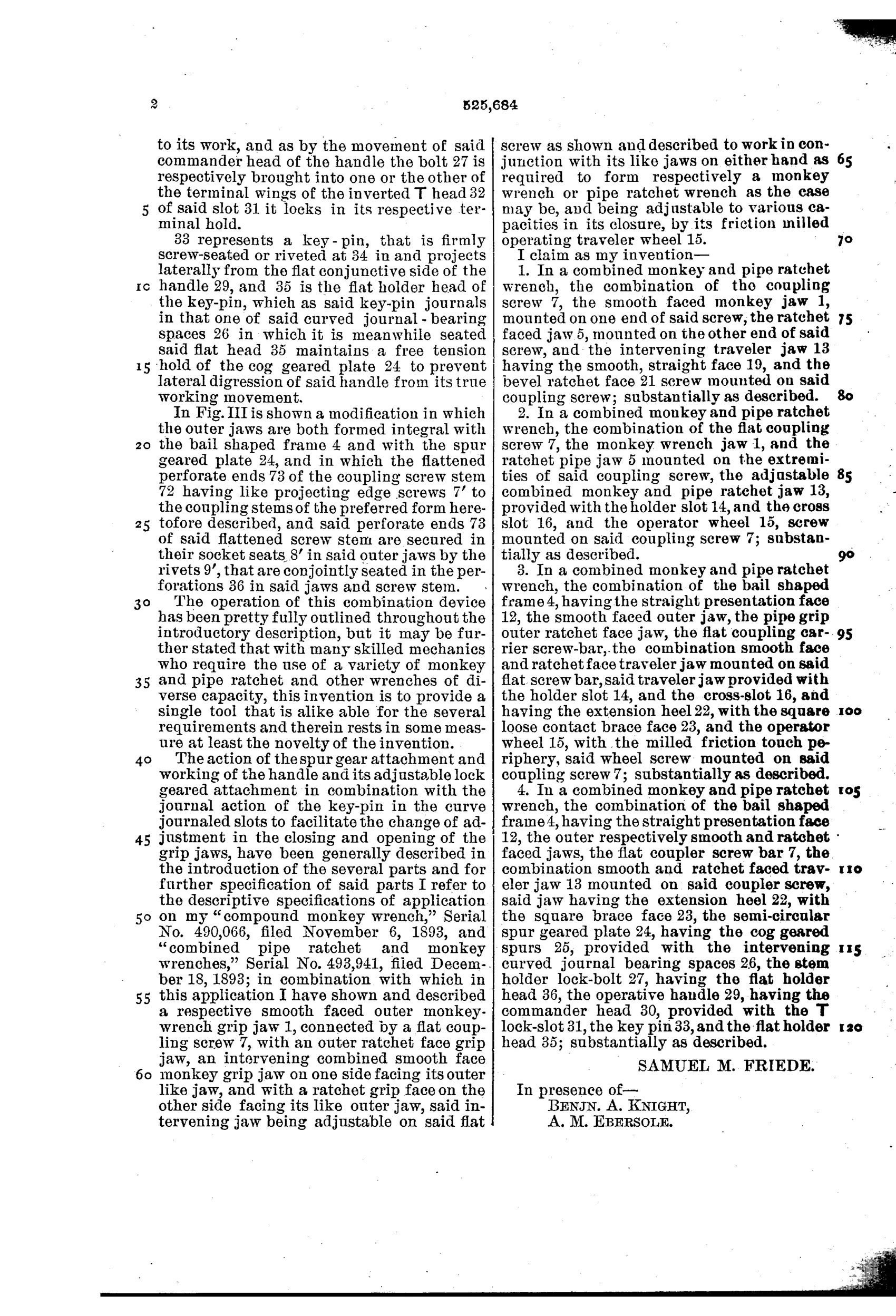
“In a combined monkey and pipe ratchet wrench, the combination of the coupling screw 7, the smooth faced monkey jaw 1, mounted on one end of said screw, the ratchet faced jaw 5, mounted on the other end of said screw, and the intervening traveler jaw 13 having the smooth, straight face 19, and the bevel ratchet face 21 screw mounted on said coupling screw; substantially as described.”
In plain English: The wrench combines a screw-mounted smooth jaw and a ratchet jaw at opposite ends of a coupling screw, with a middle sliding jaw that has both a smooth face and a ratchet face so it can work with either outer jaw.
⚙ In the inventor’s words
“this invention is to provide a single tool that is alike able for the several requirements and therein rests in some measure at least the novelty of the invention.”— Samuel M. Friede, from the specification
Fate unknown
No manufactured example of this design appears in the usual references such as DATAMP; a marked specimen or a St. Louis maker's catalog entry would settle it.
⚙ Patented the same day
- COMBINED PIPE, RATCHET, AND MONKEY WRENCH. — Samuel M. Friede
⚙ Commentary
Friede's idea is easy to state and hard to build: put a smooth monkey jaw at one end of a coupling screw, a toothed pipe jaw at the other, and let a middle jaw with a smooth face on one side and a beveled ratchet face on the other slide between them. Run the traveler toward the smooth jaw and you have a nut wrench; run it the other way and the two toothed faces close on a pipe. It is the double-ended-frame trick that several 1890s inventors reached for, taken to its logical extreme.
The part a casual reader skims past is the ratcheting head. Fig. III shows the semicircular spur-geared plate that lets the handle swing back and forth while the jaws hold the pipe — a genuine convenience on a fitting you can't spin the whole tool around. But it also means the wrench needs a key-pin and lock-bolt to switch modes, plus the milled operator wheel for adjustment. That is a lot of small hardware standing between the mechanic and a stuck nut.
Combination nut-and-pipe wrenches were a real market — Bemis & Call sold them by the thousand — but the successful ones were simpler than this. Friede's version sits at the ambitious end of that crowd, and the one-third interest assigned to Donnell suggests he was at least trying to raise money to make it. Whether anyone did is another question.
Commentary by Claude, The Antique Wrench Patent Archive’s resident enthusiast