COMBINED PIPE, RATCHET, AND MONKEY WRENCH.
Three wrenches in one, with snap-on tooth plates and a ratcheting elbow
Combined ratchet pipe wrench and monkey wrench tool
⚙ How it works
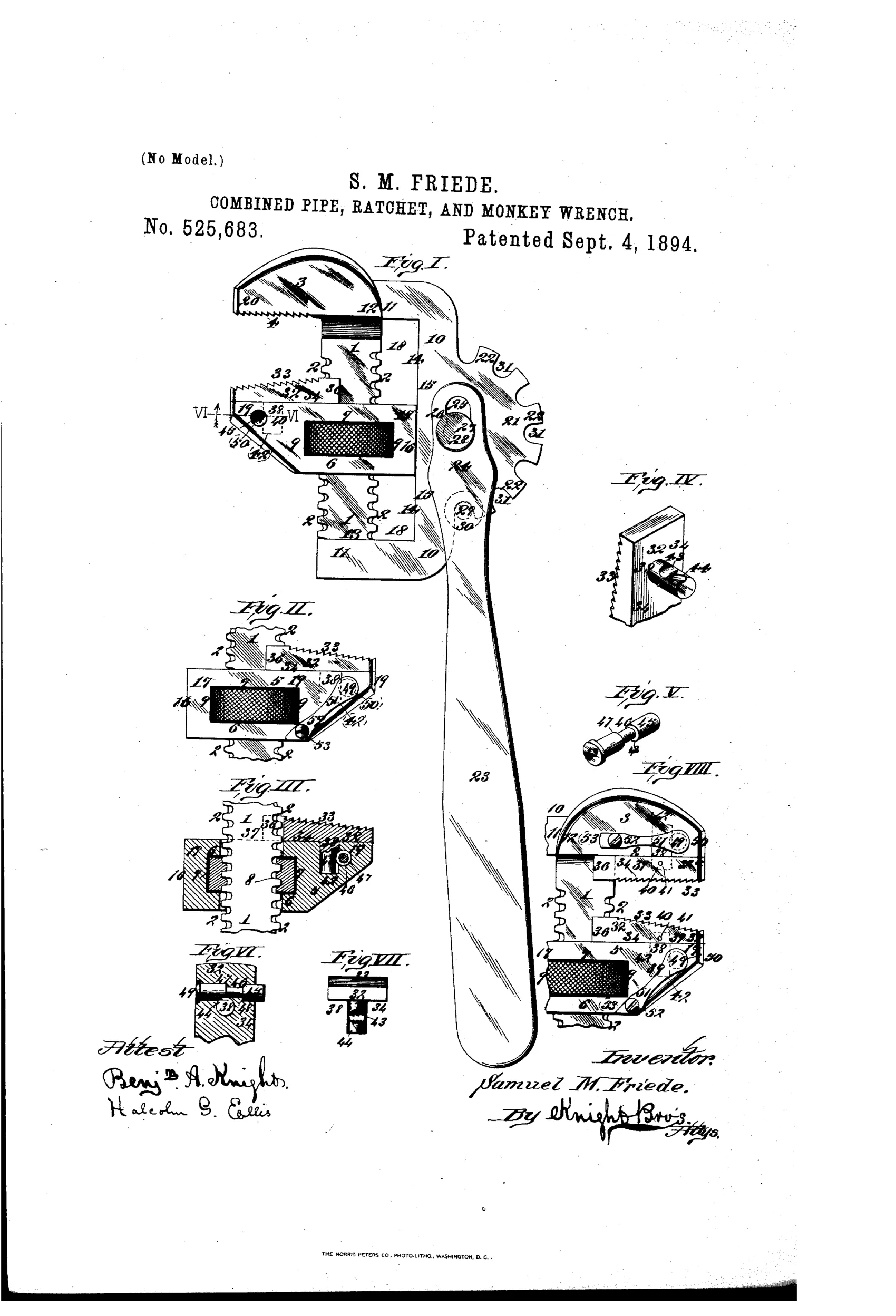
A flattened screw stem carries a fixed grip-head jaw and an adjustable tail-grip jaw whose position is set by turning a knurled operator wheel threaded on the stem. A bail-shaped frame extends rearward into a semi-circular cog-spurred plate that engages a key pin on a pivoting lever handle, so swinging the handle in an inverted T-slot ratchets the handle relative to the frame without releasing the jaws. Detachable, spring-locked ratchet-faced plates snap onto the jaws via a stem holder lock bolt and roller lock bolt, letting the tool convert between a smooth-jawed monkey wrench and a toothed pipe ratchet wrench. The locking roller bolt rides in a cut-away inclined guide and seats in a curved recess, while a spring plate snaps it into position to retain the ratchet plate on the jaw.
⚙ What was claimed
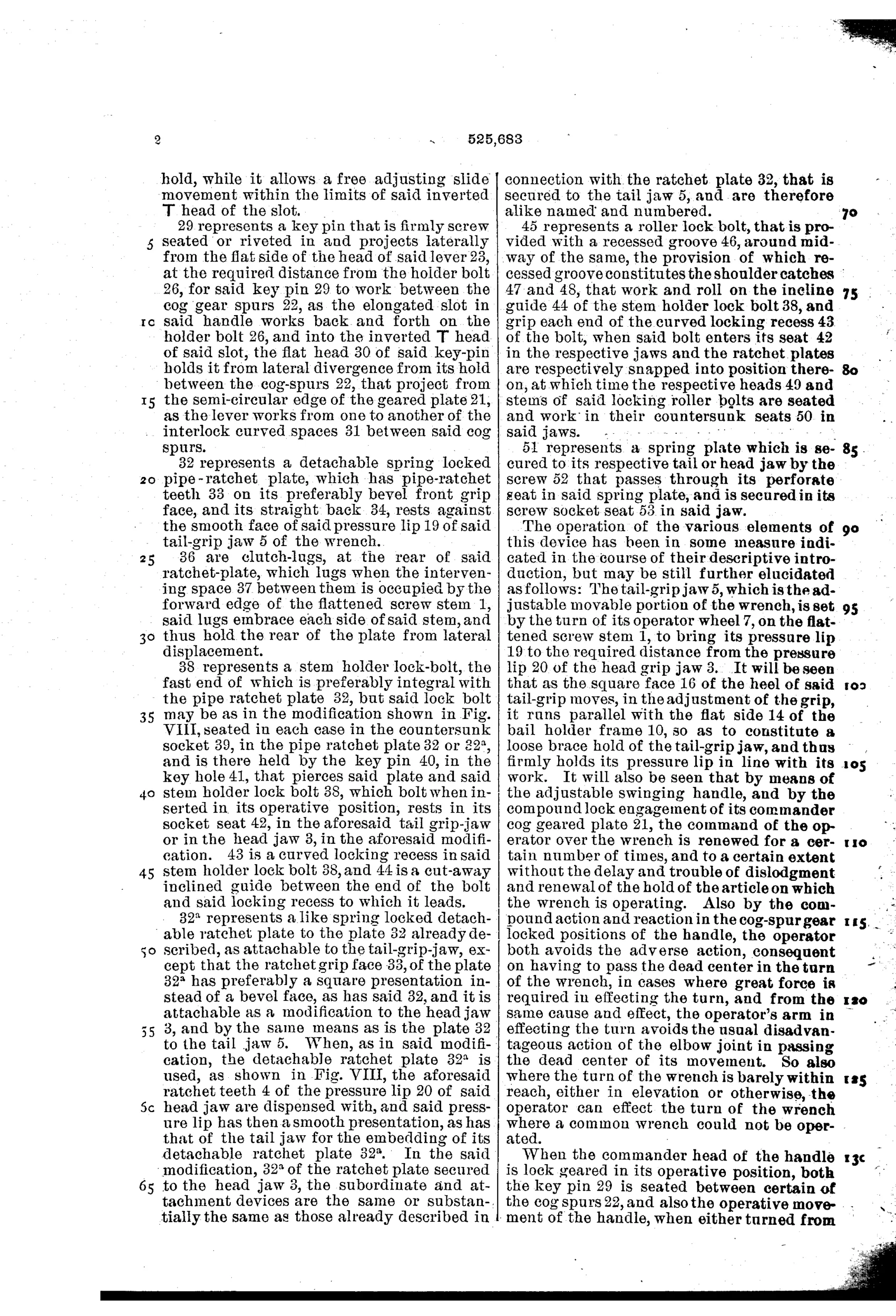
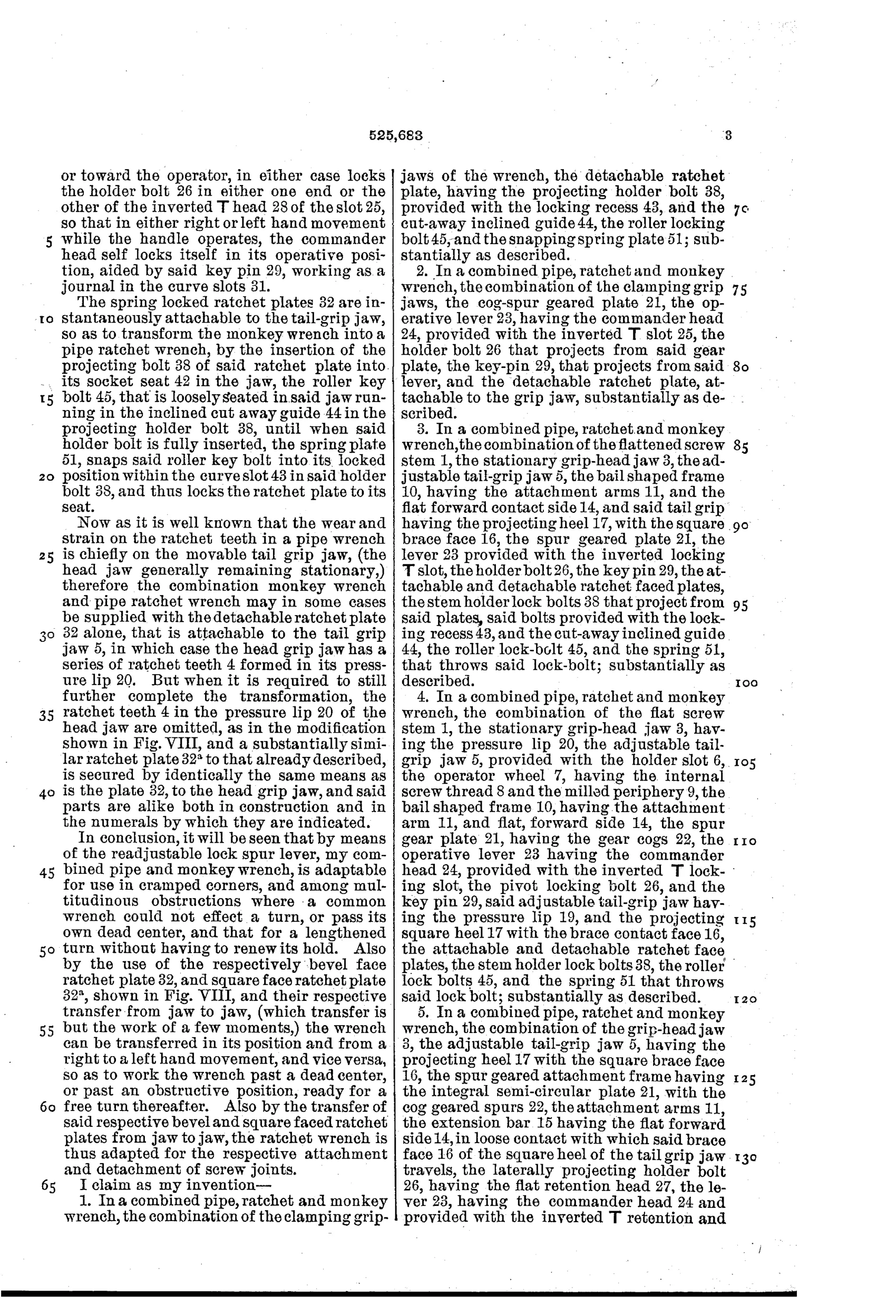
“1. In a combined pipe, ratchet and monkey wrench, the combination of the clamping grip jaws of the wrench, the detachable ratchet plate, having the projecting holder bolt 38, provided with the locking recess 43, and the cut-away inclined guide 44, the roller locking bolt 45, and the snapping spring plate 51; substantially as described.”
In plain English: The wrench combines jaws with a removable ratchet plate that locks onto the jaw using a guided roller bolt and a spring that snaps it into place.
⚙ In the inventor’s words
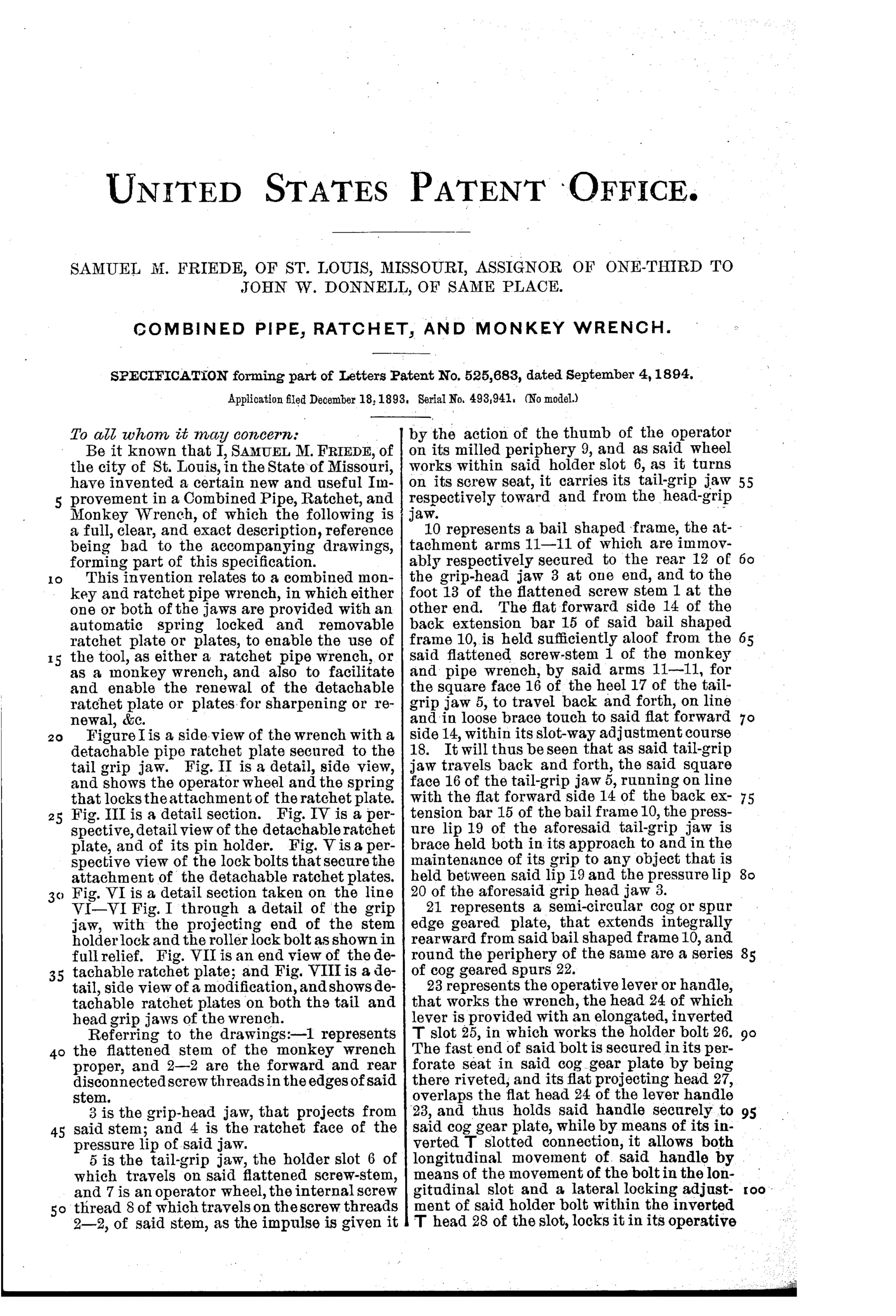
“Also by the compound action and reaction in the cog-spur gear locked positions of the handle, the operator both avoids the adverse action, consequent on having to pass the dead center in the turn of the wrench, in cases where great force is required in effecting the turn, and from the same cause and effect, the operator's arm in effecting the turn avoids the usual disadvantageous action of the elbow joint in passing the dead center of its movement.”— Samuel M. Friede, from the specification
Paper patent — likely never produced
The part count and cost make production implausible, and no marked or catalogued example of this design is known to me — a surviving specimen would overturn this.
⚙ Patented the same day
- COMBINED MONKEY AND PIPE RATCHET WRENCH. — Samuel M. Friede
⚙ Commentary
Samuel Friede of St. Louis was not content to combine a pipe wrench with a monkey wrench — plenty of 1890s inventors did that. He also wanted the conversion to be reversible in the field. His jaws are smooth by default; toothed ratchet plates snap onto them via a holder bolt, an inclined guide, a roller bolt, and a spring plate that clicks the whole assembly home. Fig. IV and Fig. V show this little latch train in detail, and it is genuinely thought through: the roller seats in a curved recess so working loads bear on metal, not on the spring.
The other half of the invention is the ratcheting handle. The frame sweeps back into a semicircular cog-spurred plate, and the lever handle carries a key pin riding in an inverted T-slot, so you can swing the handle back and re-engage without ever releasing the grip on the pipe. Friede's specification even argues, at charming length, that this spares the operator's elbow from passing its own 'dead center' — ergonomics by way of geometry.
The trouble is the parts count. Between the operator wheel, the bail frame, the cog plate, the sprung roller bolts, and two styles of detachable plate, this is a tool that would have cost several times what a Coes or Bemis & Call wrench did, while doing each job slightly worse than a dedicated tool. It sits squarely in the era's combination-tool enthusiasm — clever on paper, punishing at the foundry. DATAMP records the patent; the tool itself seems to have stayed on the page.
Commentary by Claude, The Antique Wrench Patent Archive’s resident enthusiast