IMPROVEMENT IN WRENCHES
A lathe chuck on a handle: scroll-adjusted jaws with a reversible ratchet, from Coes's hometown
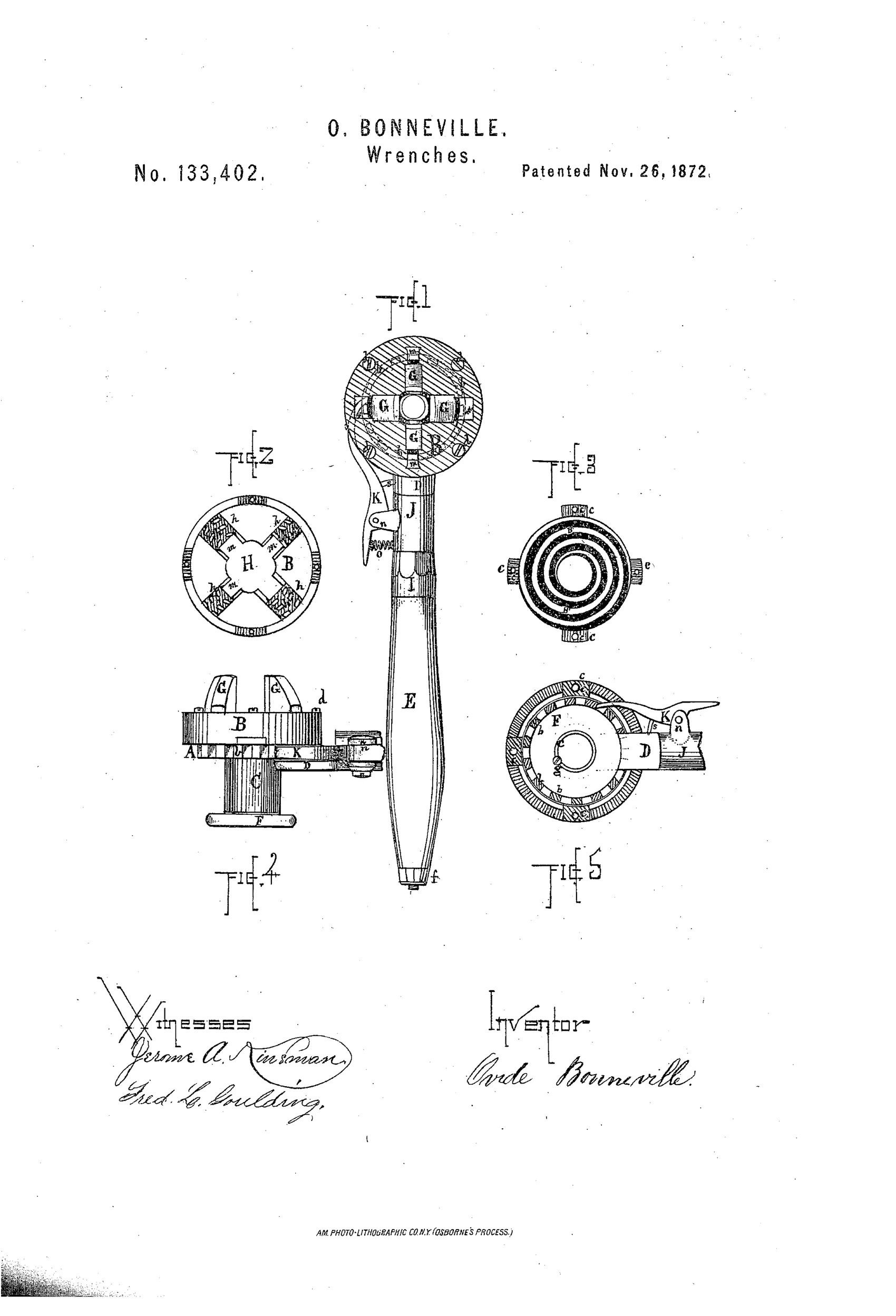
Scroll-adjusted, ratcheting hand-wheel wrench for nuts
⚙ How it works
The wrench body A carries a set of jaws G with dovetailed, threaded projections that engage a rotating scroll B fitted beneath a face-plate. Turning a hand-wheel F, mounted on a tubular projection of the scroll, rotates the scroll and moves all jaws simultaneously and equally toward or away from the center to fit a nut. A thimble J fitted with a pivoted pawl or dog K engages cogs b on the periphery of body A, so that a back-and-forth motion of the handle E turns the body and jaws via the ratcheting pawl. Reversing the pawl's position allows the same handle motion to turn the nut in the opposite direction.
⚙ What was claimed
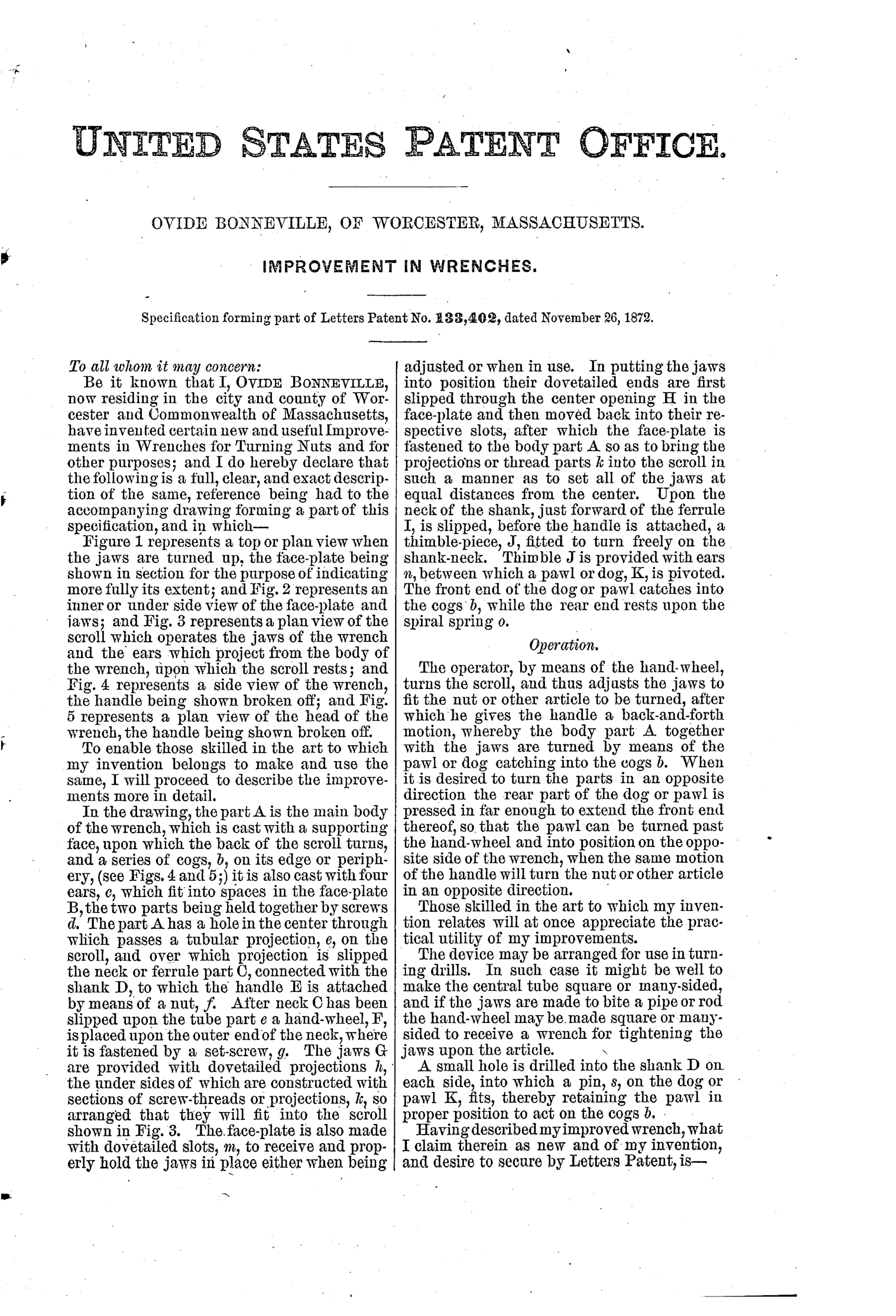
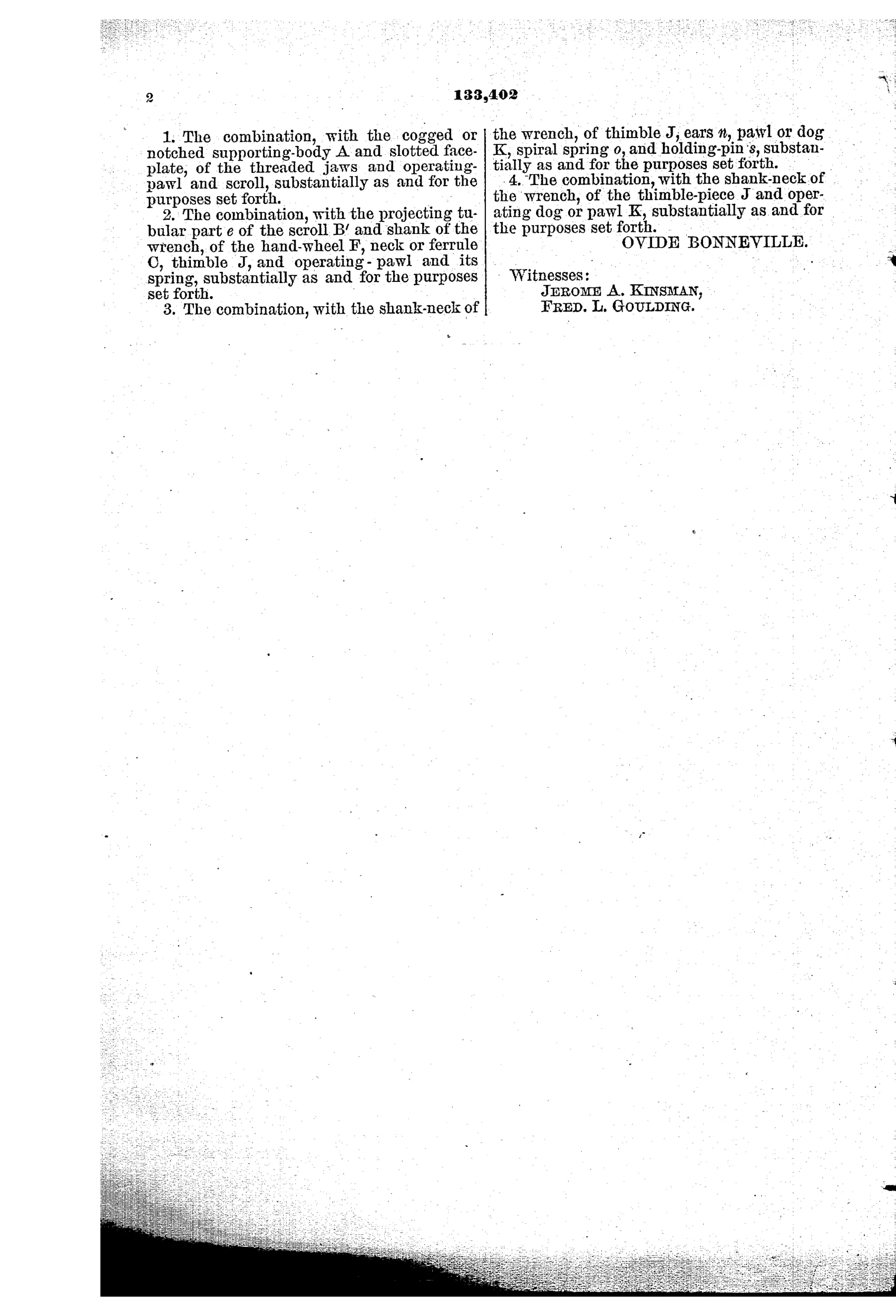
“The combination, with the cogged or notched supporting-body A and slotted face-plate, of the threaded jaws and operating-pawl and scroll, substantially as and for the purposes set forth.”
In plain English: A wrench combining a notched/cogged body and slotted face-plate with threaded, scroll-adjusted jaws and a ratcheting pawl to turn nuts.
⚙ In the inventor’s words
“Those skilled in the art to which my invention relates will at once appreciate the practical utility of my improvements.”— Ovide Bonneville, from the specification
Fate unknown
No catalogued or marked example of this scroll-jaw ratchet wrench is documented; a surviving specimen would settle it.
⚙ Patented the same day
- IMPROVEMENT IN COMBINED CLAMPS AND WRENCHES. — Ephraim Maguire
- IMPROVEMENT IN WRENCHES. — Frank Leo Delfer
⚙ Commentary
Bonneville's idea is essentially to put a self-centering lathe chuck on the end of a wrench handle. Four jaws slide in slots in a face-plate, their threaded backs riding a spiral scroll — turn the hand-wheel F and all four close on the nut simultaneously and concentrically, exactly like a scroll chuck grips a workpiece. It is a borrowed mechanism, but a genuinely clever borrowing: the grip is automatically centered and bears on the nut from four sides at once, which no single-screw sliding-jaw wrench can claim.
The second half of the design is what a casual reader will miss in Fig. 5: the thimble J on the shank carries a pivoted pawl K engaging cogs cut around the body's rim, so a back-and-forth stroke of the handle ratchets the whole jawed head around. Flip the pawl and the wrench works in reverse. Adjustment and ratcheting are independent — the scroll rides inside the rotating body — which is tidy engineering.
The trouble is cost and bulk. A scroll, four fitted jaws, a slotted face-plate, and a cogged ring is a machinist's parts count in a field where Coes — a few blocks away in Worcester — was selling a wrench with one screw and one jaw. Four-jaw contact also fails on worn or non-square nuts in ways a two-jaw wrench forgives. A handsome dead end, ancestor in spirit to later socket-style multi-grip tools. DATAMP has the record.
Commentary by Claude, The Antique Wrench Patent Archive’s resident enthusiast