SELF-ADJUSTING FULCRUM-LEVER WRENCH
Squeeze the handle and the jaw squeezes back: grip proportional to force applied
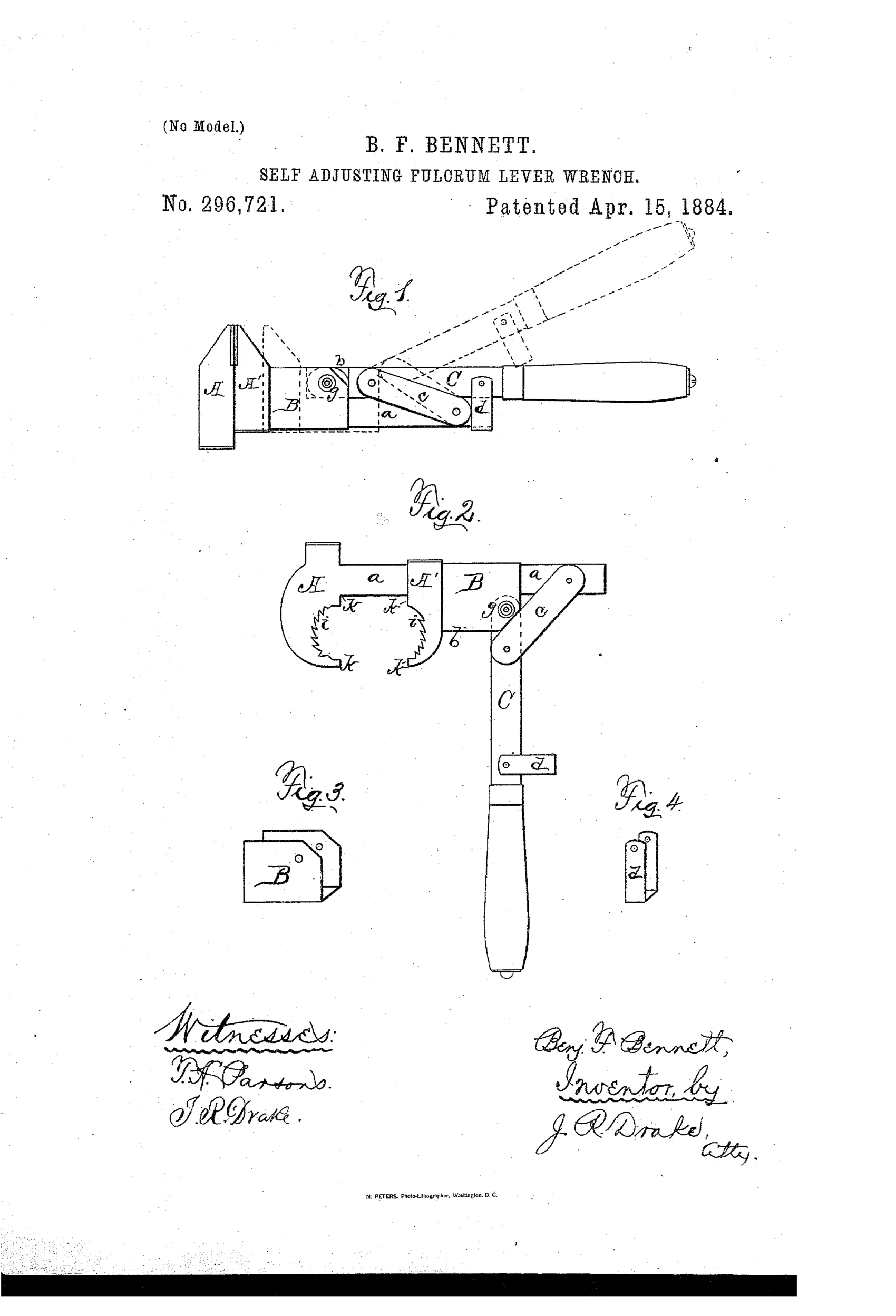
Self-adjusting fulcrum-lever hand wrench
⚙ How it works
A sliding jaw bar rides on a main bar and is confined by a metallic plate forming a track. The lever handle is hinged to the sliding jaw bar and connected by two pivoted side braces to the rear of the main bar, forming a fulcrum. When the handle is opened to the angle required by the nut, the braces act as a fulcrum so that force on the handle squeezes the sliding jaw tighter against the nut. A metallic loop pivoted to the handle bar swings over the main bar's rear end to lock the handle closed against the main bar when not in use.
⚙ What was claimed
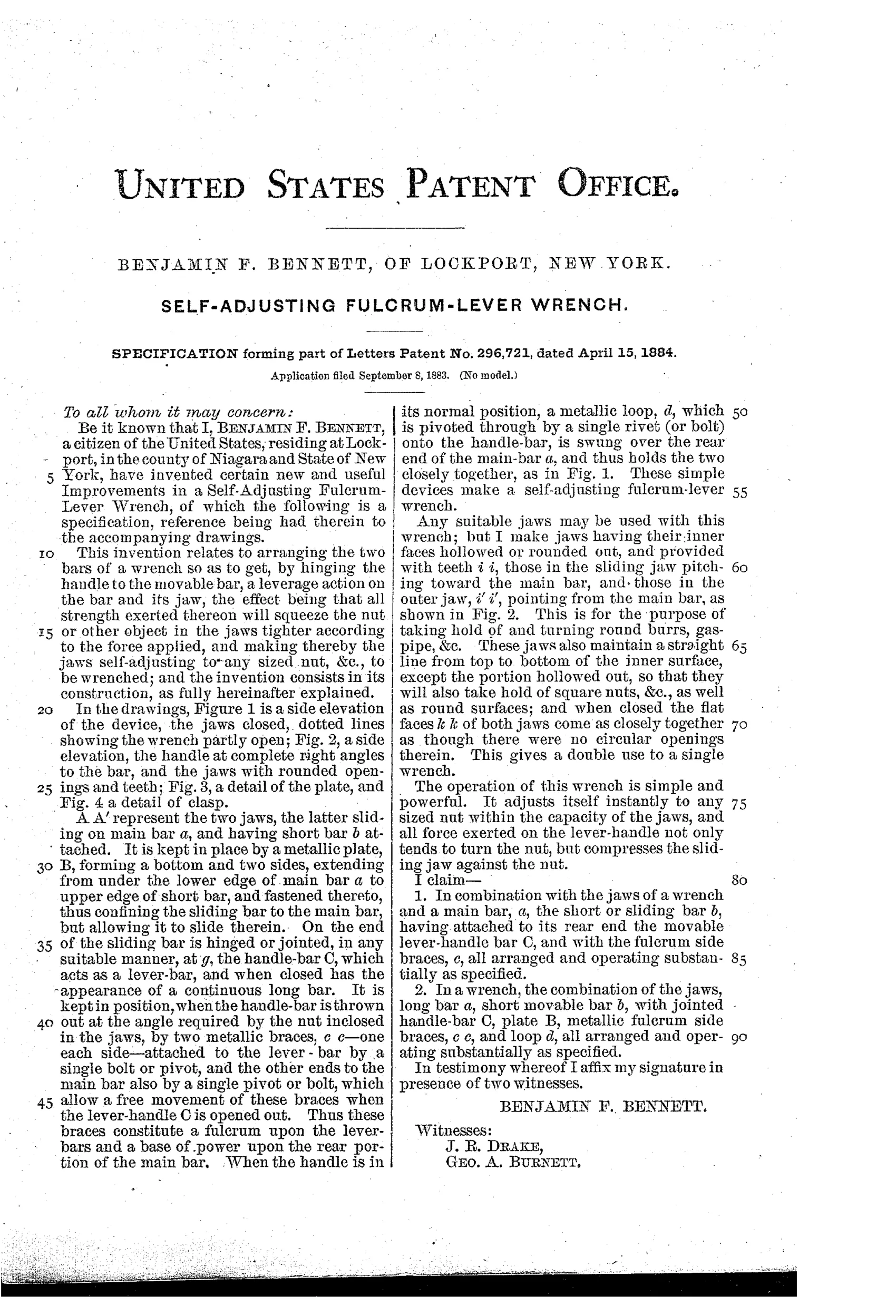
“In combination with the jaws of a wrench and a main bar, a, the short or sliding bar b, having attached to its rear end the movable lever-handle bar C, and with the fulcrum side braces, c, all arranged and operating substantially as specified.”
In plain English: The wrench combines a main bar with a sliding jaw bar whose rear end carries a movable lever handle linked by fulcrum side braces, all working together as described.
⚙ In the inventor’s words
“The operation of this wrench is simple and powerful.”— Benjamin F. Bennett, from the specification
Fate unknown
No manufactured example of Bennett's fulcrum-lever wrench appears in the standard references; a marked specimen or DATAMP-documented survivor would settle it.
⚙ Commentary
Bennett's idea belongs to the self-adjusting family, the pre-1900 crowd chasing a wrench you could work one-handed without spinning a screw. His mechanism is a toggle in disguise: the handle hinges on the sliding jaw bar, and two pivoted side braces tie it back to the main bar. Open the handle to whatever angle the nut demands, bear down, and the braces become a fulcrum — the harder you pull, the harder the sliding jaw is driven against the work. Grip force scales with turning force, which is exactly the property you want in a self-adjuster and exactly what a screw-adjusted monkey wrench can't give you.
Fig. 2 rewards a close look: the jaws are toothed, which tells you Bennett was aiming at pipe and round stock as much as nuts, in the alligator-adjacent tradition. The little details are honest workmanship too — the plate B forming a track for the sliding bar, and the loop clasp d that swings over to lock the handle flat so the tool doesn't flop about in a toolbox.
The weak point is the same one that dogged most lever-grip wrenches of the era: several pivots carrying the full working load, all of which must stay tight for the geometry to hold. It's a plausible tool, but a fiddly one to make cheaply, and the market kept buying Coes-pattern screw wrenches instead. A clever dead end, sympathetically drawn.
Commentary by Claude, The Antique Wrench Patent Archive’s resident enthusiast