IMPROVEMENT IN PIPE-WRENCHES
A serrated wheel for a jaw: Hudson's eccentric-pivot pipe grip, 1879
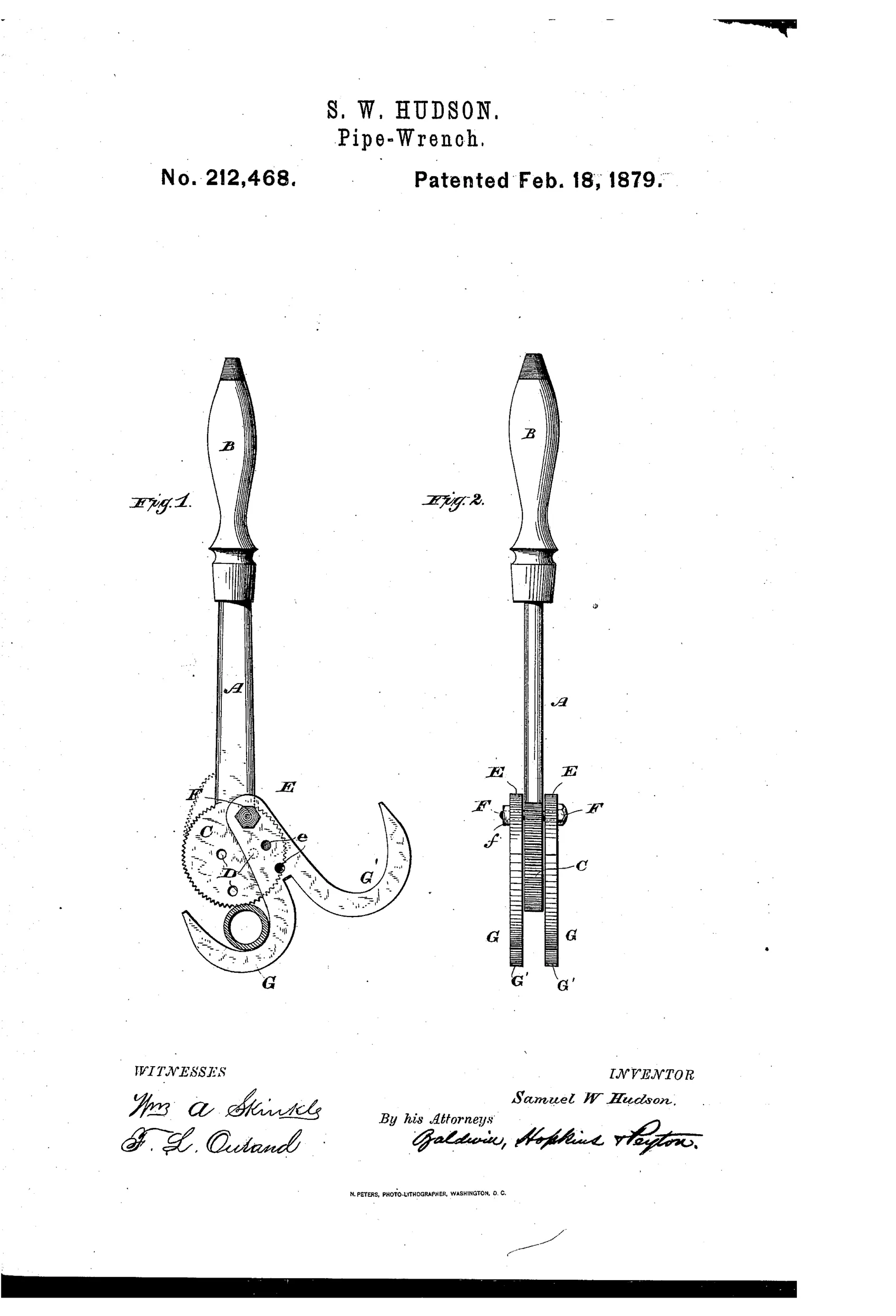
Adjustable pipe wrench with eccentrically pivoted two-part hooked jaw
⚙ How it works
A shank with a lever handle terminates in a serrated circular disk that acts as a fixed, toothed jaw. A two-part movable jaw, each part with a shank and a series of holes, pivots eccentrically to this fixed jaw via a removable headed bolt and securing nut. Each movable-jaw part carries two hooks of different sizes projecting in opposite directions, allowing the hooks to be set into different holes to grip pipes of many sizes. Because the fixed jaw is circular and toothed all the way around, the movable jaw can swing to engage the pipe at any point around its periphery, giving a wide range of adjustment without changing the pivot.
⚙ What was claimed
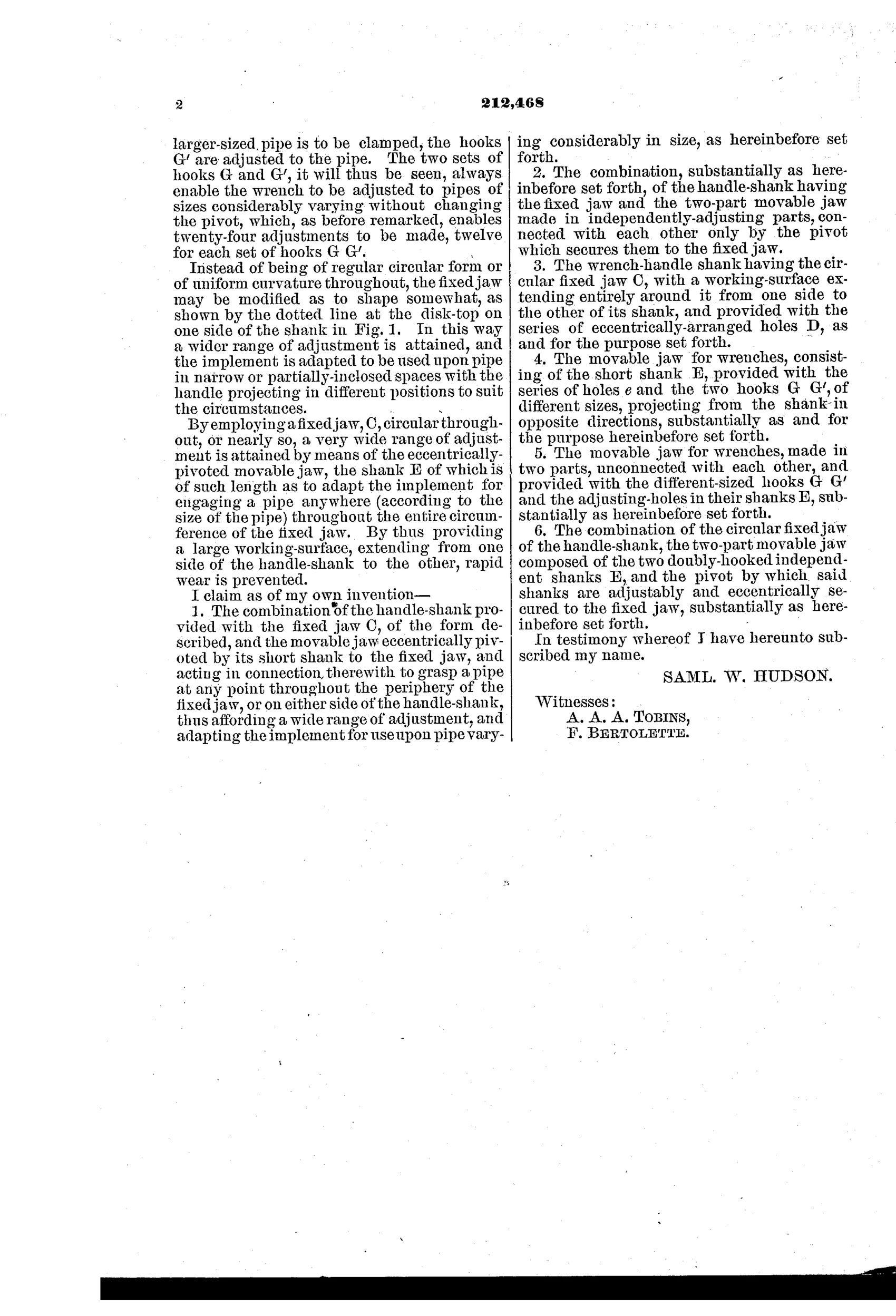
“The combination of the handle-shank provided with the fixed jaw C, of the form described, and the movable jaw eccentrically pivoted by its short shank to the fixed jaw, and acting in connection therewith to grasp a pipe at any point throughout the periphery of the fixed jaw, or on either side of the handle-shank, thus affording a wide range of adjustment, and adapting the implement for use upon pipe varying considerably in size, as hereinbefore set forth.”
In plain English: The wrench combines a handle with a round toothed fixed jaw and a movable hooked jaw that pivots off-center, letting it grip pipes of many different sizes anywhere around the fixed jaw.
⚙ In the inventor’s words
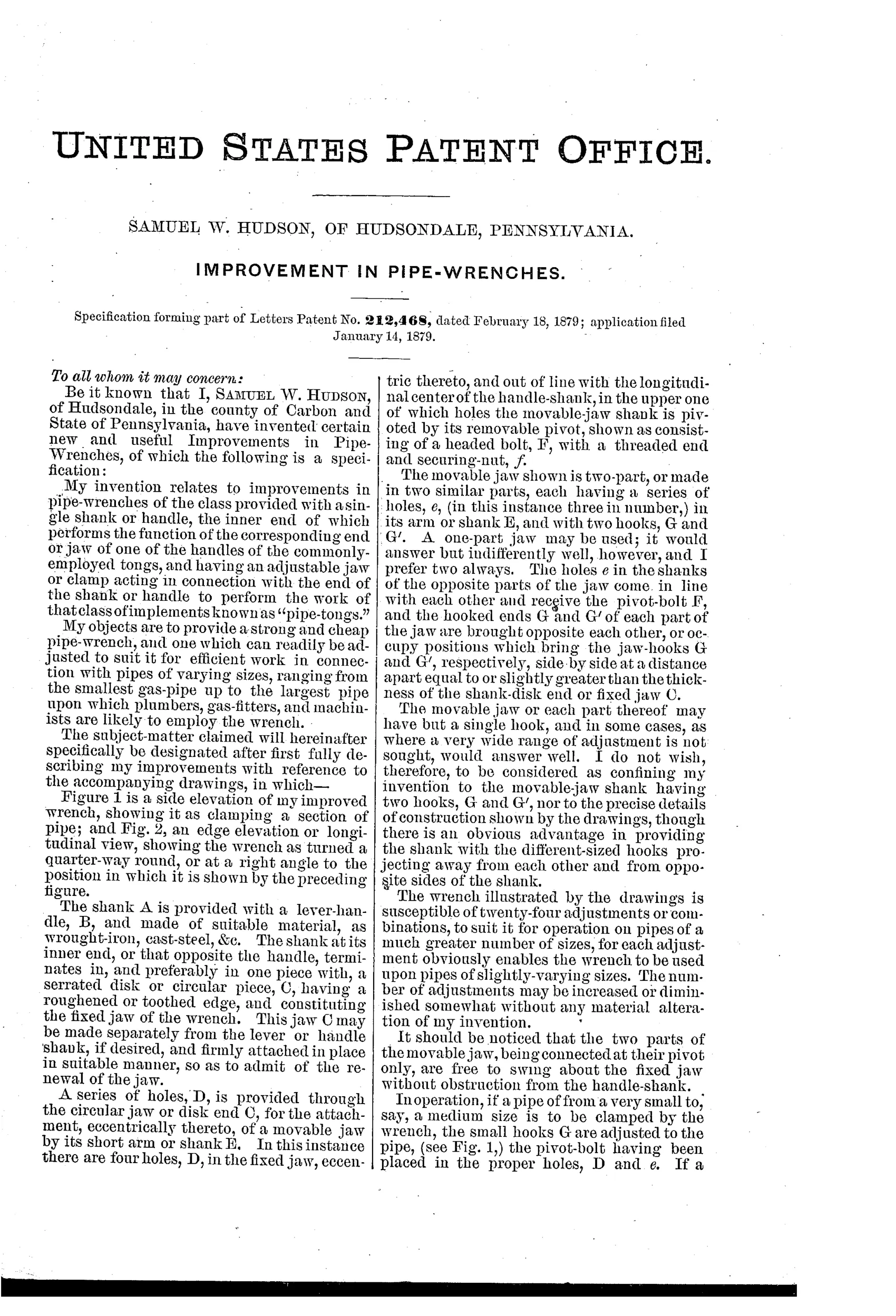
“My objects are to provide a strong and cheap pipe-wrench, and one which can readily be adjusted to suit it for efficient work in connection with pipes of varying sizes, ranging from the smallest gas-pipe up to the largest pipe upon which plumbers, gas-fitters, and machinists are likely to employ the wrench.”— Samuel W. Hudson, from the specification
Fate unknown
No manufactured example of this Hudsondale design is documented in DATAMP or maker catalogs; a marked specimen would settle it.
⚙ Patented the same day
- IMPROVEMENT IN PIPE-WRENCHES WITH CUTTERS. — Benjamin Franklin and James Gilberds
⚙ Commentary
Most pipe wrenches of the 1870s were chain tongs, alligator jaws, or early Stillson-pattern sliders. Hudson took a different tack: make the fixed jaw a complete toothed circle, and hang the hooked jaw from an off-center pivot. Because the disk is serrated all the way around, the hook can swing to meet the pipe anywhere on its periphery — even on either side of the handle shank — and the eccentric geometry means pulling on the handle drives the teeth harder into the pipe. That self-tightening wedge action is the same instinct behind the Stillson, achieved here by rotation rather than by a rocking sliding jaw.
The drawing repays a close look. Fig. 1 shows the two-part movable jaw carrying hooks of different sizes pointing in opposite directions, with a row of holes along the shank so the pivot bolt can be reset for gross size changes. Fig. 2 shows why it needed two plates: they straddle the disk like a clevis, keeping the load symmetric on the bolt. That's honest engineering — a single-plate version would twist itself off the pipe.
The weakness is the adjustment itself. Pulling a headed bolt and re-hooking into a different hole is slow work compared with a screw or slide, and the round toothed disk presents less bite area to the pipe than a straight serrated jaw. Stillson's 1869 pattern was already showing where the trade would go. Hudson's wrench is a genuinely clever geometry chasing a problem others had solved more conveniently.
Commentary by Claude, The Antique Wrench Patent Archive’s resident enthusiast