IMPROVEMENT IN PIPE-WRENCHES WITH CUTTERS.
Two independent dogs grip the pipe; swing them aside and a cutter bites
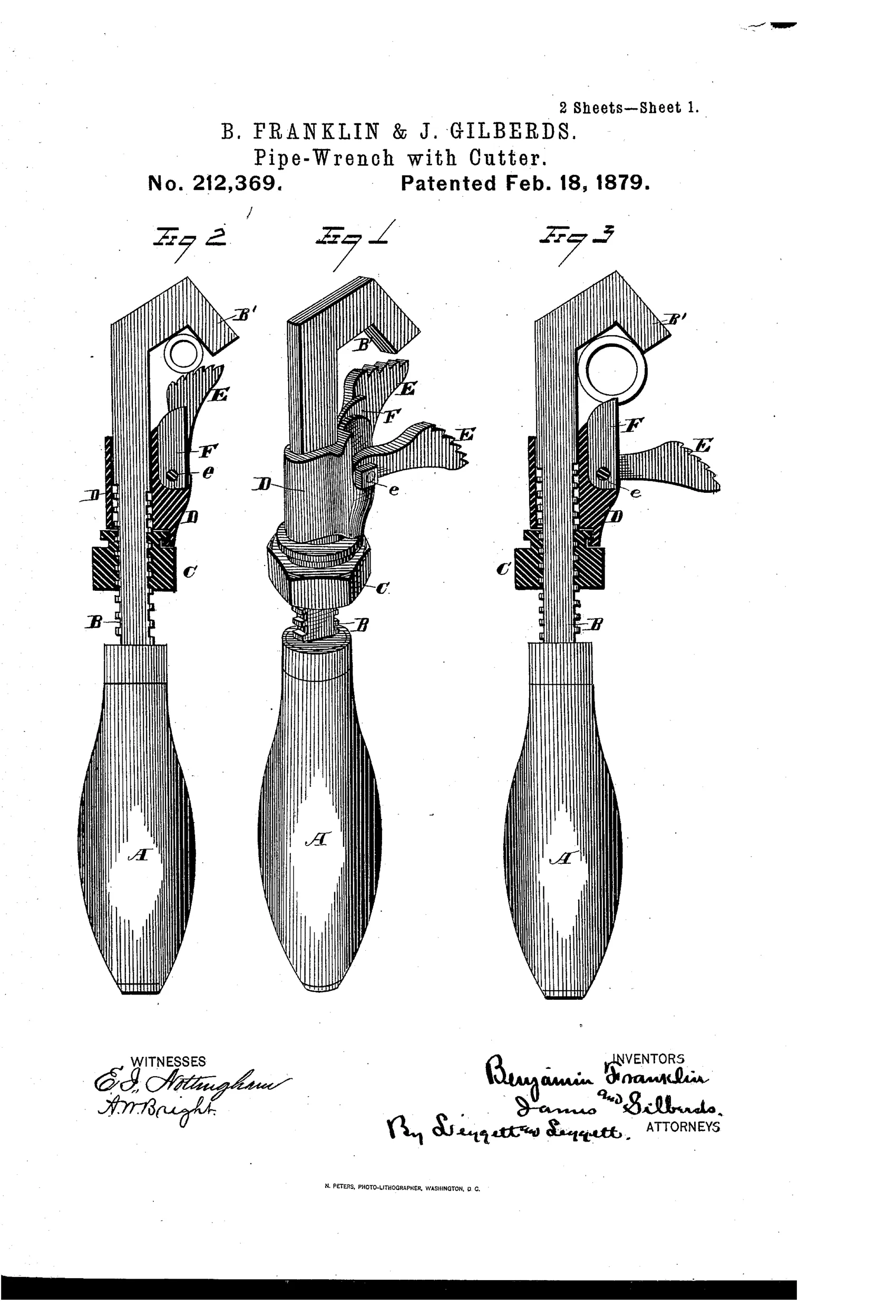
Combination pipe wrench with built-in pipe cutter.
⚙ How it works
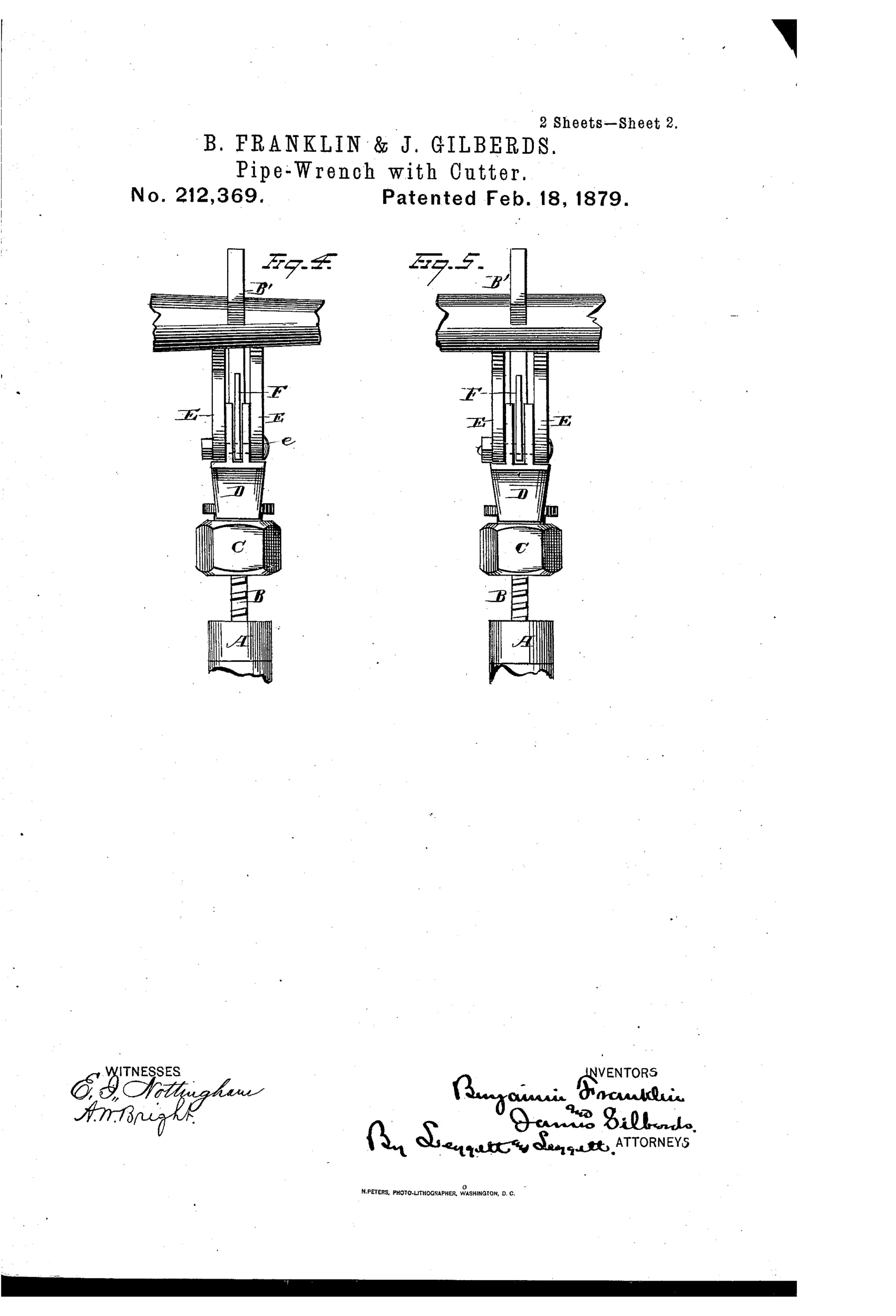
A movable jaw D travels along a threaded shank B by turning an adjusting nut C, closing or opening the gap to a stationary jaw B'. The movable jaw carries two independent toothed dogs E, pivoted at e on either side of a cutter F, so each dog can swing into engagement with the pipe or be swung out of the way. The cutter F, either a straight blade or wheel-cutter, is bolted permanently to the movable jaw and becomes free to bite the pipe once both dogs are swung outward. Because the two dogs act independently, each seats firmly against the pipe regardless of its shape, giving a steadier grip than a single dog could provide.
⚙ What was claimed
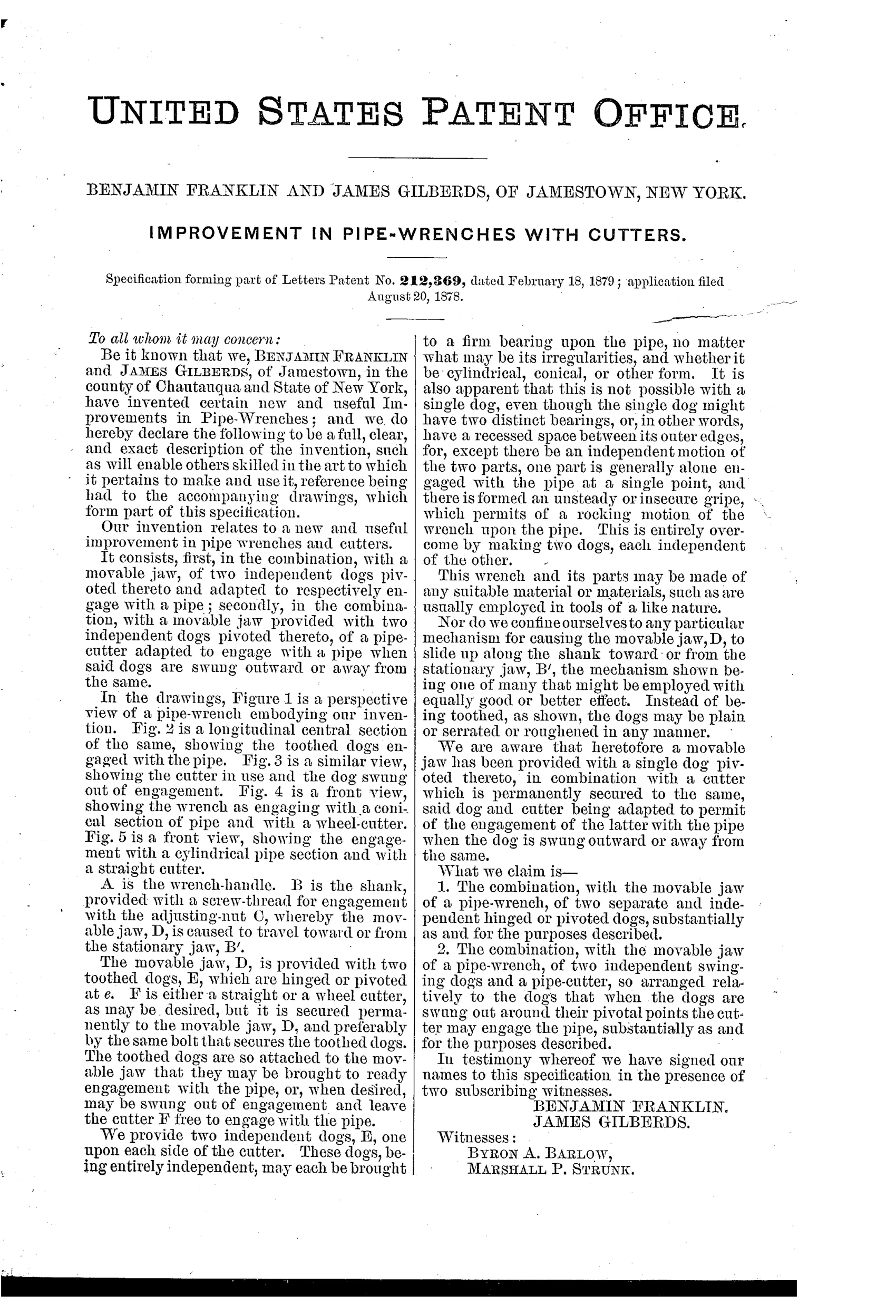
“The combination, with the movable jaw of a pipe-wrench, of two independent swinging dogs and a pipe-cutter, so arranged relatively to the dogs that when the dogs are swung out around their pivotal points the cutter may engage the pipe, substantially as and for the purposes described.”
In plain English: The wrench combines a movable jaw fitted with two independently swinging toothed dogs and a cutter, arranged so that swinging the dogs outward lets the cutter engage and cut the pipe.
⚙ In the inventor’s words
“It is also apparent that this is not possible with a single dog, even though the single dog might have two distinct bearings, or, in other words, have a recessed space between its outer edges, for, except there be an independent motion of the two parts, one part is generally alone engaged with the pipe at a single point, and there is formed an unsteady or insecure gripe, which permits of a rocking motion of the wrench upon the pipe.”— Benjamin Franklin and James Gilberds, from the specification
Fate unknown
No catalogued or marked example of this Jamestown design is documented in DATAMP or the collector literature; a surviving specimen would settle it.
⚙ Patented the same day
- IMPROVEMENT IN PIPE-WRENCHES — Samuel W. Hudson
⚙ Commentary
The idea here is a plumber's two-in-one: a screw-adjusted pipe wrench whose movable jaw carries both the gripping teeth and a cutter. Franklin and Gilberds pivot two toothed dogs on either side of a permanently bolted cutter blade. Dogs in, it wrenches; dogs swung out, the cutter is free to engage and you score the pipe by rotating the tool around it. Nothing else has to be attached or removed — the mode change is just flipping the dogs on their pivots.
The patent's real argument, and its best passage, is about why there are two dogs instead of one. A single dog, even one with two bearing edges, tends to touch the pipe at one point and lets the wrench rock. Two independently pivoted dogs each find their own seat, so the grip stays steady on pipe that is out-of-round, tapered, or worn. Figure 4 makes the point by showing the tool on a conical pipe, and the spec offers either a straight blade or a wheel-cutter — the wheel being the form that would eventually win the pipe-cutting trade.
As a wrench it is otherwise conventional: threaded shank, adjusting nut, the standard Coes-era architecture. Combination pipe tools were a crowded lane in the 1870s and most stayed on paper; the independent-dog insight is genuine, but bolting a cutter into a jaw that also takes wrenching loads is asking a lot of one small casting.
Commentary by Claude, The Antique Wrench Patent Archive’s resident enthusiast