IMPROVEMENT IN WRENCHES
A ratchet with swappable square sockets, twenty years before socket sets caught on
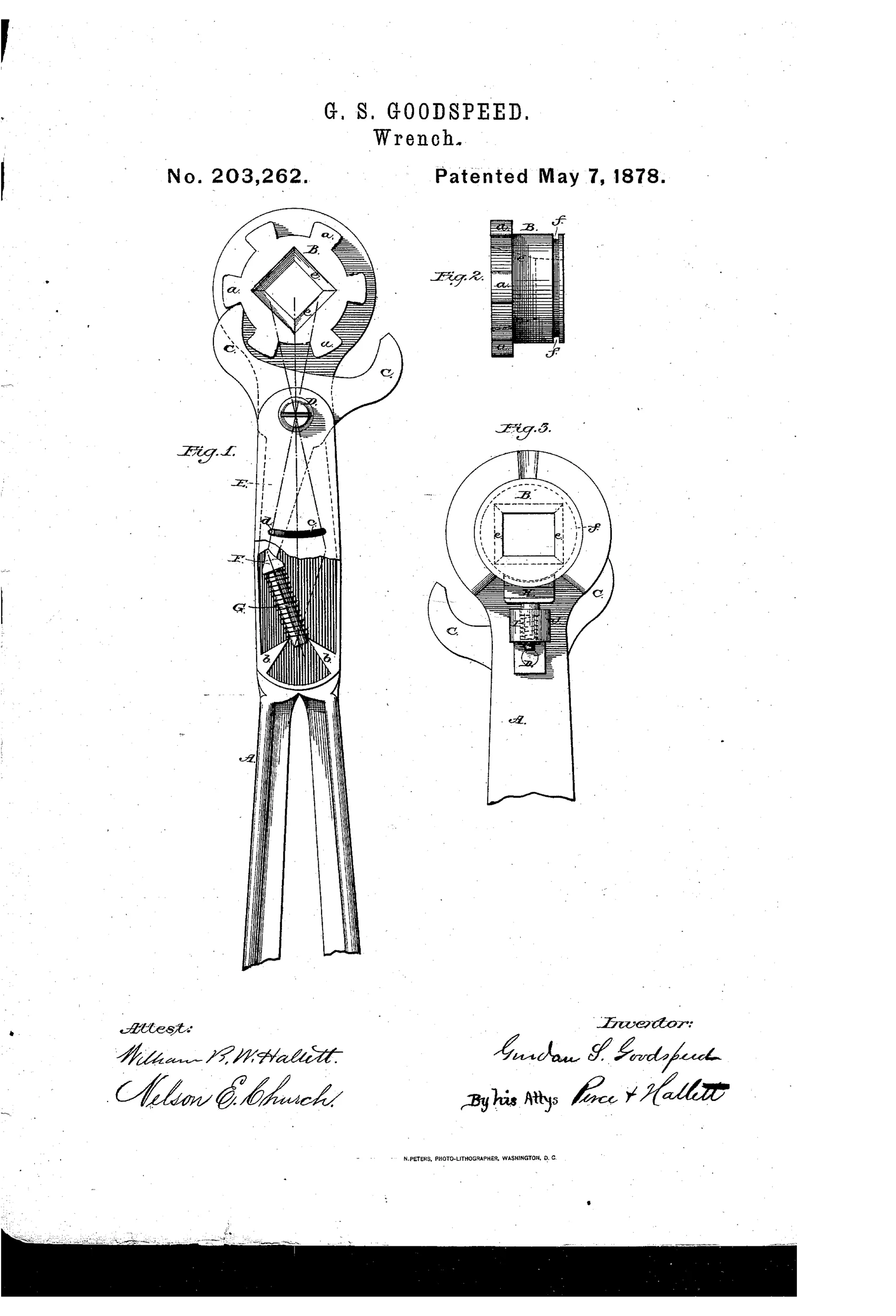
Adjustable wrench with rotating cogged nut-holder
⚙ How it works
The handle A terminates in a circular opening that loosely holds a rotating, detachable nut-holder B bearing pentagonal cogs a a around its circumference. A pallet-shaped pawl C pivots on D and engages these cogs, while a spring-loaded dog F with a barbed point bears against the pawl's stem E to set its position via a slot-and-pin adjustment. The nut-holder's beveled interior faces e allow it to grip nuts or bolts of varying sizes, and a rear circumferential groove f engages a spring-loaded catch H so the nut-holder can be withdrawn and swapped for one of different capacity.
⚙ What was claimed
“The combination of the handle A, rotating cogged and grooved nut-holder B, double pawl C, pivot D, stem E, dog F, springs G and I, and catch H, arranged and operating substantially as described.”
In plain English: The invention claims the specific combination of a handle, a removable rotating cogged and grooved nut-holder, a double pawl mechanism with pivot and stem, a spring-loaded dog, and a spring-loaded catch, all working together as described.
⚙ In the inventor’s words
“By such adaptation my invention is applicable to a variety of uses—as, for example, a jack-screw.”— Gurdon S. Goodspeed, from the specification
Fate unknown
DATAMP records the patent, but no manufactured example or catalog listing is known to me; a marked specimen with its interchangeable holders would settle it.
⚙ Patented the same day
- IMPROVEMENT IN PIPE-WRENCHES — Lawrence Glynn
⚙ Commentary
Goodspeed's wrench is really a socket ratchet hiding in a monkey-wrench-era patent. The circular head carries a removable nut-holder B — the pentagonal-cogged ring in Fig. 1 with the square opening at its center — and a pivoted double pawl C that clicks over those cogs. Turn the handle one way and the pawl drives the holder; back it off and the pawl rides over the teeth. That's a ratchet, and the spring-loaded dog F bearing on the pawl's stem is there to flip which direction it drives.
The part a casual reader will miss is the groove f in Fig. 2. That circumferential groove engages the spring catch H so the whole nut-holder pops out of the head and a different-capacity holder drops in. Adjustment by interchangeable sockets rather than by a sliding jaw — a genuinely different answer to the question every 1870s wrench patent was asking. His aside that the tool could serve as a jack-screw suggests he saw the ratchet head as a general-purpose drive, not just a nut-turner.
The weakness is the same one that dogged early socket schemes: you need a kit of holders, each one a machined ring with cogs and a groove, and losing one cripples the tool. A Coes screw wrench covered the same range with one moving part. Clever, ahead of its moment, and probably too expensive to make.
Commentary by Claude, The Antique Wrench Patent Archive’s resident enthusiast