IMPROVEMENT IN PIPE-WRENCHES
An egg-shaped nut that rocks in its slot, replacing the hinge entirely
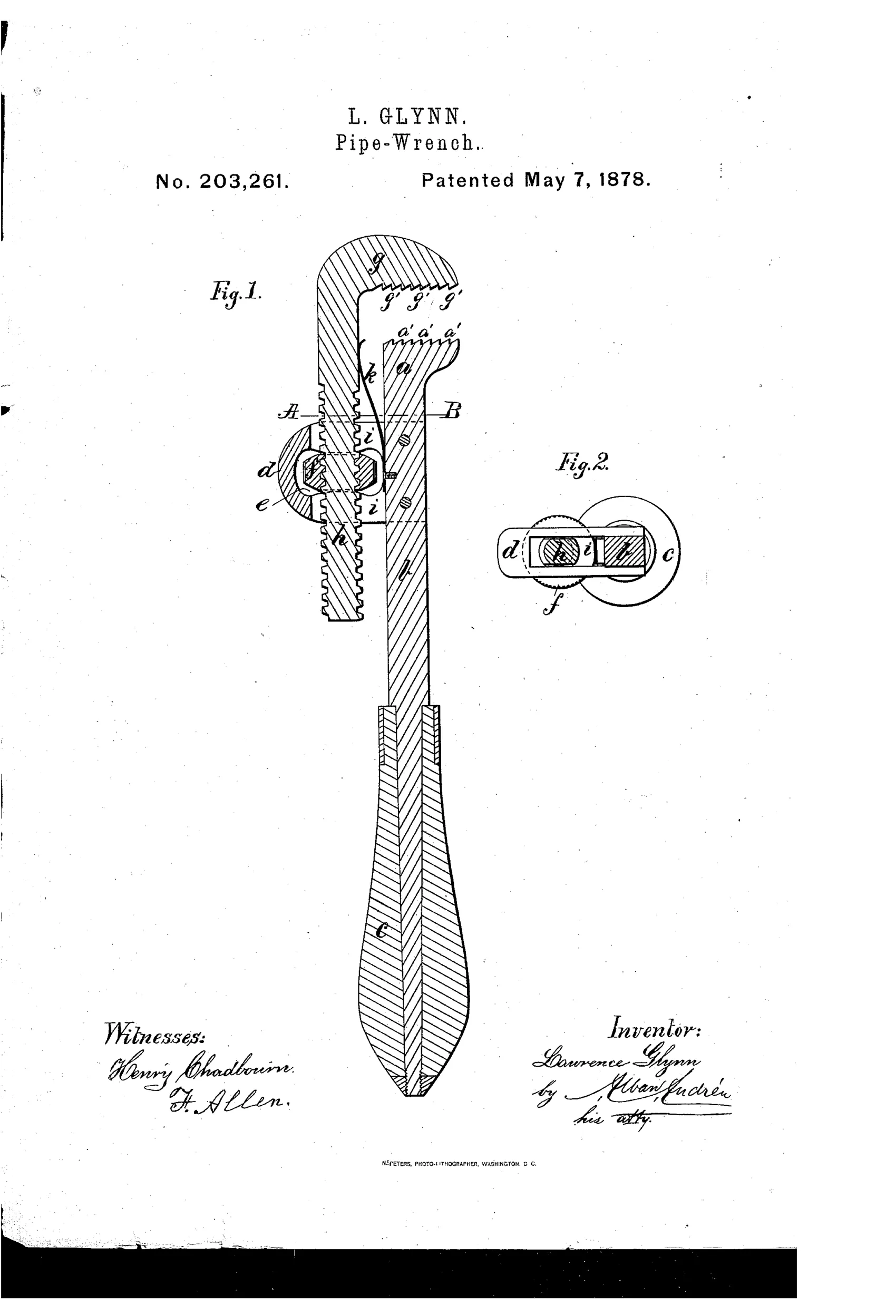
Adjustable pipe wrench with sliding jaw and egg-nut
⚙ How it works
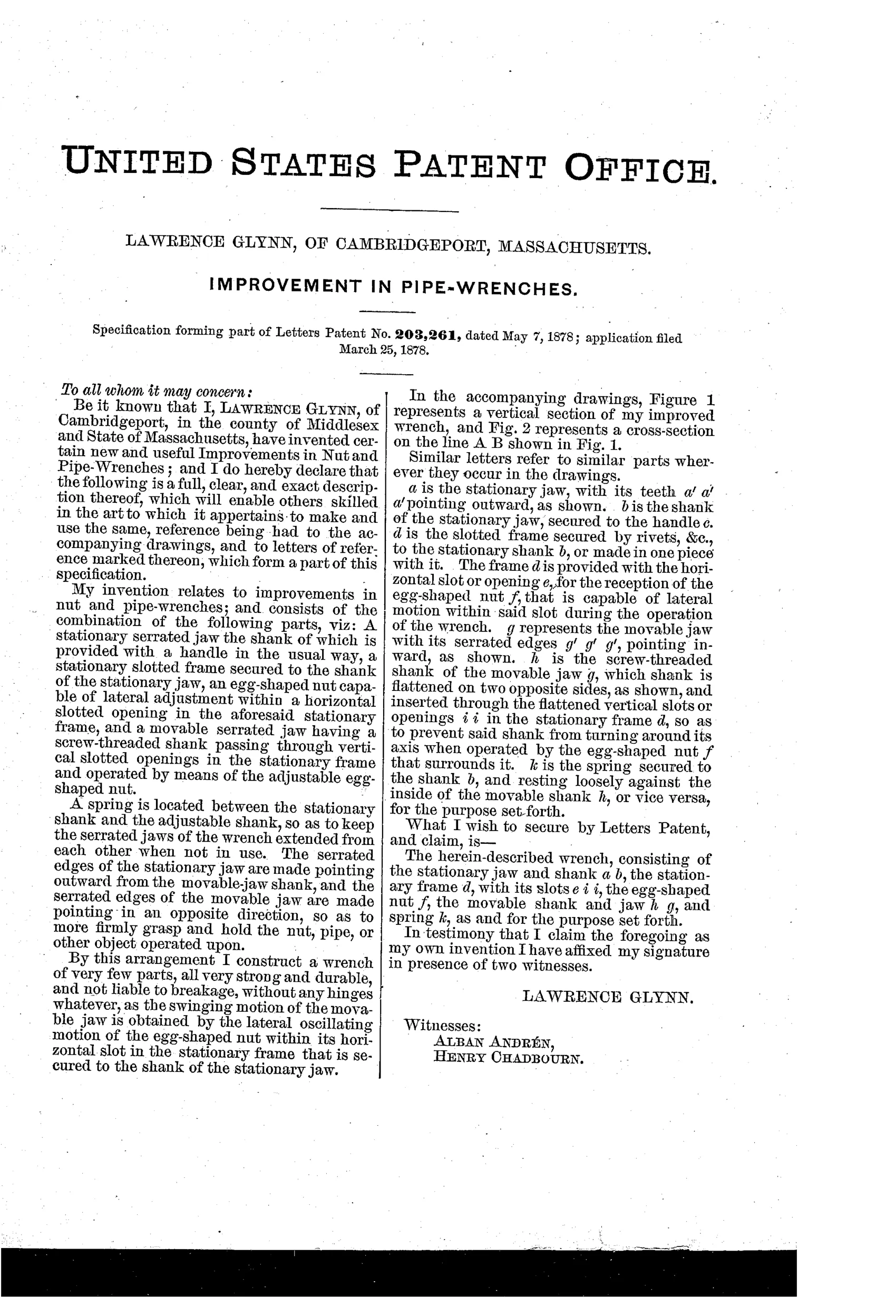
A stationary serrated jaw with an outward-toothed edge is fixed to a handle, while a slotted frame is riveted to that jaw's shank. A movable serrated jaw has a flattened, screw-threaded shank that passes through vertical slots in the frame, preventing the shank from rotating. An egg-shaped nut sits in a horizontal slot in the frame and can shift laterally, so turning it moves the movable jaw's shank up or down without any pivot or hinge. A spring between the two shanks keeps the jaws spread apart when not gripping an object.
⚙ What was claimed
“The herein-described wrench, consisting of the stationary jaw and shank a b, the stationary frame d, with its slots e i i, the egg-shaped nut f, the movable shank and jaw h g, and spring k, as and for the purpose set forth.”
In plain English: The wrench claimed combines a fixed toothed jaw and shank, a slotted frame, an egg-shaped adjusting nut, a sliding threaded jaw, and a spring, all working together as described.
⚙ In the inventor’s words
“By this arrangement I construct a wrench of very few parts, all very strong and durable, and not liable to breakage, without any hinges whatever, as the swinging motion of the movable jaw is obtained by the lateral oscillating motion of the egg-shaped nut within its horizontal slot in the stationary frame that is secured to the shank of the stationary jaw.”— Lawrence Glynn, from the specification
Fate unknown
No manufactured example appears in the collector literature or DATAMP; a marked specimen with this egg-nut mechanism would settle it.
⚙ Patented the same day
- IMPROVEMENT IN WRENCHES — Gurdon S. Goodspeed
⚙ Commentary
Glynn's problem is one every pipe-wrench designer of the 1870s wrestled with: a pipe wrench needs its movable jaw to swing slightly, so the teeth bite and self-tighten as the handle is pulled. The usual answer was a pivot or a deliberately loose fit — parts that wear, slop, and break. Glynn's answer is the oddest bit of this drawing: the adjusting nut is egg-shaped and sits in a horizontal slot in the frame, so the nut itself can shift sideways. Turn it and the jaw adjusts like any screw wrench; pull on the handle and the nut oscillates in its slot, letting the jaw rock into the pipe with no hinge anywhere.
Look closely at Fig. 2 and you can see the whole trick: the flattened threaded shank passes through vertical slots that stop it rotating, while the ovoid nut floats laterally between them. The spring k between the shanks keeps the jaws sprung open so the tool falls onto the pipe ready to grip — a small courtesy to the user.
It sits in the crowd of self-gripping pipe wrenches that eventually converged on the Stillson pattern, patented just a few years earlier a few miles away. Stillson got the floating-jaw geometry into production steel; Glynn's version is a genuinely clever variation on the same insight, but there is no sign it left the paper.
Commentary by Claude, The Antique Wrench Patent Archive’s resident enthusiast