IMPROVEMENT IN WRENCHES
A brace-style wheel wrench with its own onboard oil can, 1874
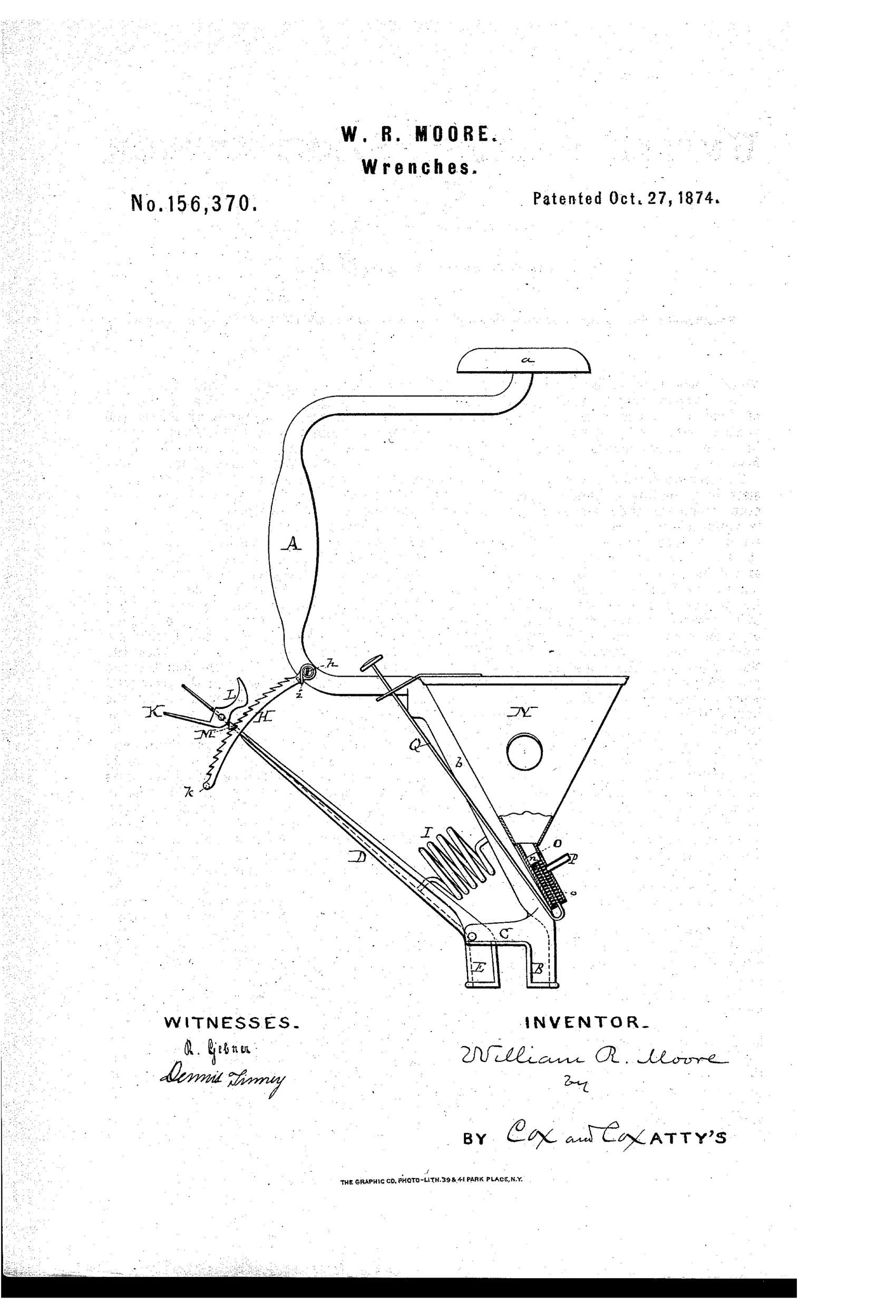
Crank-handled ratcheting wrench for removing vehicle wheels
⚙ How it works
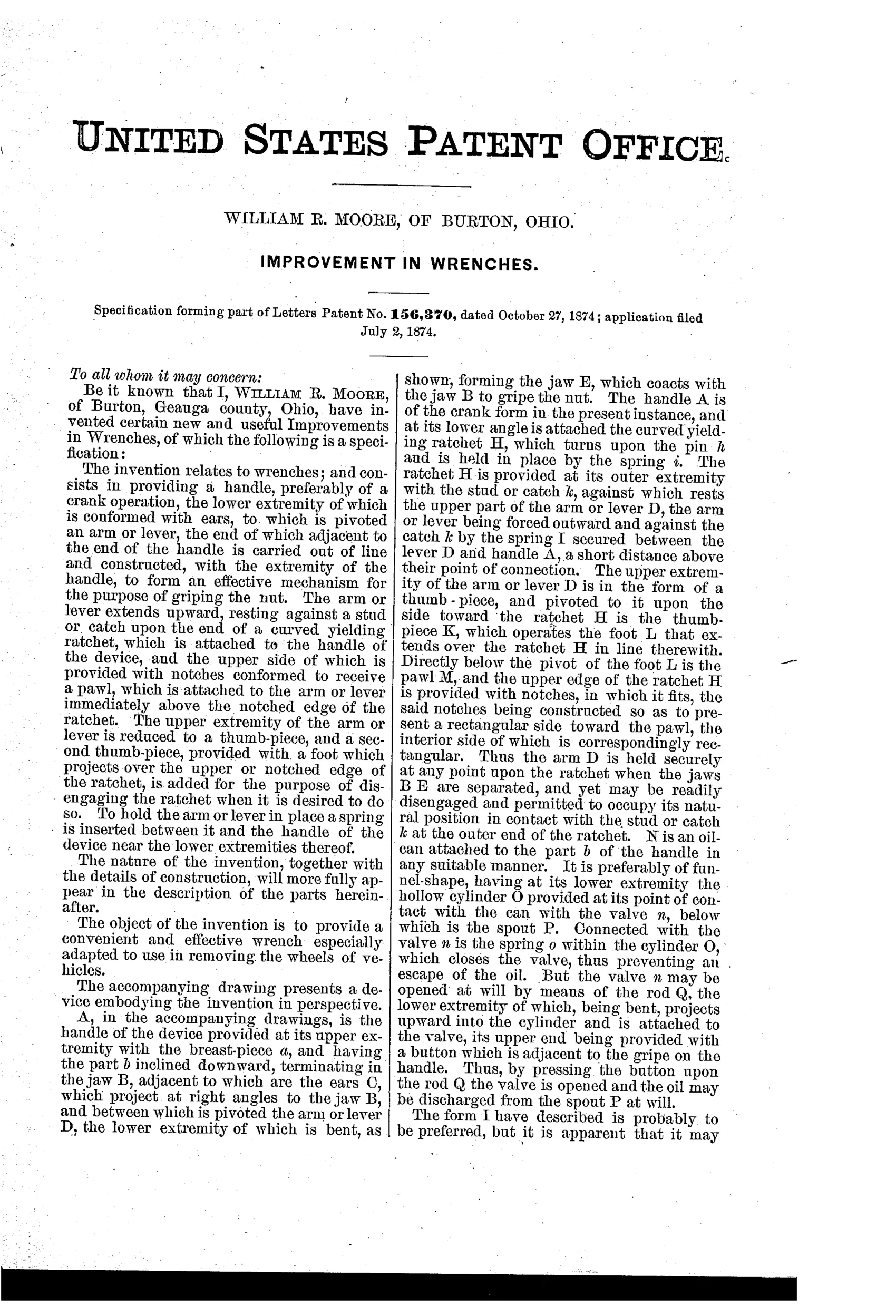
A crank-form handle carries a fixed jaw and terminates in ears that pivot a lever ending in a second jaw, so the two jaws grip a nut. A curved yielding ratchet attached to the handle engages a pawl on the lever, held by a spring, so the lever locks at any position to keep the jaws closed on the nut. Two thumb-pieces let the operator disengage the pawl from the ratchet to release the jaws. An oil-can with a spring-closed valve and spout is mounted on the handle so oil can be discharged onto the wrench at will by pressing a button.
⚙ What was claimed
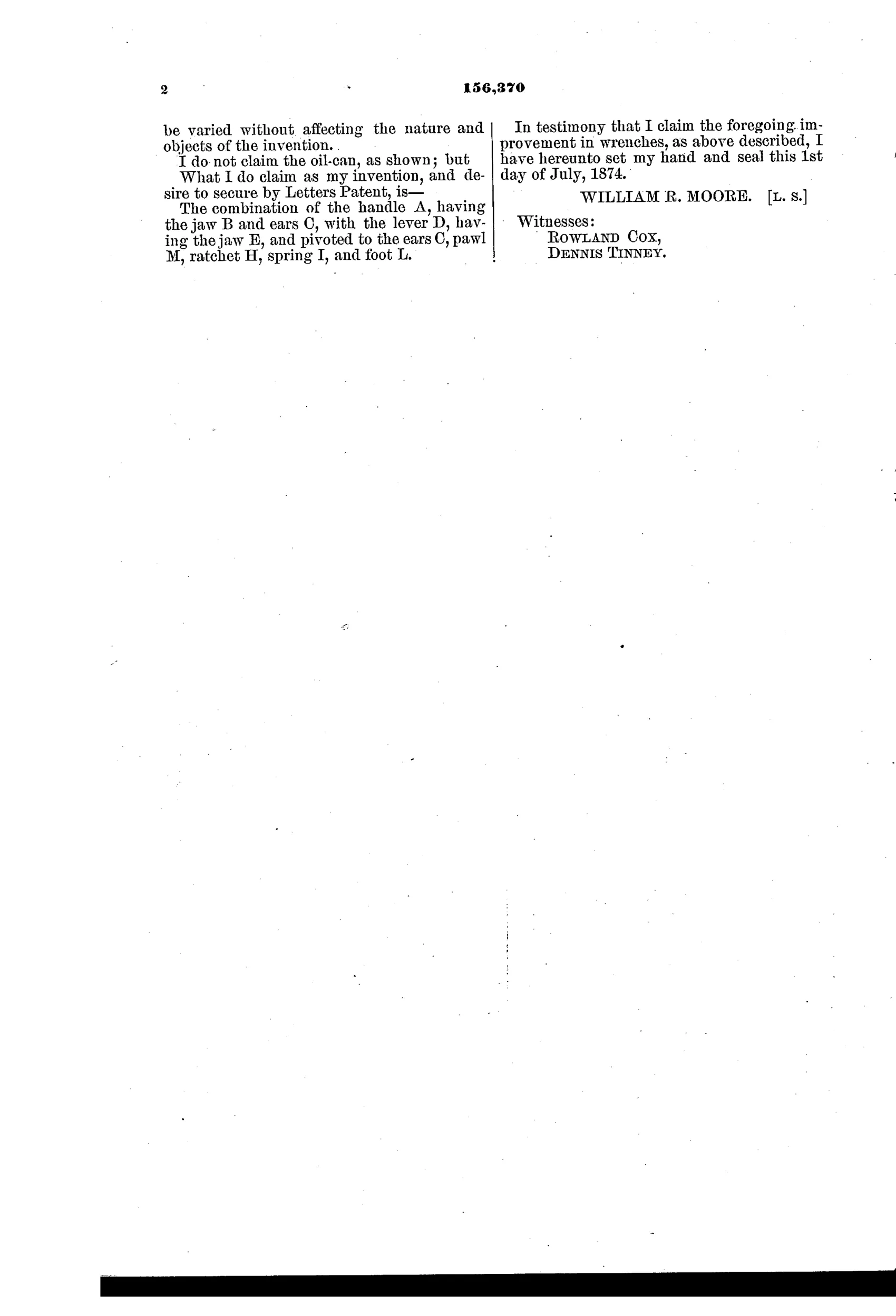
“The combination of the handle A, having the jaw B and ears C, with the lever D, having the jaw E, and pivoted to the ears C, pawl M, ratchet H, spring I, and foot L.”
In plain English: The claim covers the combined handle-and-jaw assembly working with a pivoted lever-and-jaw, pawl, ratchet, spring, and release foot that together grip and lock onto a nut.
⚙ In the inventor’s words
“The object of the invention is to provide a convenient and effective wrench especially adapted to use in removing the wheels of vehicles.”— William R. Moore, from the specification
Fate unknown
No manufactured example or catalog listing is documented; a marked specimen with the oil-can fitting would settle it.
⚙ Patented the same day
- IMPROVEMENT IN WRENCHES — Benjamin G. Martin
⚙ Commentary
William Moore of Burton, Ohio was solving a whole chore, not just a gripping problem. Removing carriage wheels meant spinning a large axle nut many turns, then oiling the spindle — so he built the wrench as a bit-brace: a crank handle with a breast-piece at the top, so you lean into it and turn continuously instead of ratcheting a flat handle back and forth ninety degrees at a time. That crank form, obvious to any brace user, is genuinely rare in the wrench record.
The jaw mechanism is a pivoted lever with a pawl riding a curved, spring-backed ratchet — squeeze the lever and the jaws close on the nut at whatever spacing fits, the pawl locking them shut. It's a self-clamping alligator idea rather than a screw adjustment, quick to apply and quick to release via the thumb-pieces. The dubious part is precision: a toothed ratchet grips in increments, so the fit on any given nut is only as good as the nearest tooth, and a loose fit under cranking torque will chew corners.
And then there's the oil can, mounted right on the handle with a spring valve and a button, so you can lubricate the axle while the wheel is off. It's the kind of everything-in-one-hand thinking that fills the implement-wrench era — charming, specific, and almost certainly heavier and costlier than the plain wrench a farmer already owned. DATAMP records the patent; the marketplace, as far as anyone can show, did not follow.
Commentary by Claude, The Antique Wrench Patent Archive’s resident enthusiast