IMPROVEMENT IN WRENCHES.
A Worcester wrench that tapers its bar and still keeps the jaw snug
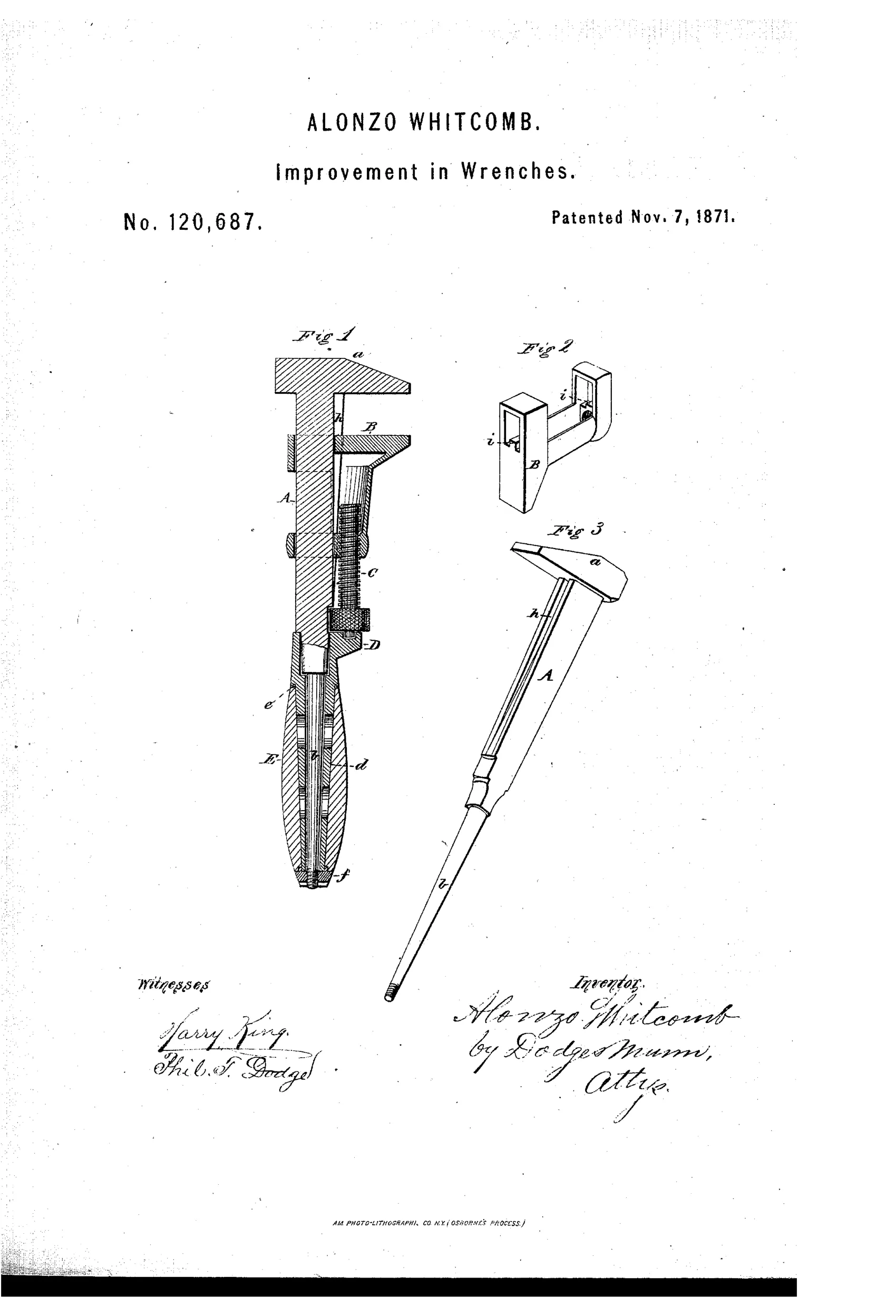
Tapering-bar monkey wrench with grooved sliding jaw
⚙ How it works
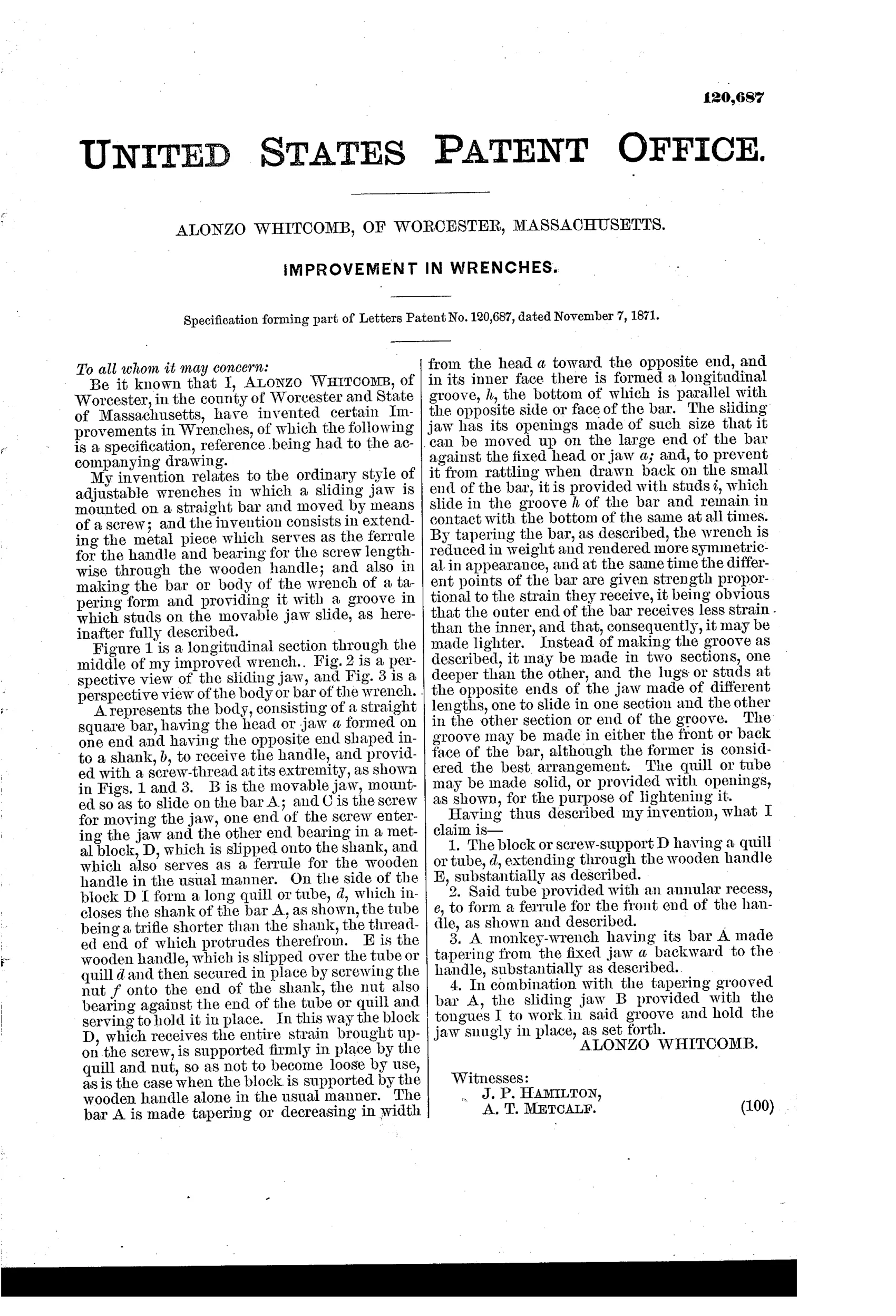
The wrench body A is a straight square bar with a fixed jaw a at one end and a threaded shank at the other, tapering in width from the head backward to the handle. A movable jaw B slides along the bar and is driven by screw C, which bears in a metal block D that also serves as the ferrule for the wooden handle E. The block D carries a quill or tube d that extends through the wooden handle and encloses the shank of the bar, supporting the screw firmly and preventing looseness from wear on the handle alone. A longitudinal groove h in the bar's inner face, parallel to the opposite face, receives studs i on the sliding jaw so that the jaw stays snug against the tapering bar without rattling.
⚙ What was claimed
“3. A monkey-wrench having its bar A made tapering from the fixed jaw a backward to the handle, substantially as described. 4. In combination with the tapering grooved bar A, the sliding jaw B provided with the tongues I to work in said groove and hold the jaw snugly in place, as set forth.”
In plain English: The wrench's bar tapers from the fixed jaw back to the handle, and the sliding jaw rides on a groove in that tapered bar via tongues that keep it snug and rattle-free.
⚙ In the inventor’s words
“By tapering the bar, as described, the wrench is reduced in weight and rendered more symmetrical in appearance, and at the same time the different points of the bar are given strength proportional to the strain they receive.”— Alonzo Whitcomb, from the specification
Fate unknown
Worcester origin makes production plausible, but no marked example of this specific tapered-bar design is documented; a surviving specimen would settle it.
⚙ Patented the same day
- IMPROVEMENT IN PIPE-WRENCHES — Ira S. Hamilton
⚙ Commentary
The obvious puzzle here is the one Whitcomb solves in his fourth claim. Taper the bar of a monkey wrench — thick at the fixed jaw, slimmer toward the handle — and you save weight and put metal where the bending strain actually lives. But a sliding jaw fitted to a tapering bar should wobble everywhere except one spot. His answer is a groove cut in the bar's inner face, machined parallel to the opposite face rather than to the taper, with tongues on the jaw riding in it. The jaw references the groove and the flat face, not the tapering sides, so it stays snug over its whole travel. Fig. 2 shows the little studs that make it work; Fig. 3 shows the bare bar, and you can see the taper a casual reader might miss.
The second good idea is quieter: the ferrule block D carries a quill tube running clear through the wooden handle, so the adjusting screw bears on metal, not on wood that shrinks and loosens. Anyone who has handled an old wrench with a rattling handle knows exactly what he was fixing.
Coming out of Worcester in 1871, this is a refinement inside Coes's own kingdom — not a new mechanism, but two honest answers to the two ways screw wrenches went sloppy with age. Per DATAMP, it sits among many such incremental Worcester entries.
Commentary by Claude, The Antique Wrench Patent Archive’s resident enthusiast