IMPROVEMENT IN WRENCH
Spring-loaded hinged jaw grips pipe on the swing — no reset between bites
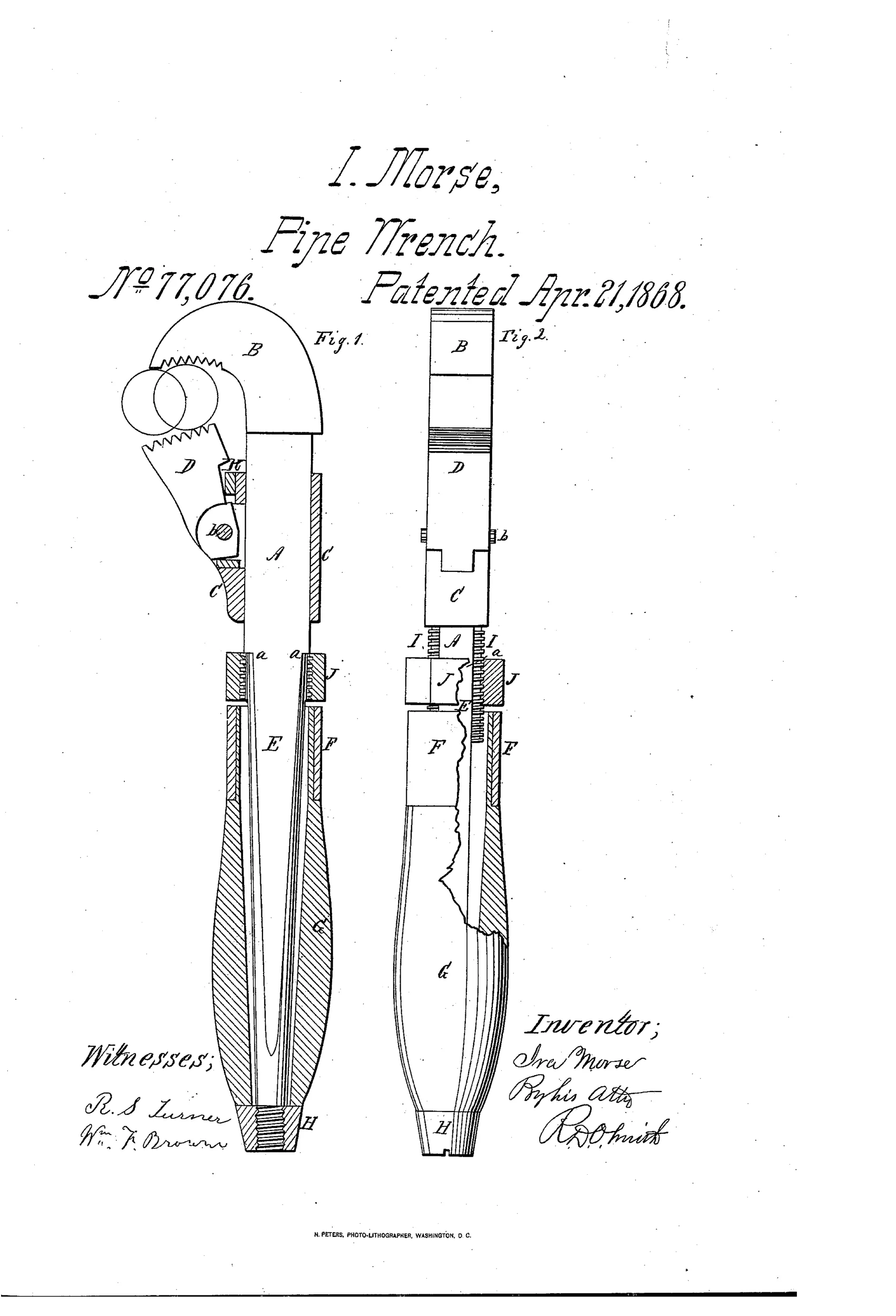
Self-adjusting pipe wrench with divergent jaws
⚙ How it works
A bar A ends in a fixed serrated jaw B, while a sliding case C carries a hinged serrated jaw D that is spring-loaded open by spring K. The case is moved along the bar by a screw-nut J turning on threaded slabs I I attached to the case, which advances or retracts the jaws without needing to reset them. Because the jaws are constructed to diverge outward from back to front, a pipe of proper size can be inserted between the outer edges and gripped instantly by a slight turn of the handle, without changing the screw-nut setting for each new pipe.
⚙ What was claimed
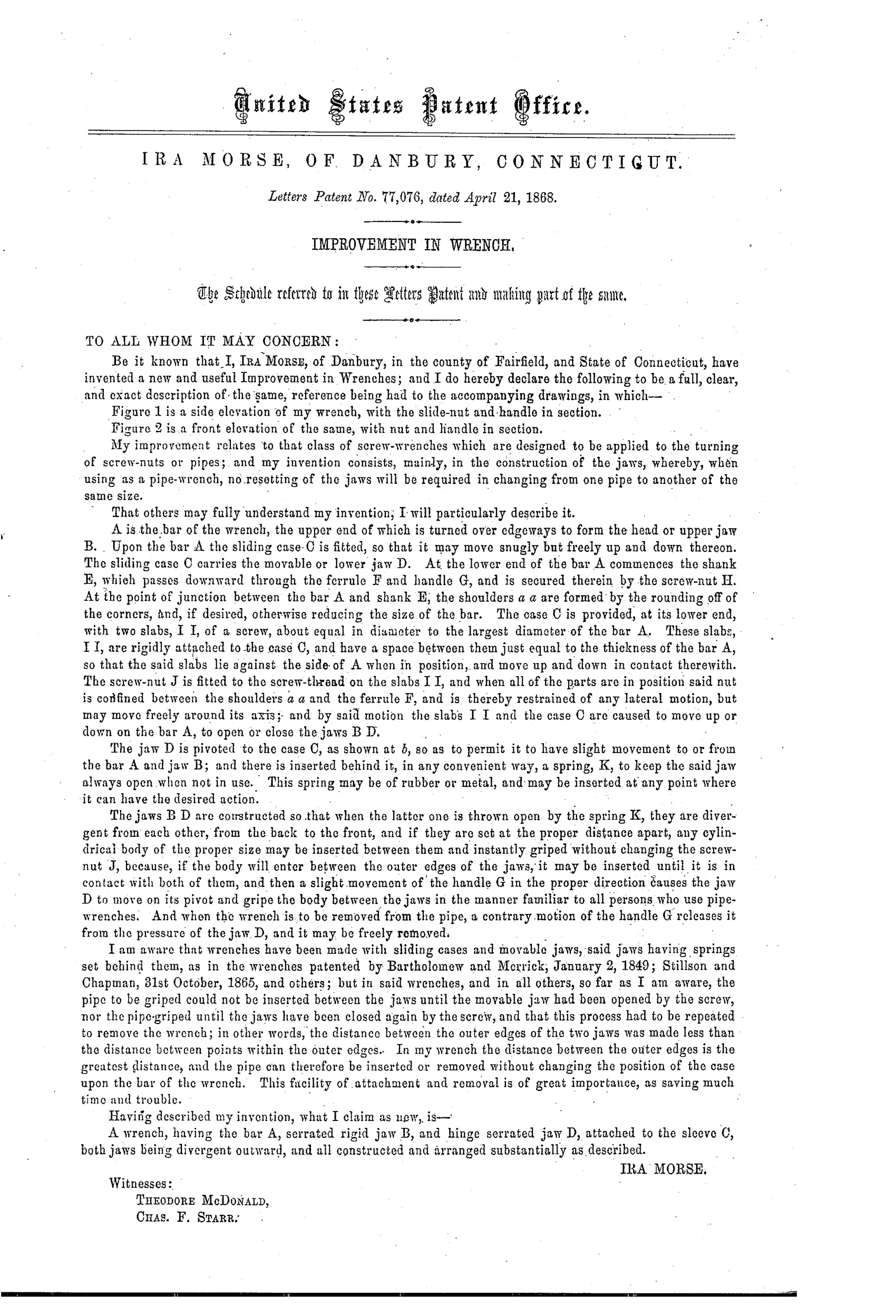
“A wrench, having the bar A, serrated rigid jaw B, and hinge serrated jaw D, attached to the sleeve C, both jaws being divergent outward, and all constructed and arranged substantially as described.”
In plain English: The invention claims a wrench with a fixed serrated jaw and a hinged serrated jaw mounted on a sliding sleeve, both jaws angled outward so pipes can be gripped without resetting.
⚙ In the inventor’s words
“This facility of attachment and removal is of great importance, as saving much time and trouble.”— Ira Morse, from the specification
Fate unknown
No marked Morse pipe wrench is documented to my knowledge; a surviving specimen or period trade listing would settle it.
⚙ Commentary
Morse's 1868 design is an early answer to the pipe wrench's central annoyance: having to re-set the jaw every time you release the grip to take a fresh bite. His hinged serrated jaw D rides on a sliding case, held open by spring K, so when you back the handle off, the jaw springs clear of the pipe and you can swing around for the next pull without touching the adjusting nut. The screw-nut J is only for coarse sizing; the actual gripping is done by the geometry of the jaws.
That geometry is the interesting part. Both jaws diverge outward from back to front, so a pipe slipped between them wedges tighter as the handle turns — the same self-energizing principle Daniel Stillson would claim to greater fame the following year with his pivoting-jaw pipe wrench. Morse is working the problem from a different angle, with a hinge and spring instead of Stillson's deliberate frame slop, but chasing the identical behavior: bite hard under load, let go instantly when reversed.
The drawing rewards a close look at the handle end — the tapered wooden grip G is clamped between ferrule F and nut H on a threaded tang, a construction detail most patents of the era don't bother to show in section. It's a thoughtful, buildable tool that arrived just before Stillson's simpler solution swept the field. DATAMP has the record.
Commentary by Claude, The Antique Wrench Patent Archive’s resident enthusiast