IMPROVEMENT IN WRENCHES
The handle is the cam: torque itself squeezes the jaws shut
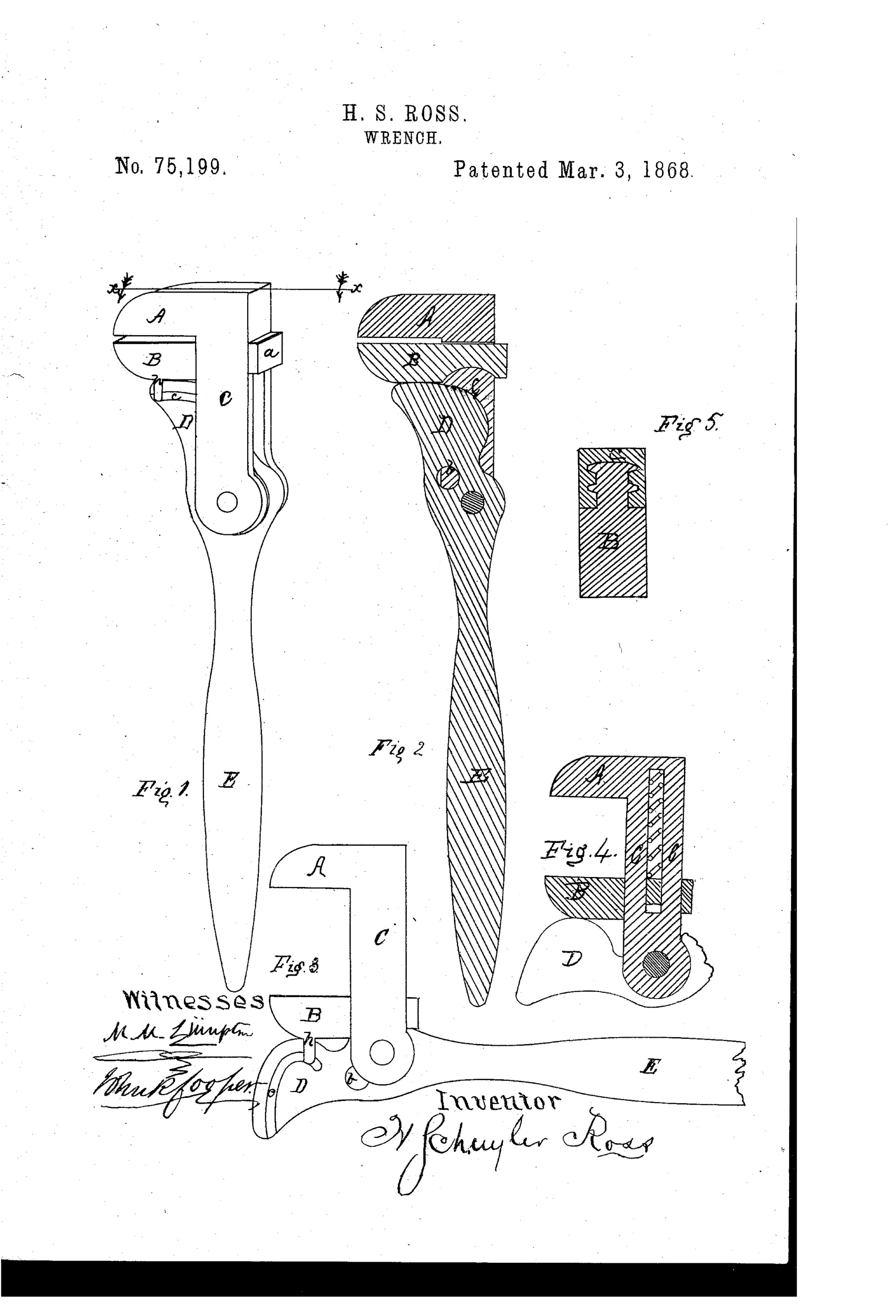
Cam-actuated self-tightening nut/pipe wrench
⚙ How it works
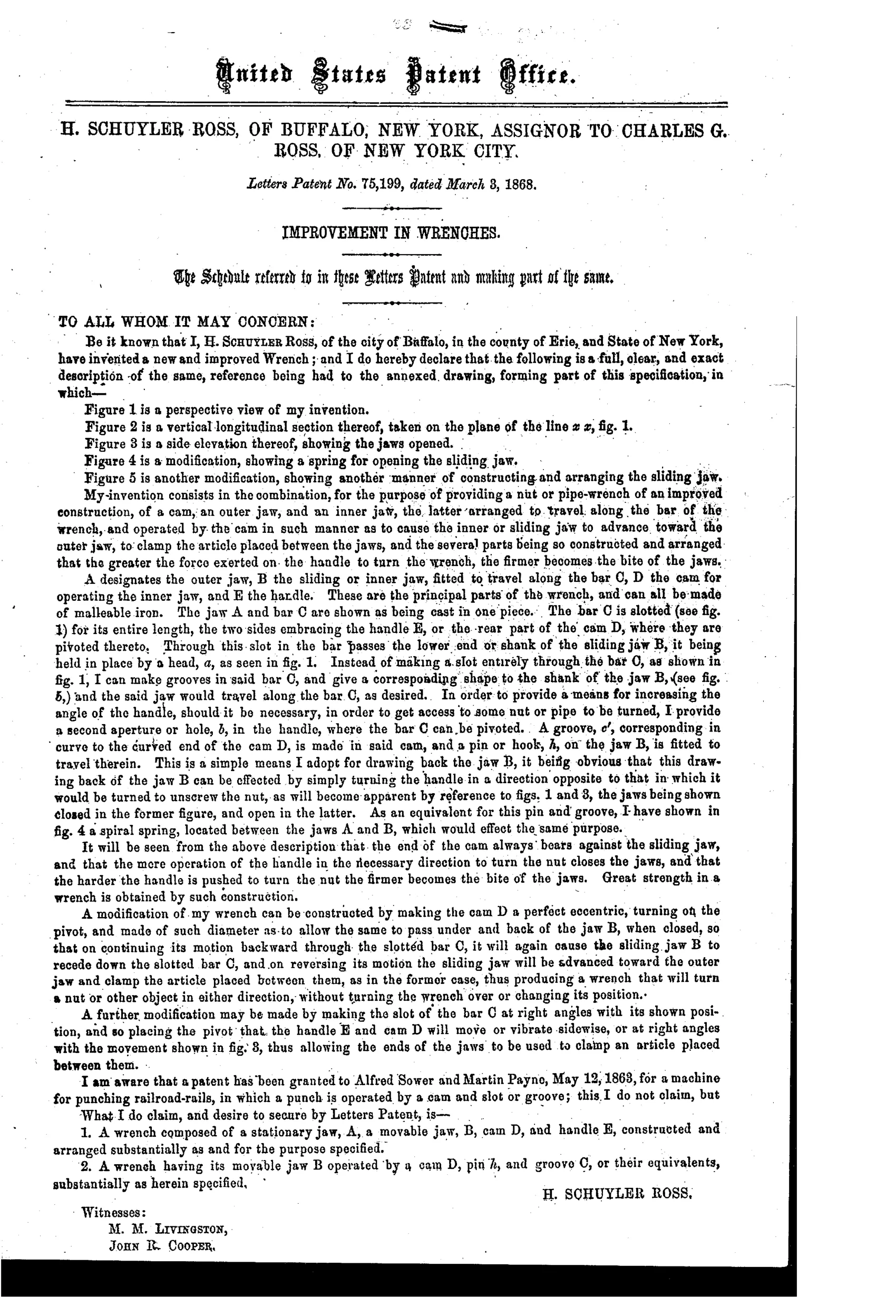
The wrench has a stationary outer jaw A cast with a slotted bar C, and a movable inner jaw B that slides along the bar. A cam D, pivoted to the bar and forming the rear part of the handle E, bears against the sliding jaw B and advances it toward the outer jaw as the handle is turned. A pin or hook h on jaw B rides in a curved groove c' in the cam, so that turning the handle in the reverse direction draws the jaw back open. Because the cam directly transmits handle force to the sliding jaw, greater torque applied to turn the nut produces a firmer bite of the jaws.
⚙ What was claimed
“1. A wrench composed of a stationary jaw, A, a movable jaw, B, cam D, and handle E, constructed and arranged substantially as and for the purpose specified.”
In plain English: A wrench made of a fixed jaw, a movable jaw, a cam, and a handle arranged so the cam moves the jaw as described.
⚙ In the inventor’s words
“the several parts being so constructed and arranged that the greater the force exerted on the handle to turn the wrench, the firmer becomes the bite of the jaws.”— H. Schuyler Ross, from the specification
Fate unknown
No catalogued production example is documented in DATAMP or maker records; a marked specimen would settle it.
⚙ Commentary
Ross's idea is elegantly simple to state: instead of a screw setting the jaw and your grip merely turning the nut, the handle pivots as a cam that bears directly on the sliding jaw. Pull harder and the cam presses harder — the bite is proportional to the torque you apply. That's the same principle that would later make the Stillson pipe wrench (1869, one year after this) a permanent fixture, though Stillson got there with a loose-pivoting toothed jaw rather than a full cam handle.
The section in Fig. 2 is where to look. The cam D forms the whole rear of the handle and rides on a pin in the slotted bar C, with a curved groove c' engaging a hook on the sliding jaw B. That groove is the thoughtful part: reversing the handle positively retracts the jaw, so the wrench opens itself for the next grip rather than relying on gravity or a shake. Fig. 4 shows Ross hedging with a spring-return version, which suggests he knew the groove would be tricky to machine and keep free of grit.
The weakness is the one that dogs every cam-handle wrench: the jaw position and handle angle are coupled. Each nut size puts the handle at a different starting angle, and your working arc is limited before the cam runs out of throw. Fine for pipe, awkward for hex nuts. A clever early entry in the self-tightening line, arriving just before Stillson's simpler answer swept the field.
Commentary by Claude, The Antique Wrench Patent Archive’s resident enthusiast