IMPROVEMENT IN PIPE-TONGS
One 1868 tong for every gas-pipe size, geometry doing the adjusting
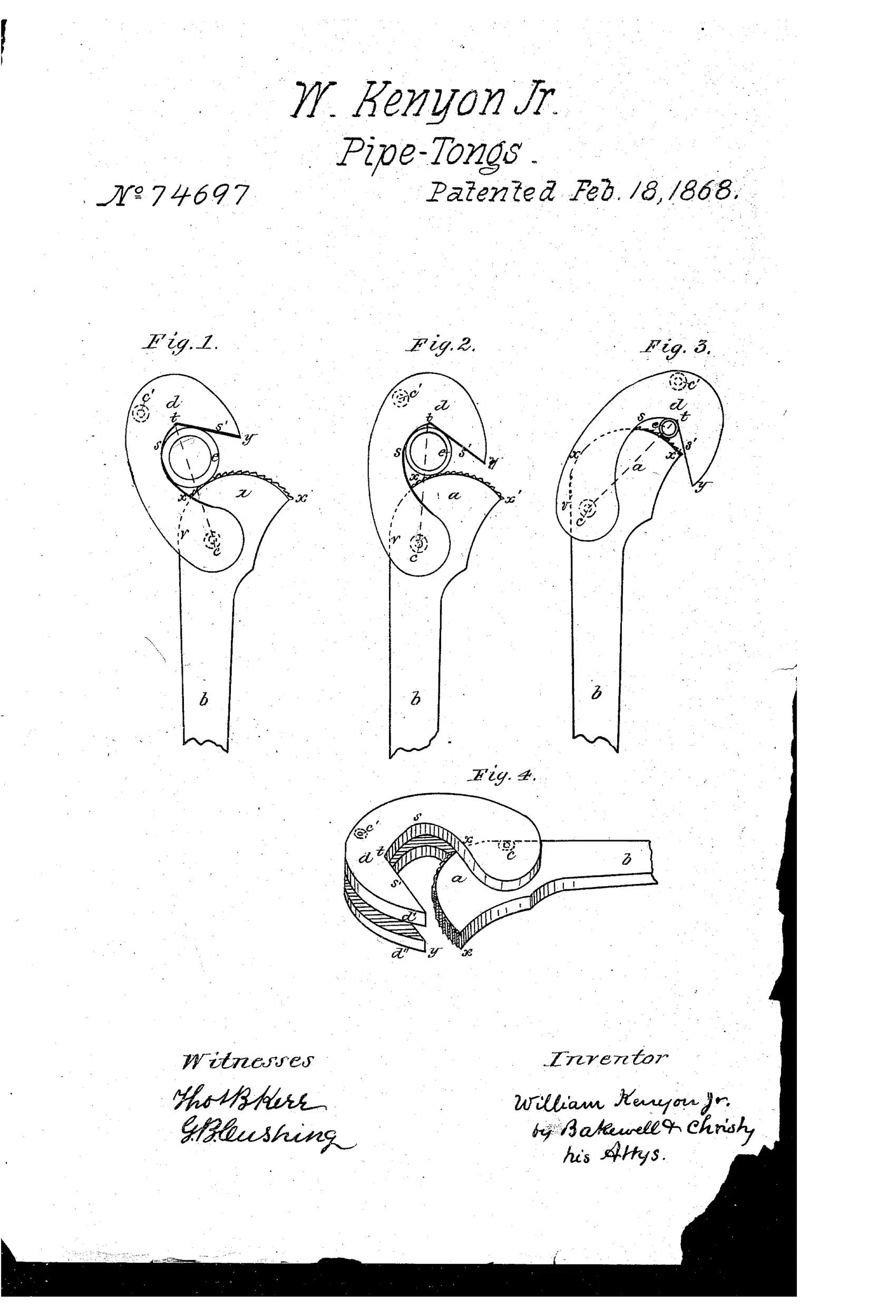
Self-adjusting pipe-tongs / gas-wrench for gripping pipes
⚙ How it works
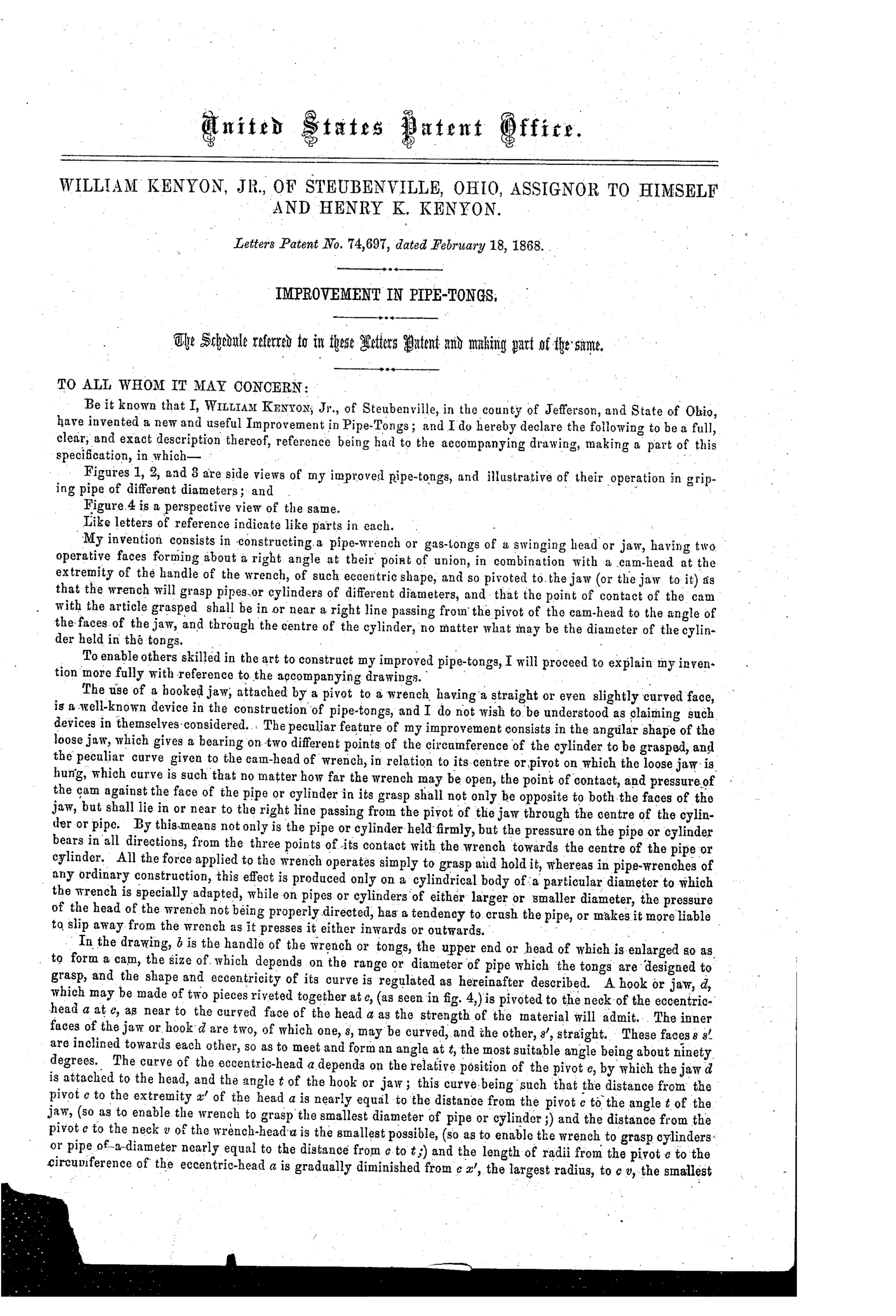
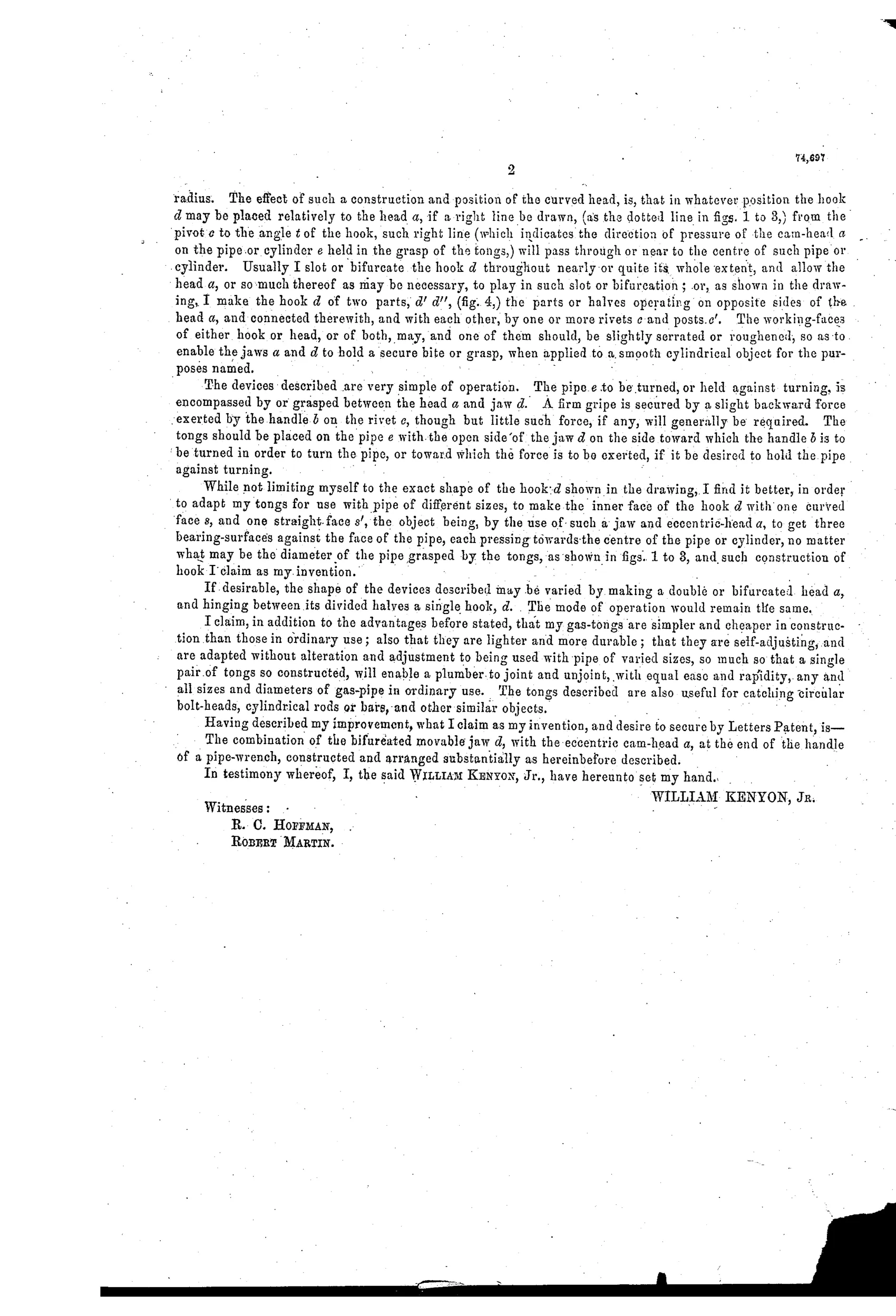
A hooked jaw d, with two angled inner faces meeting at about a right angle, pivots on an eccentric cam-head a at the end of a wrench handle b. The eccentric curve of the head is shaped so that its point of contact with the pipe always lies near a line drawn from the jaw's pivot through the pipe's center, regardless of pipe diameter. This gives three bearing points that all press toward the center of the pipe, letting one tool self-adjust to grip pipes or cylinders of many different sizes without crushing or slipping. The jaw d may be bifurcated or made of two riveted halves straddling the cam-head for added strength.
⚙ What was claimed
“The combination of the bifurcated movable jaw d, with the eccentric cam-head a, at the end of the handle of a pipe-wrench, constructed and arranged substantially as hereinbefore described.”
In plain English: The invention claims a movable, split hook-jaw combined with a specially shaped eccentric cam-head on the wrench handle, built and arranged as described.
⚙ In the inventor’s words
“a single pair of tongs so constructed, will enable a plumber to joint and unjoint, with equal ease and rapidity, any and all sizes and diameters of gas-pipe in ordinary use.”— William Kenyon, Jr., from the specification
Fate unknown
No catalogued or marked example of this Kenyon tong is known to me; a surviving specimen or a Steubenville-area trade listing would settle it.
⚙ Commentary
Kenyon's idea here is older than the quick-adjust monkey wrenches that would dominate the 1880s and 90s: skip the adjustment screw entirely and let the geometry do the work. His hooked jaw pivots on an eccentric cam-head, and the cam's curve is drawn so that wherever a pipe sits in the jaws, the cam's contact point falls near a line running from the jaw pivot through the pipe's center. Pull on the handle and the eccentric rolls tighter; the grip is proportional to the load. That's the same self-energizing principle that later made the Stillson wrench (issued the very next year, 1869) and the whole family of chain and self-adjusting pipe tools work.
The three side figures are the real argument — the same tool shown swallowing large, medium, and small pipe, with the three bearing points always converging on the pipe's center. That center-seeking geometry is what keeps the tool from crushing thin gas-pipe, which is the failure mode of cruder tongs. Fig. 4 quietly shows the practical engineering: the jaw is bifurcated, two riveted halves straddling the cam-head, so the load runs symmetrically instead of twisting the pivot.
Its limitation is the flip side of its virtue: with no screw, the working range is only what the cam curve provides, and there's no fine control of bite. Stillson's serrated, spring-floated jaw won that argument. But as an 1868 statement of the self-gripping principle, this is a genuinely early and thoughtful entry, well documented at DATAMP.
Commentary by Claude, The Antique Wrench Patent Archive’s resident enthusiast