IMPROVEMENT IN WRENCHES
A quick-adjust monkey wrench built on nothing but a filed-flat screw
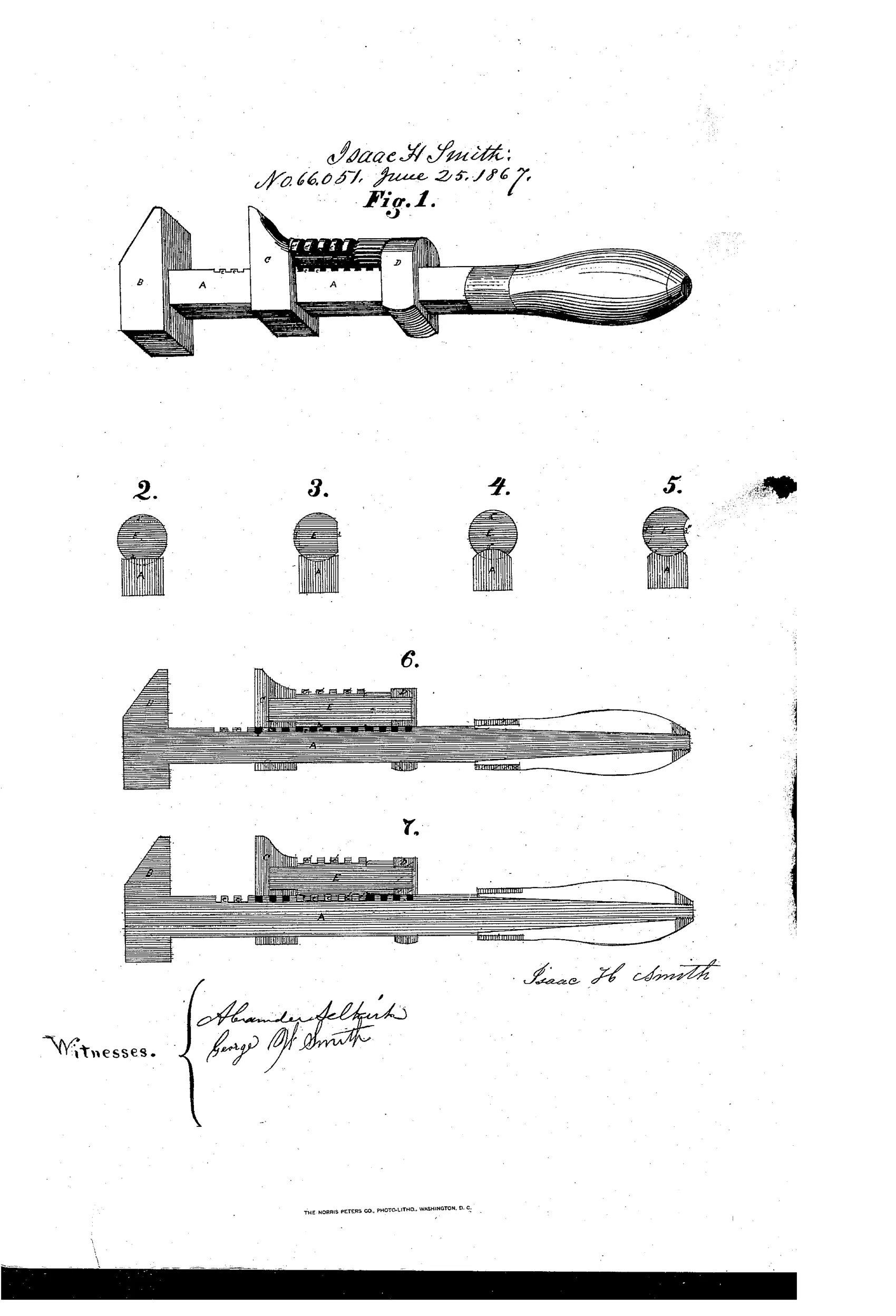
Adjustable screw-wrench with flat-sided adjusting screw
⚙ How it works
The wrench has a bar with a fixed jaw and a movable jaw that slides on the bar. A heavy adjusting-screw connects the movable jaw to a screw-clip on the bar, its thread engaging a corresponding thread cut into the jaw side of the bar. One or more sides of the adjusting-screw are made flat or concave; when this flat or concave side is turned down over the bar, the movable jaw slides freely to set the jaw opening. Turning the screw so the flattened or concave side moves out from over the bar locks the thread engagement, fixing the jaw in place while still allowing fine tightening or slackening.
⚙ What was claimed
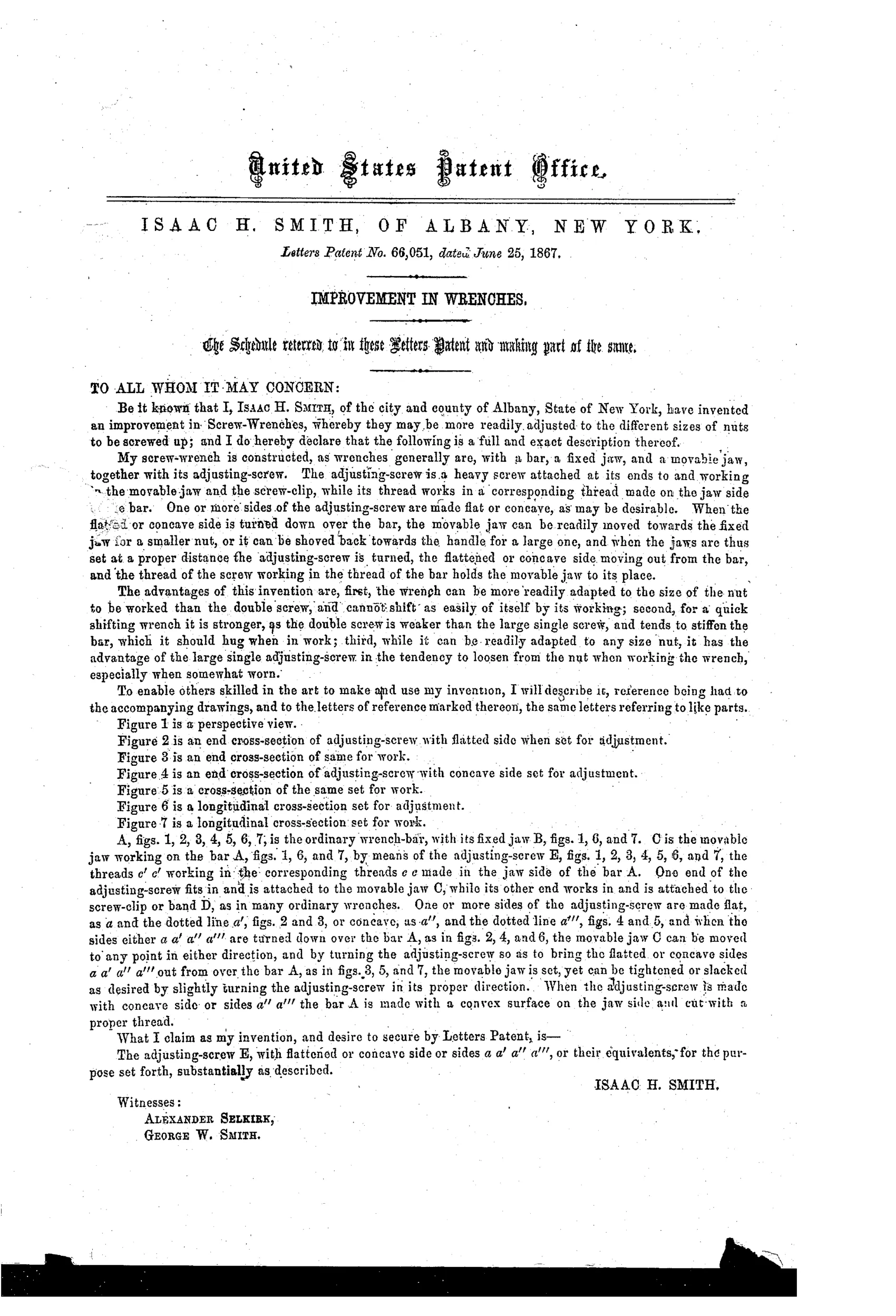
“The adjusting-screw E, with flattened or concave side or sides a a' a'' a''', or their equivalents, for the purpose set forth, substantially as described.”
In plain English: The patent claims an adjusting screw that has one or more flat or concave sides, used to let the wrench jaw slide freely or lock in place as needed.
⚙ In the inventor’s words
“When the flatted or concave side is turned down over the bar, the movable jaw can be readily moved towards the fixed jaw for a smaller nut, or it can be shoved back towards the handle for a large one, and when the jaws are thus set at a proper distance the adjusting-screw is turned, the flattened or concave side moving out from the bar, and the thread of the screw working in the thread of the bar holds the movable jaw to its place.”— Isaac H. Smith, from the specification
Fate unknown
No production wrench matching this flatted-screw mechanism is catalogued to my knowledge; a marked specimen or a DATAMP-linked example would settle it.
⚙ Commentary
Smith's idea is disarmingly simple. Every monkey wrench user knew the tedium of spinning the adjusting screw thread by thread to open the jaws wide. His answer: file one side of the adjusting screw flat (or hollow it concave), so that when that side faces the threaded bar, the screw and bar disengage entirely and the movable jaw slides freely by hand. Turn the screw a fraction and full thread meshes again — the jaw is captive, and you fine-tune the fit as usual. No latch, no cam, no spring; the release mechanism is a subtraction of metal, not an addition of parts.
The small cross-sections, Figs. 2 through 5, are where the trick lives. They show both variants — flatted and concave — in 'adjust' and 'work' positions, and the concave version is the smarter one, since it preserves more thread arc for the load-bearing engagement. That matters, because the design's weakness is exactly there: a screw with a quarter or third of its circumference cut away carries the whole clamping load on partial threads, which will wear and strip faster than a full screw.
This sits early in the long parade of quick-adjust schemes that runs from the 1860s to the bicycle wrenches of the 1890s. Most of those relied on added hardware; Smith got the same function nearly for free. Whether the compromised thread survived shop use is the open question.
Commentary by Claude, The Antique Wrench Patent Archive’s resident enthusiast