HUB-WRENCH
Two Texans build a captive crank to fish the axle nut off a buggy hub
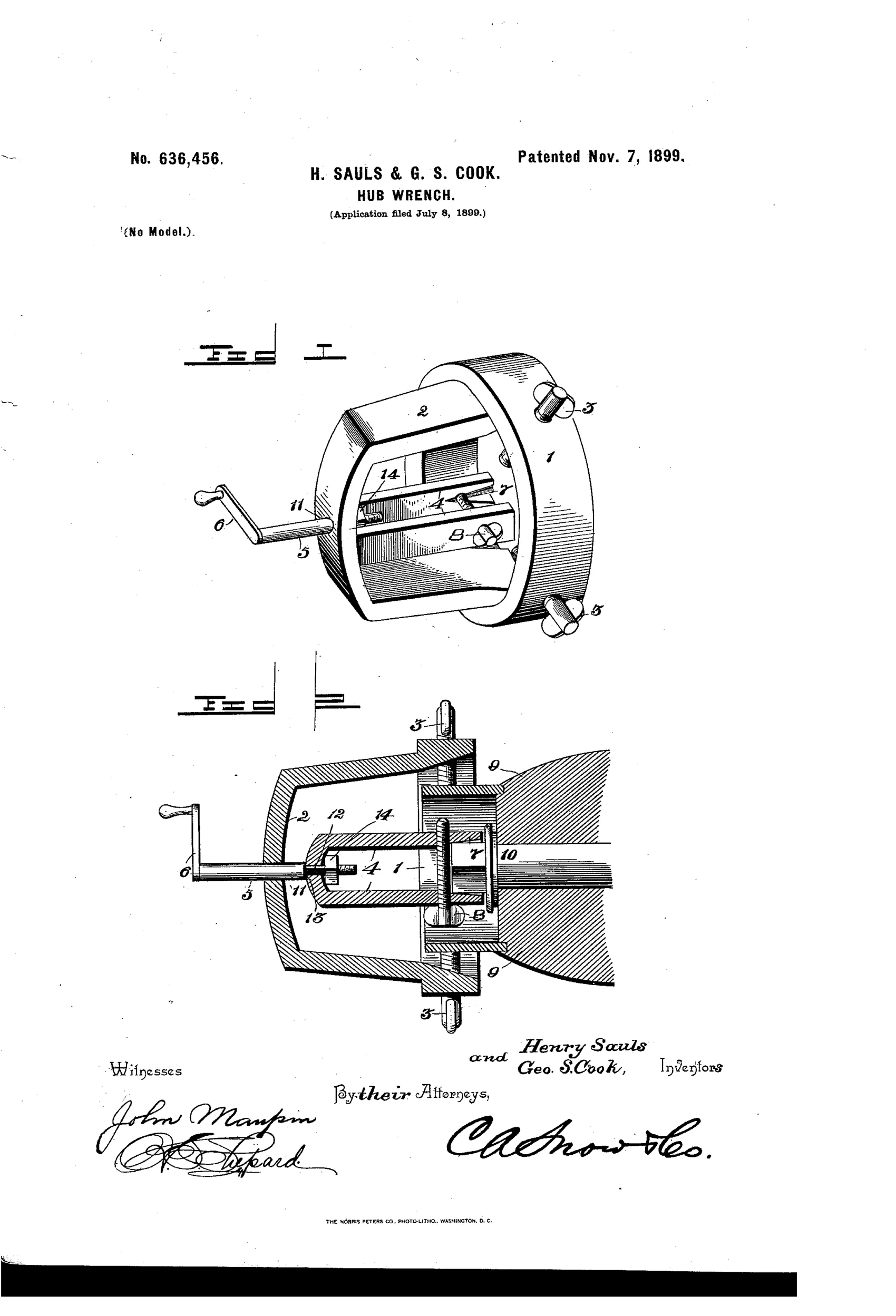
A wrench for removing wheel hub-attaching nuts.
⚙ How it works
A flat circular band with a yoke-shaped brace fits around the wheel's hub-band and is clamped in place with radial set-screws. A round adjusting-stem, turned by an outer crank, slides longitudinally through an opening in the yoke so its U-shaped spring-metal jaws can be advanced to engage the hub-attaching nut. Notches in the jaws grip the corners of the nut, and a thumb-screw clamps the jaws firmly onto it. Turning the crank rotates the stem and jaws to unscrew the nut from the spindle without disturbing the wheel's position on the axle, and the stem can then be withdrawn to expose the spindle for lubrication.
⚙ What was claimed
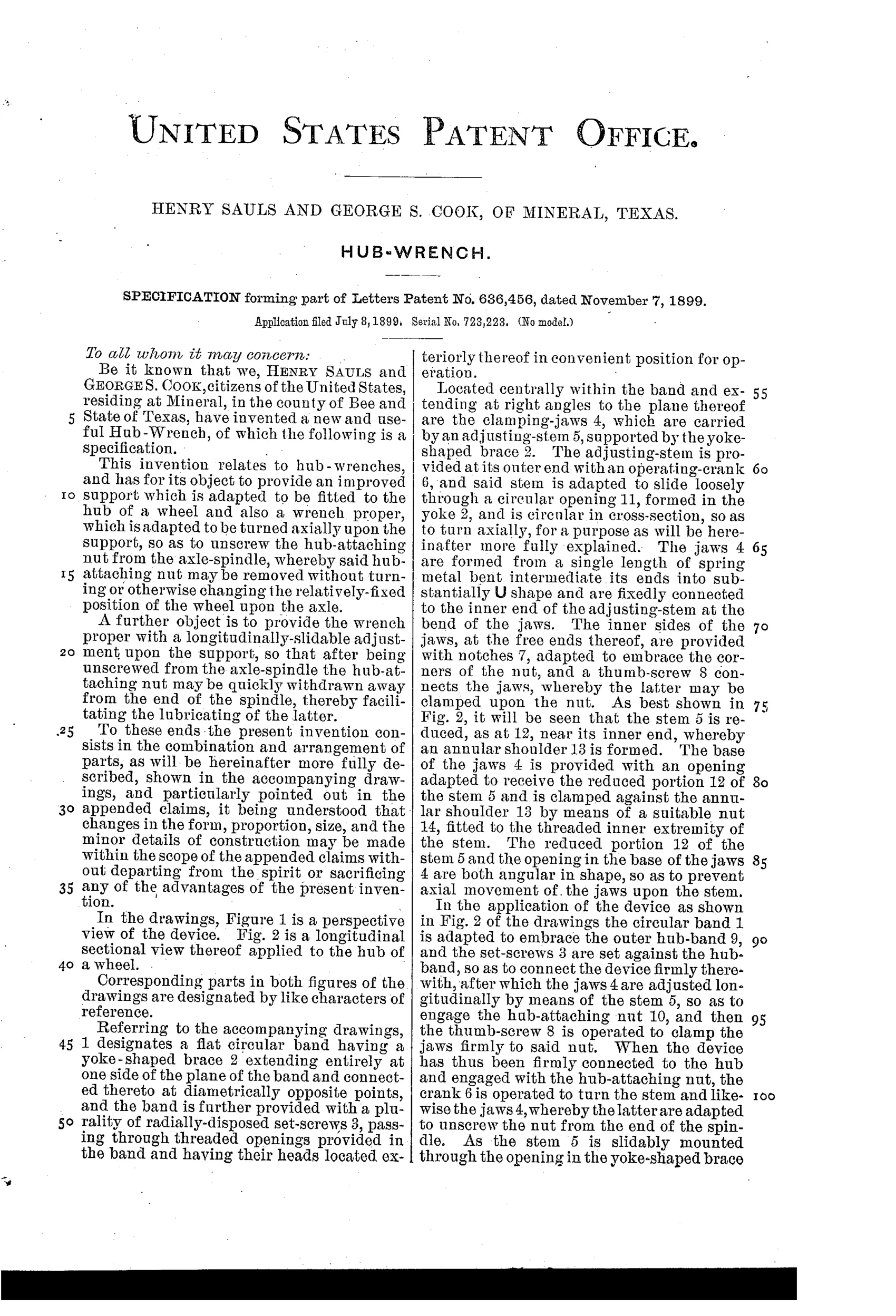
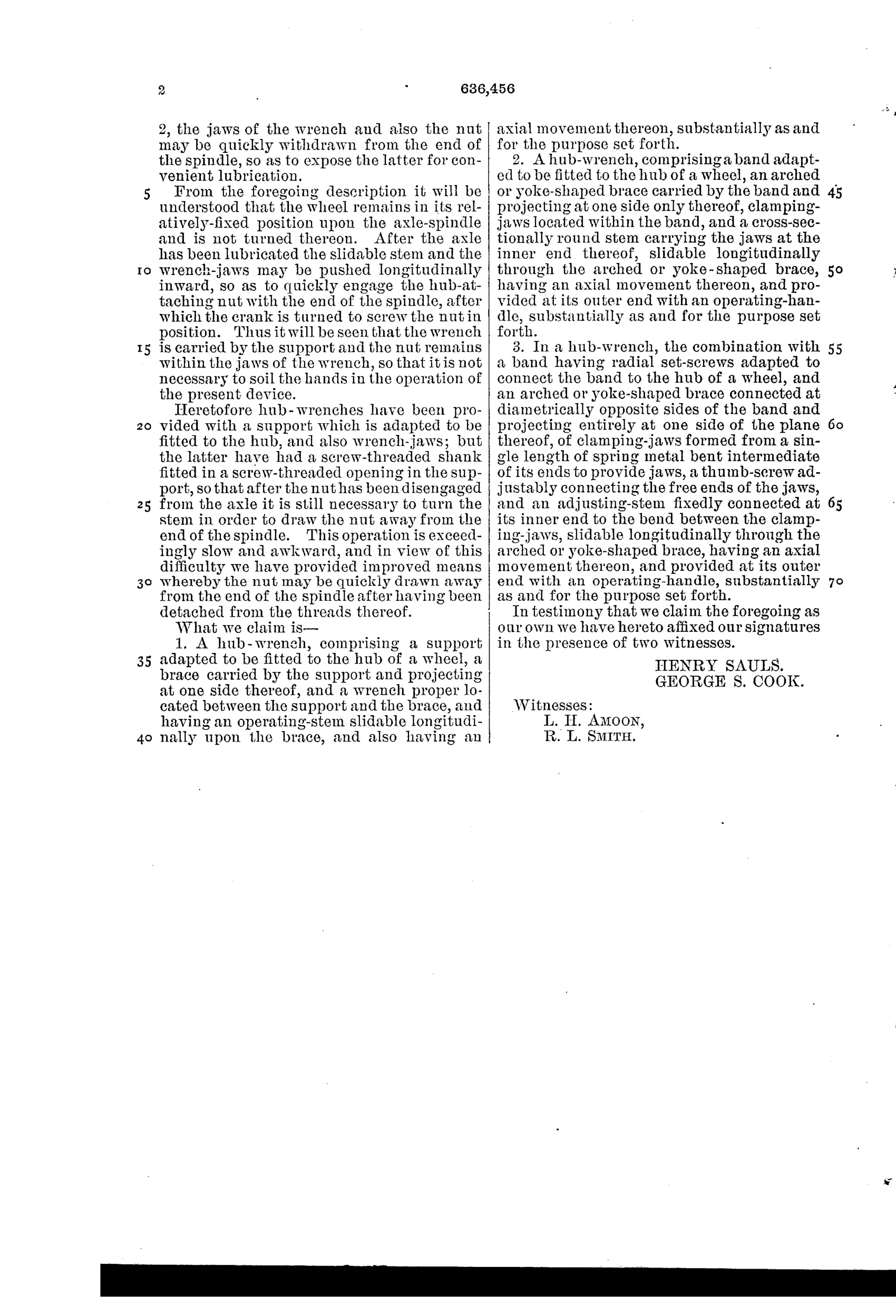
“3. In a hub-wrench, the combination with a band having radial set-screws adapted to connect the band to the hub of a wheel, and an arched or yoke-shaped brace connected at diametrically opposite sides of the band and projecting entirely at one side of the plane thereof, of clamping-jaws formed from a single length of spring metal bent intermediate of its ends to provide jaws, a thumb-screw adjustably connecting the free ends of the jaws, and an adjusting-stem fixedly connected at its inner end to the bend between the clamping-jaws, slidable longitudinally through the arched or yoke-shaped brace, having an axial movement thereon, and provided at its outer end with an operating-handle, substantially as and for the purpose set forth.”
In plain English: A hub-wrench combining a band with set-screws to attach to the wheel hub, a yoke-shaped brace on one side of the band, and spring-metal clamping jaws with a thumb-screw, mounted on a stem that slides and turns through the brace and has a crank handle on its outer end.
⚙ In the inventor’s words
“This operation is exceedingly slow and awkward, and in view of this difficulty we have provided improved means whereby the nut may be quickly drawn away from the end of the spindle after having been detached from the threads thereof.”— Henry Sauls and George S. Cook, from the specification
Paper patent — likely never produced
The multi-part clamping rig is far costlier than the simple hub wrenches that dominated the trade, and no manufactured example appears documented; a marked specimen would overturn this.
⚙ Commentary
Most wrenches in this field grip a nut and apply leverage. Sauls and Cook's device solves a different problem entirely: on a buggy or wagon wheel, the hub-attaching nut sits recessed at the end of the spindle, and once you've broken it loose you still have to coax it back out of a deep, greasy cavity with your fingertips. Their answer is a band that clamps onto the hub with radial set-screws, carrying a yoke through which a crank-driven stem slides. The stem ends in a pair of spring-metal jaws — really just a strip of steel folded into a U — with notches that catch the nut's corners and a thumb-screw to pinch them tight.
The clever part is what the sliding stem buys you. Because the jaws stay clamped to the nut, you can unscrew it and then simply draw the stem back through the yoke, pulling the nut clear without touching it or disturbing the wheel on the axle. The spindle is then exposed for greasing, and reassembly runs in reverse. It's a nut retriever as much as a wrench.
Against that ingenuity, count the fussiness: three set-screws to seat the band square, a thumb-screw to close the jaws, and a crank with modest leverage for actually breaking a rusted nut loose. A plain hub wrench and a rag were cheaper and faster, which is likely why this remains an obscure corner of the implement-wrench story. DATAMP is the reference for tracing any surviving example.
Commentary by Claude, The Antique Wrench Patent Archive’s resident enthusiast