PIPE-WRENCH
A pipe wrench that wraps the pipe in a hinged ring of segments
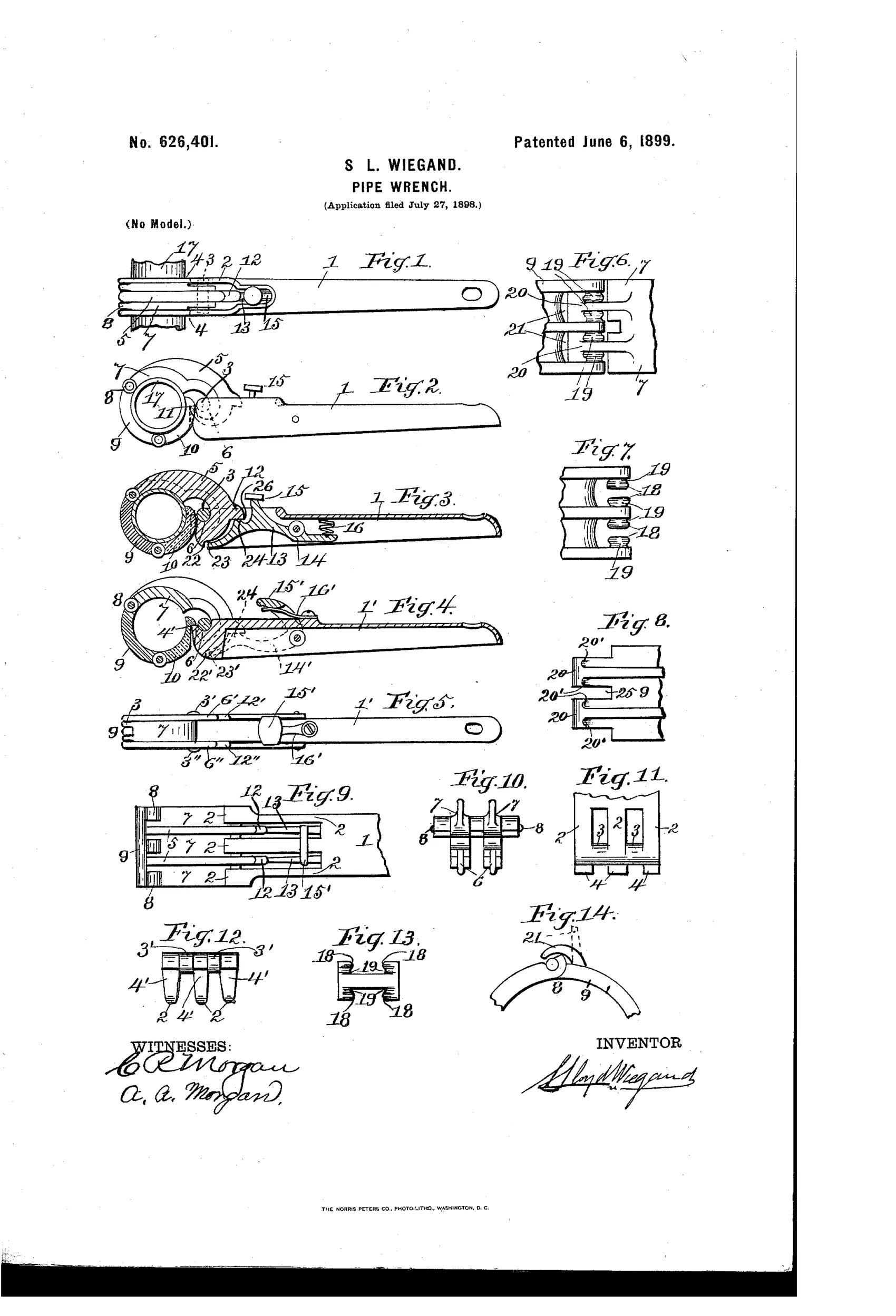
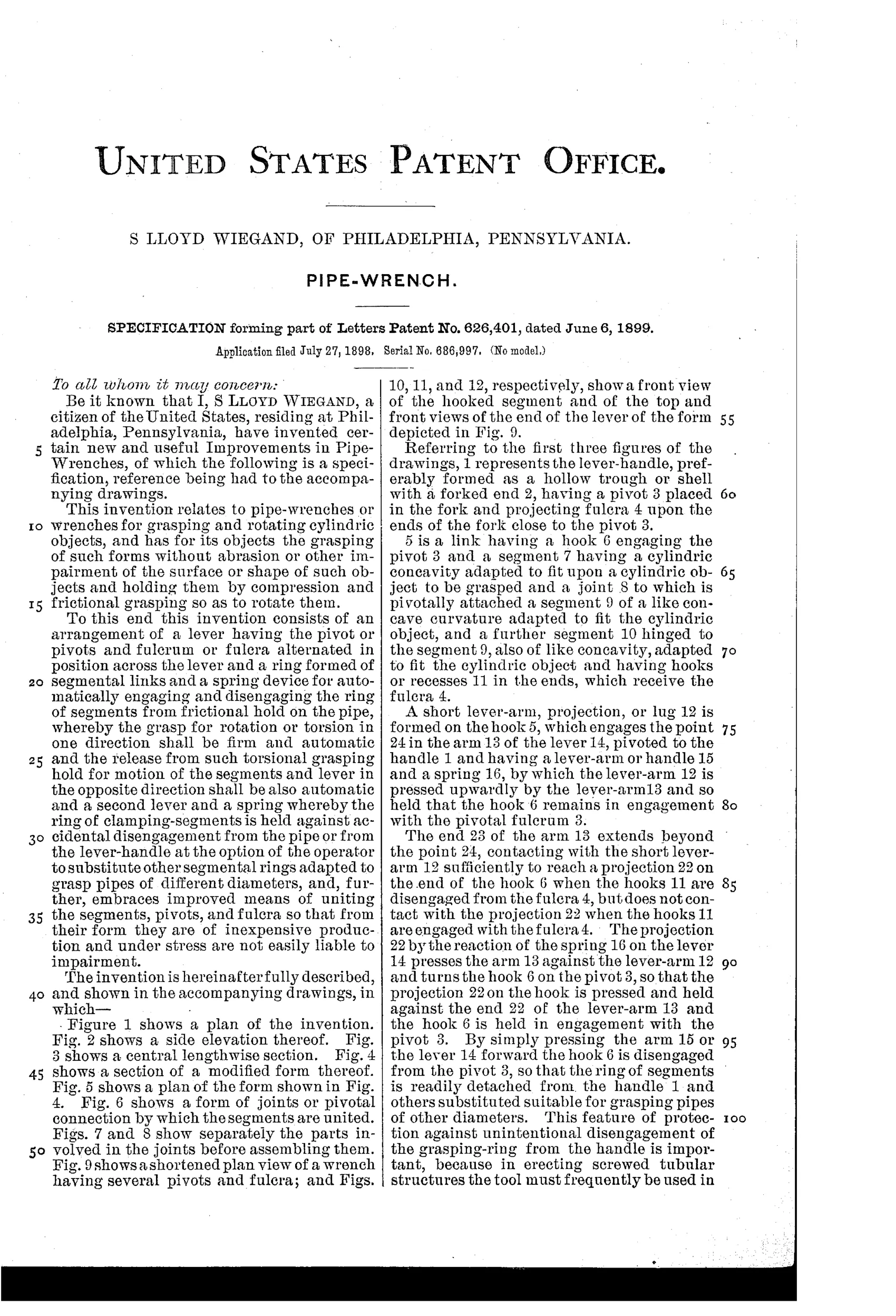
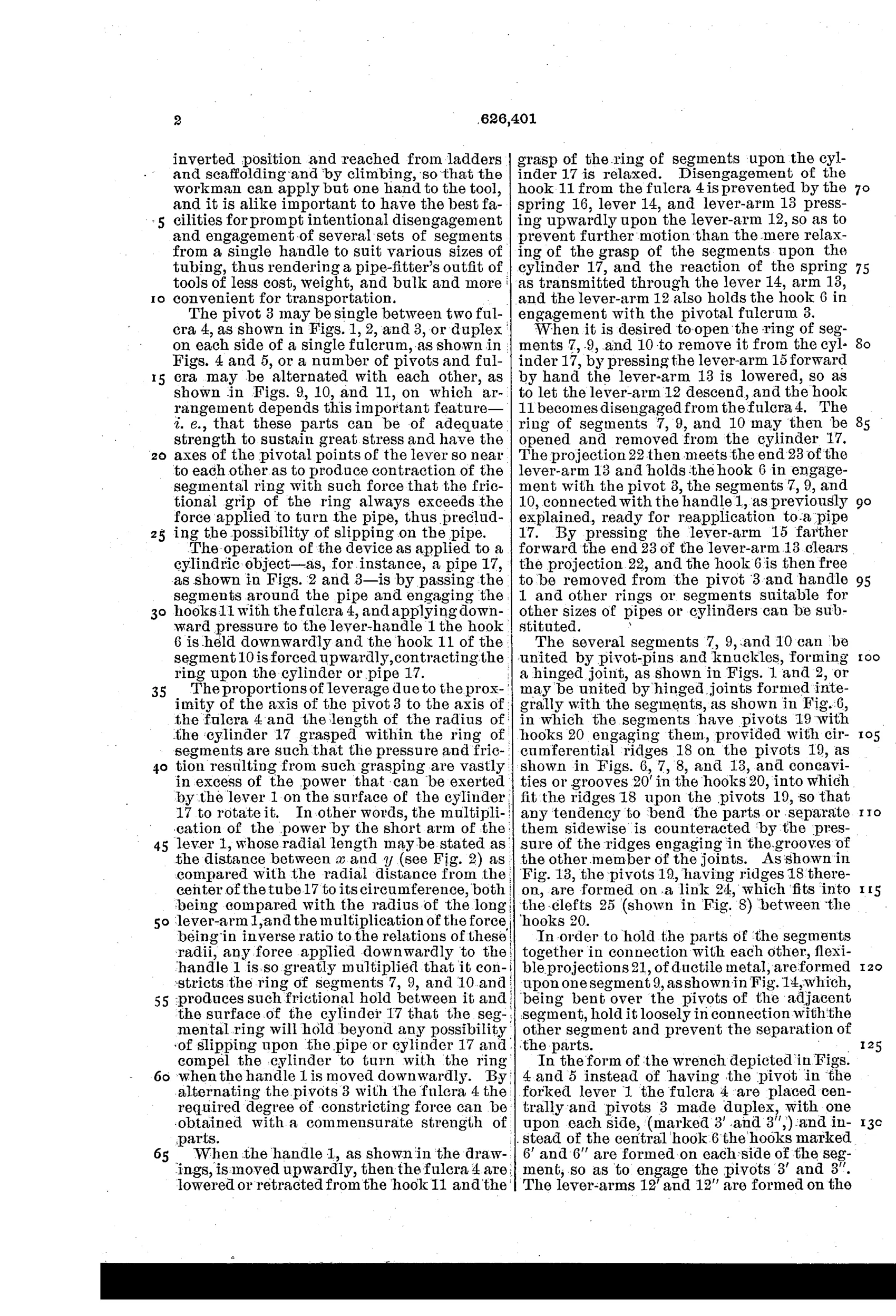
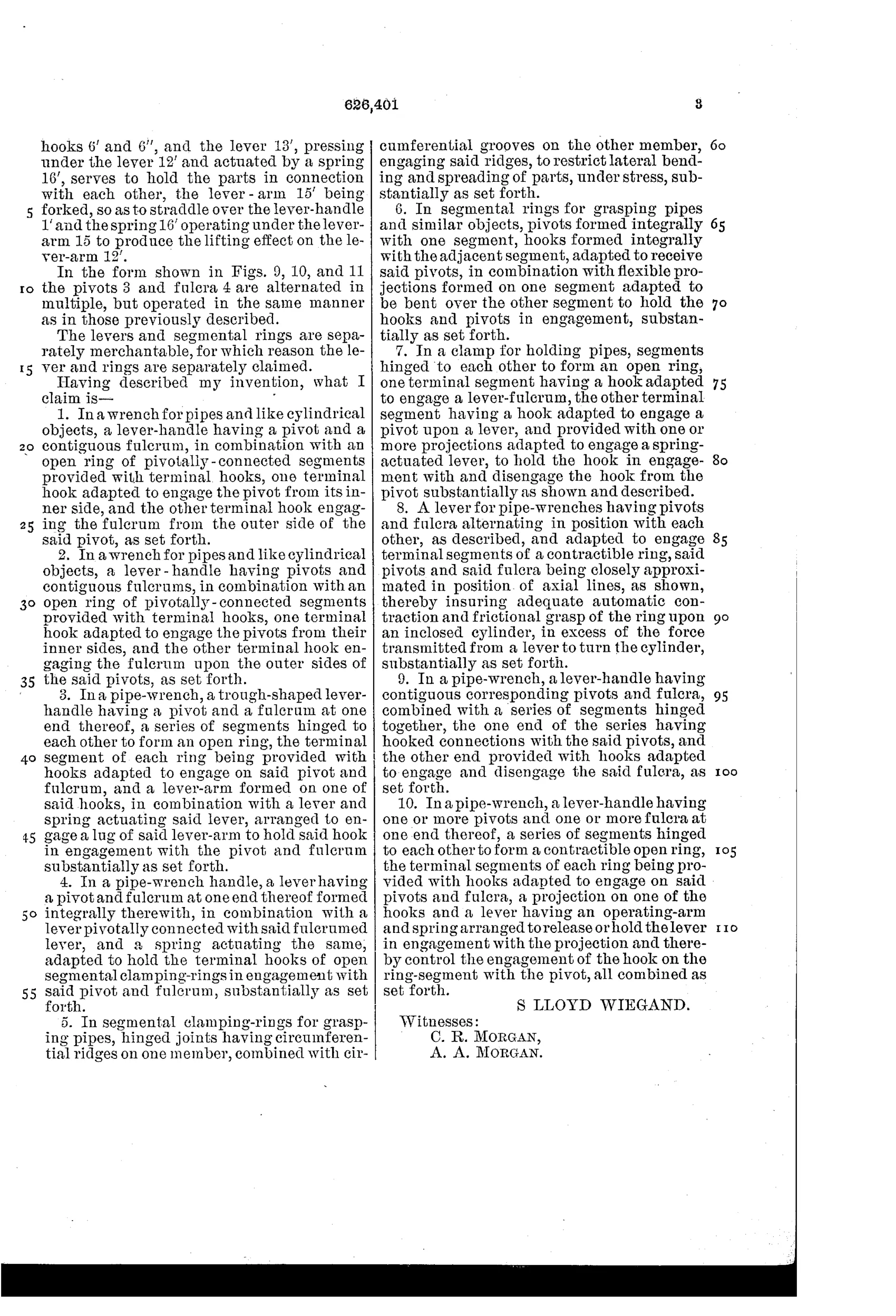
Segmented ring pipe wrench with automatic locking hooks
⚙ How it works
A trough-shaped lever-handle carries a pivot and a fulcrum near its forked end, and a ring of hinged concave segments closes around a pipe. One terminal hook engages the pivot from the inside while the other engages the fulcrum from the outside, so downward pressure on the handle contracts the ring and grips the pipe by friction. A spring-loaded secondary lever holds the hooks engaged with the pivot and fulcrum until the operator deliberately pushes it forward, releasing the ring for removal or substitution with a differently sized ring. Ridges and grooves molded into the hinge knuckles keep the segments from spreading sideways under load, and bent ductile-metal tabs hold the pivot pins captive in their sockets.
⚙ What was claimed
“In a wrench for pipes and like cylindrical objects, a lever-handle having a pivot and a contiguous fulcrum, in combination with an open ring of pivotally-connected segments provided with terminal hooks, one terminal hook adapted to engage the pivot from its inner side, and the other terminal hook engaging the fulcrum from the outer side of the said pivot, as set forth.”
In plain English: The wrench handle has a pivot and a nearby fulcrum, and the ring of hinged segments has one hook that catches the pivot from inside and another hook that catches the fulcrum from outside, so pulling the handle tightens the ring on the pipe.
⚙ In the inventor’s words
“This feature of protection against unintentional disengagement of the grasping-ring from the handle is important, because in erecting screwed tubular structures the tool must frequently be used in inverted position and reached from ladders and scaffolding and by climbing, so that the workman can apply but one hand to the tool.”— S Lloyd Wiegand, from the specification
Fate unknown
No catalogued or surviving example is known to me; a marked segmented-ring specimen or a Philadelphia hardware listing would settle it.
⚙ Commentary
Most pipe wrenches of the 1890s grip a pipe at two or three points and gouge it accordingly. Wiegand goes the other way: a ring of concave hinged segments closes clear around the pipe, and the handle's pivot-and-fulcrum geometry contracts the whole ring when you bear down. It is essentially the chain-tong idea — which pipefitters already knew — rebuilt in rigid articulated segments, with the load spread over the full circumference. Different pipe size, different ring; the handle stays.
The detail work is what earns respect. The spring-loaded secondary lever that keeps the hooks captive on the pivot and fulcrum answers a real complaint: Wiegand explicitly notes that steamfitters work inverted, off ladders, one-handed, and a ring that drops free at the wrong moment is worse than useless. Figures 6 through 8 show ridged and grooved hinge knuckles to keep the segments from splaying sideways under torque — a failure mode a desk inventor would never think of — and Fig. 14 shows pivot pins retained by bent ductile tabs, cheap and serviceable.
For all that, the design carries a lot of parts for a rough trade, and each pipe diameter wants its own segment ring. Chain tongs solved the same problem with a length of chain and one forging. This reads as a thoughtful refinement pointed down a path the market didn't take. DATAMP documents the patent; the tool itself is another matter.
Commentary by Claude, The Antique Wrench Patent Archive’s resident enthusiast