RATCHET MONKEY-WRENCH
A monkey wrench whose whole head spins like a ratchet socket, decades early
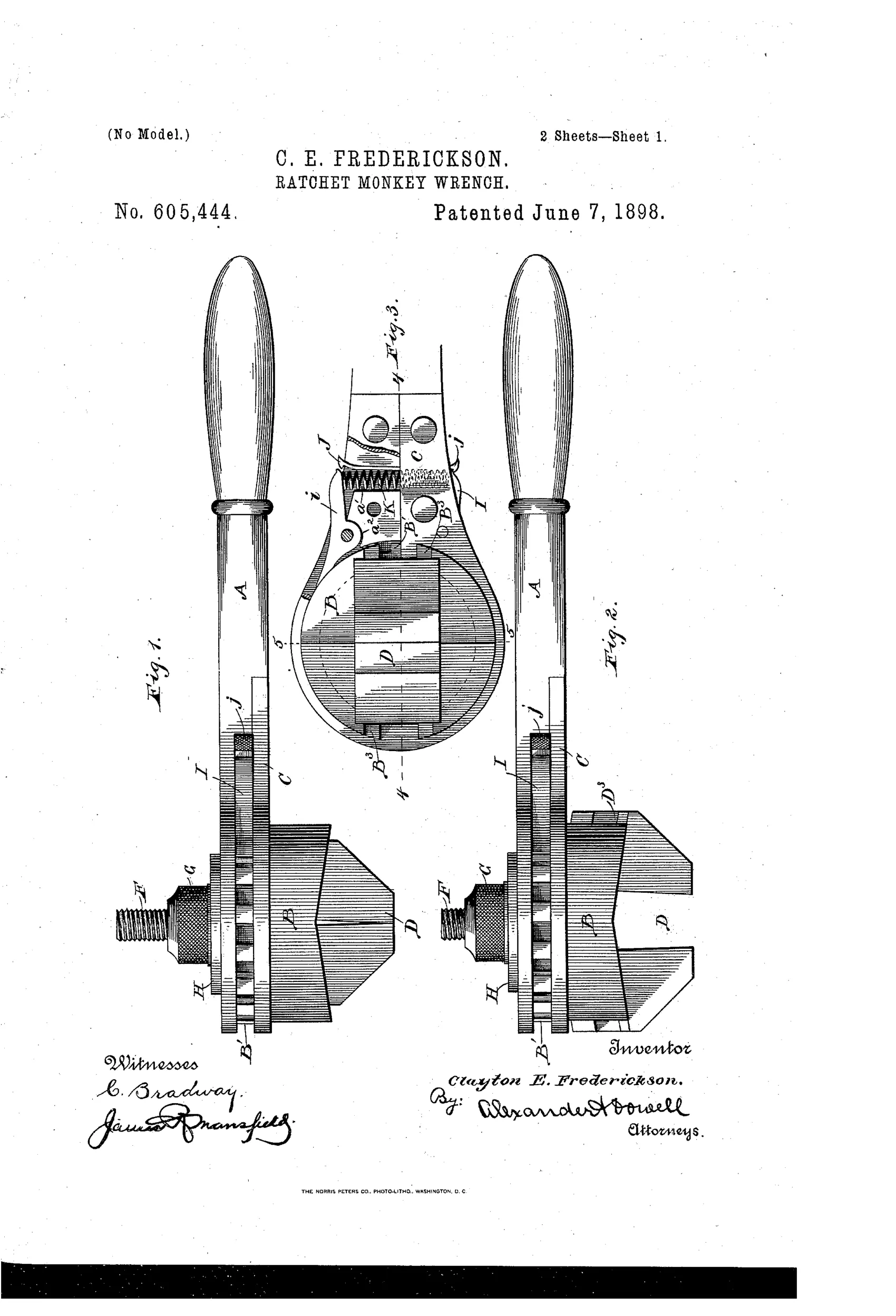
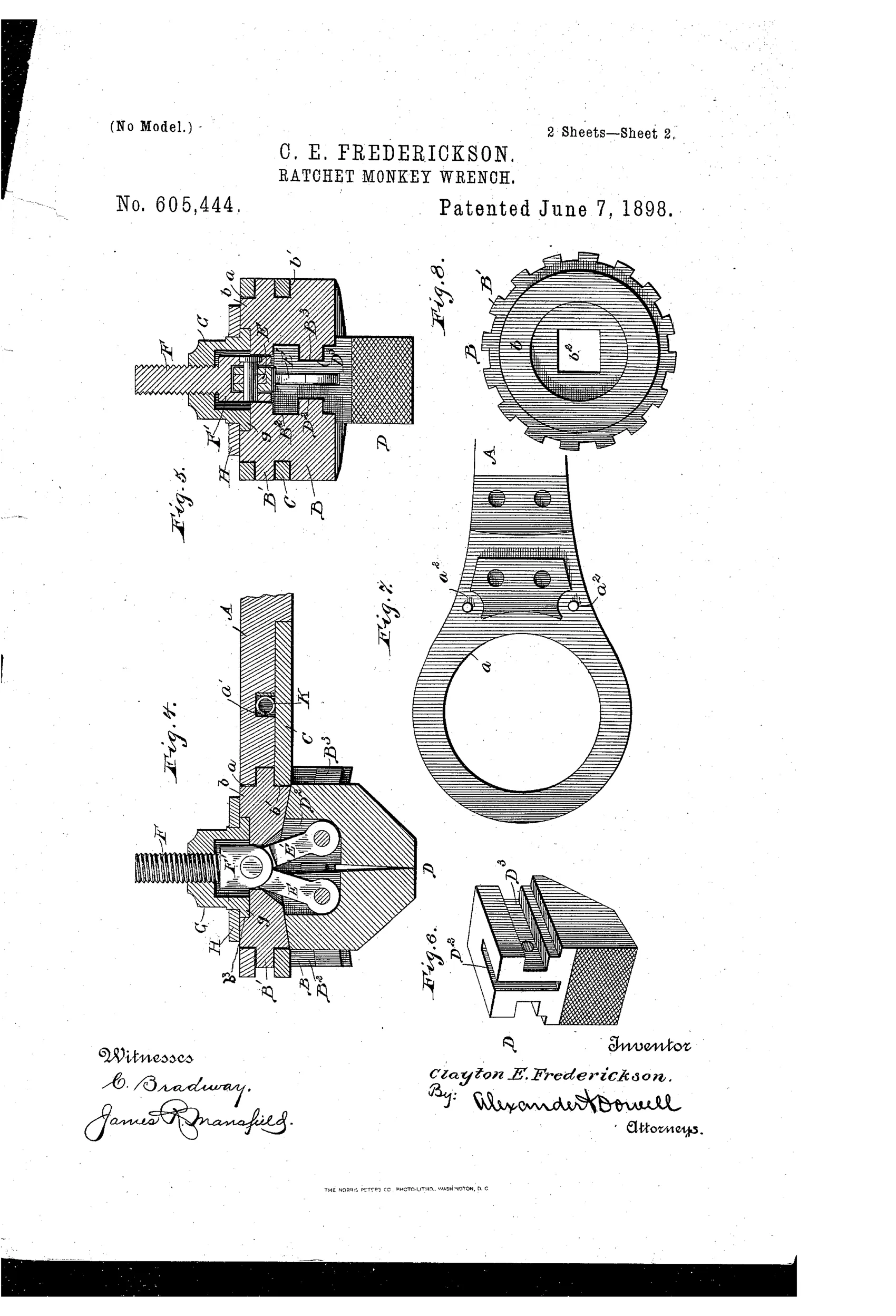
Ratchet-driven adjustable monkey wrench
⚙ How it works
A rotatable head-stock carrying two oppositely-sliding jaws is journaled in the end of the handle and can be spun by vibrating the handle back and forth. A pair of spring-loaded pivoted dogs engage a circumferential ratchet on the head-stock so that motion in one direction turns the head while the return stroke slips freely, and either dog can be disengaged by a catch to reverse rotation direction. The jaws themselves are opened or closed by turning a thumb-nut on a central bolt, which raises or lowers a bifurcated head connected by pivoted links to each jaw, spreading or drawing them together within a channel having inclined guide ribs.
⚙ What was claimed
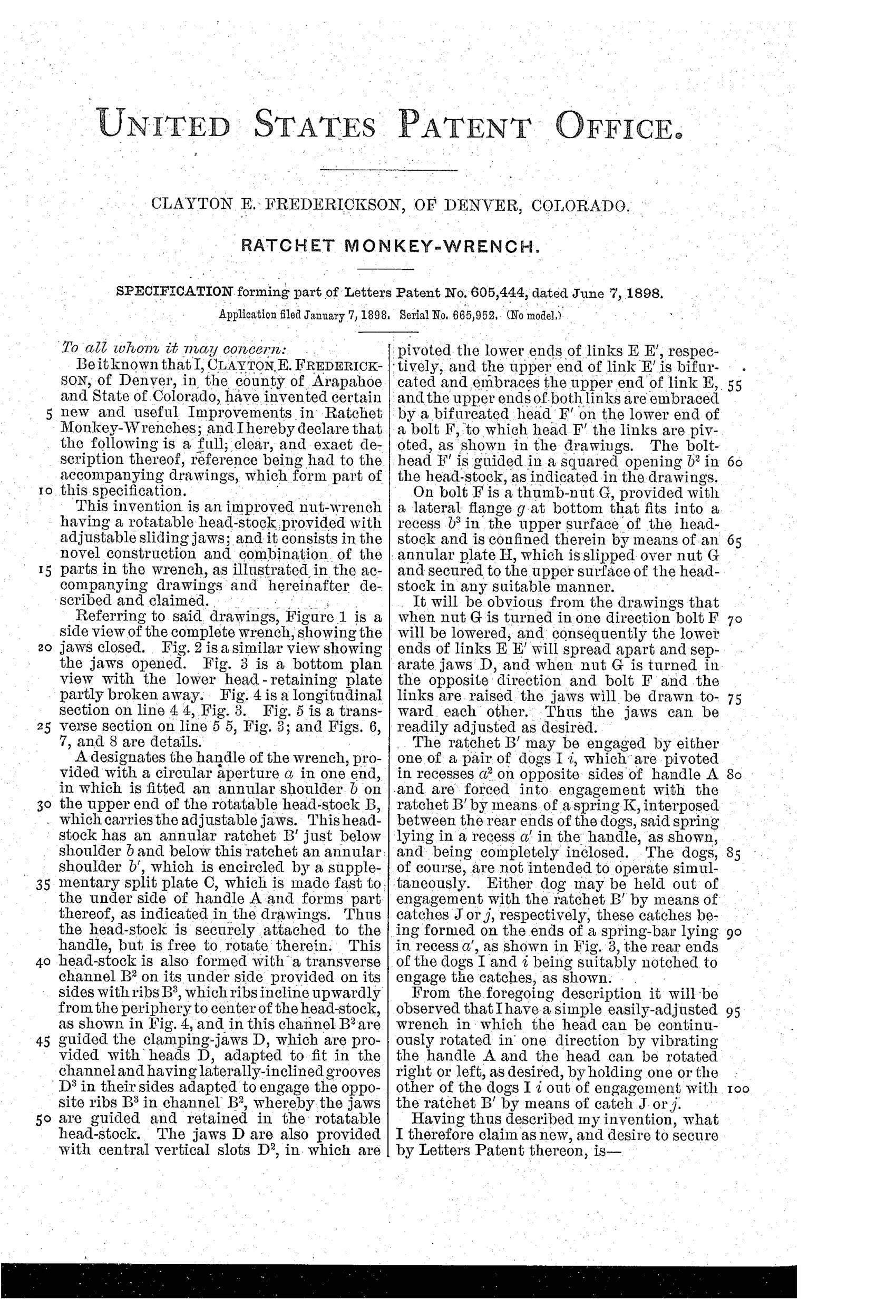
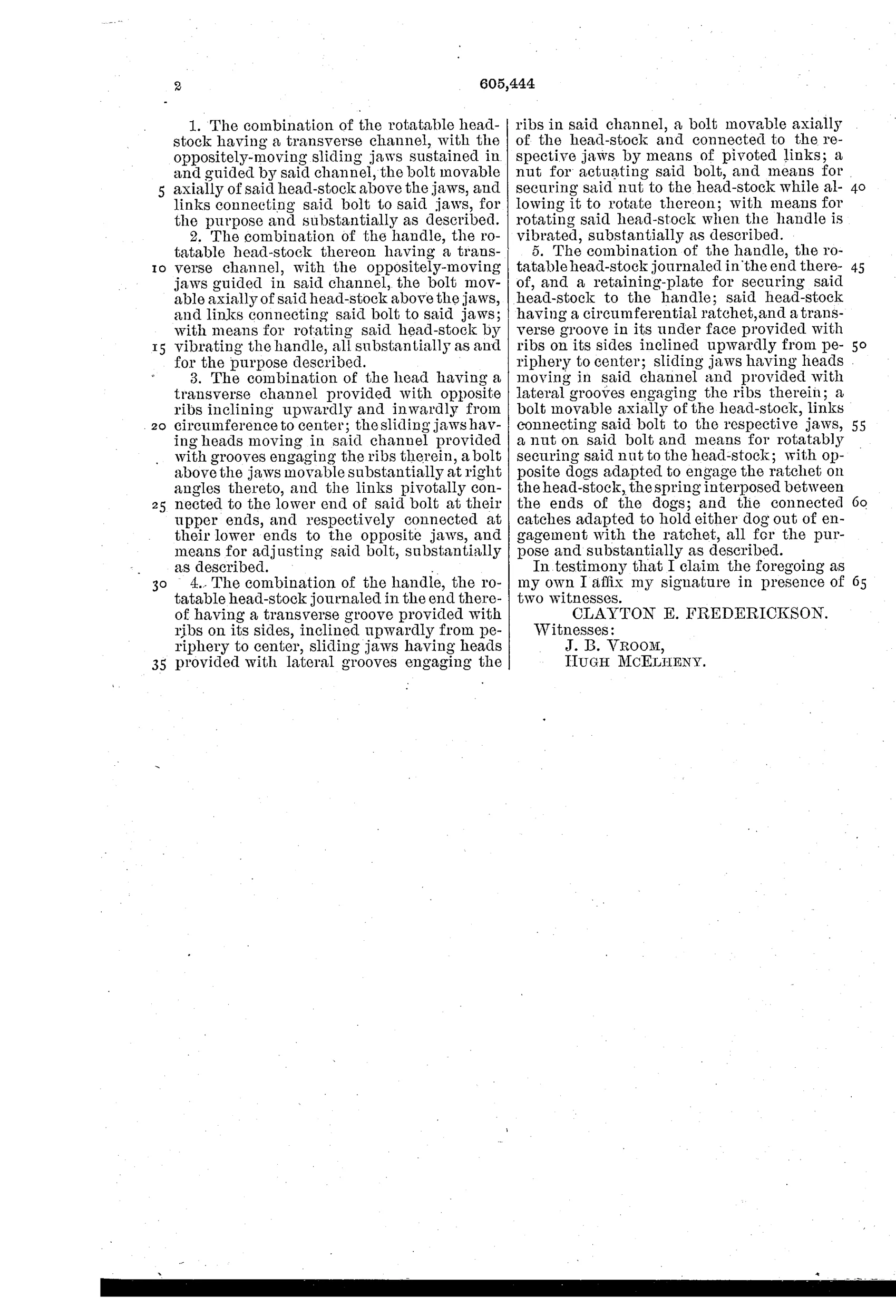
“The combination of the handle, the rotatable head-stock journaled in the end thereof, and a retaining-plate for securing said head-stock to the handle; said head-stock having a circumferential ratchet, and a transverse groove in its under face provided with ribs on its sides inclined upwardly from periphery to center; sliding jaws having heads moving in said channel and provided with lateral grooves engaging the ribs therein; a bolt movable axially of the head-stock, links connecting said bolt to the respective jaws, a nut on said bolt and means for rotatably securing said nut to the head-stock; with opposite dogs adapted to engage the ratchet on the head-stock, the spring interposed between the ends of the dogs; and the connected catches adapted to hold either dog out of engagement with the ratchet, all for the purpose and substantially as described.”
In plain English: The wrench combines a rotatable ratcheted head with adjustable sliding jaws moved by a threaded bolt and linkage, plus two spring-loaded dogs (each lockable out of action by a catch) that let the handle drive the head in either rotational direction.
⚙ In the inventor’s words
“From the foregoing description it will be observed that I have a simple easily-adjusted wrench in which the head can be continuously rotated in one direction by vibrating the handle and the head can be rotated right or left, as desired, by holding one or the other of the dogs I i out of engagement with the ratchet B' by means of catch J or j.”— Clayton E. Frederickson, from the specification
Fate unknown
No manufactured example or maker attribution appears in DATAMP or the collector literature; a marked specimen would settle it.
⚙ Commentary
Frederickson's idea is to take the ordinary monkey wrench and make its entire head a rotating element — a head-stock journaled in the handle, carrying a circumferential ratchet ring. Wag the handle back and forth and the jaws walk the nut around continuously, without ever lifting the wrench off the work. Two spring-loaded dogs engage the ratchet, and either one can be latched out of action to reverse direction. That is, functionally, the reversible ratchet we now take for granted on socket wrenches — worked out here on a full-size adjustable jaw wrench in 1898.
The jaw adjustment is where it gets baroque. Instead of the Coes worm-and-screw, the two jaws slide oppositely in a channel with inclined guide ribs, spread and drawn together by pivoted links off a central bolt turned by a thumb-nut. Compare Figs. 1 and 2 and you can see the linkage scissoring the jaws apart. It works on paper, but that channel-and-rib arrangement puts every ounce of wrenching torque through small sliding heads and pinned links — exactly the parts you don't want carrying the load when a stubborn nut fights back.
So: genuinely clever ratchet logic bolted to a fragile-looking jaw mechanism, and a lot of machining for a tool competing against dollar Coes wrenches. It reads as an inventor's answer to the 1890s obsession with speed of adjustment, taken one ambitious step further than the market wanted.
Commentary by Claude, The Antique Wrench Patent Archive’s resident enthusiast