WRENCH
A ratchet-set pipe jaw with a pivoting smooth insert for finished nuts
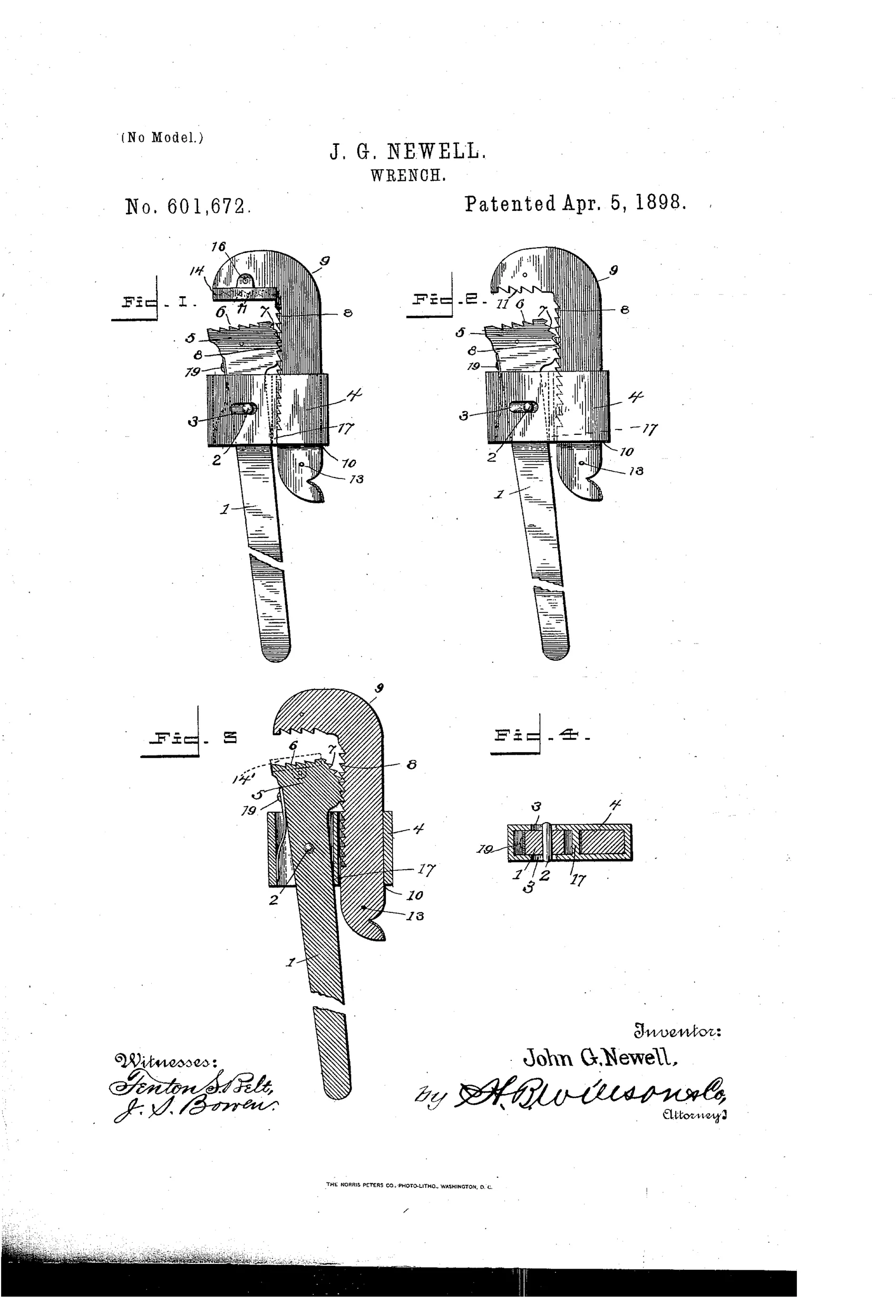
Adjustable ratchet-toothed wrench with pivoting auxiliary smooth jaw
⚙ How it works
The handle carries a fixed angular jaw with ratchet-shaped teeth on both its transverse and parallel faces, while a movable jaw slides longitudinally in a slotted yoke and engages the fixed jaw's rear teeth to set the opening width. A leaf-spring fixed to the handle presses against the yoke's web to keep the ratchet teeth engaged, and a transverse pin limits the movable jaw's travel so it cannot detach. An auxiliary smooth-faced jaw is pivoted on a pin to the movable jaw for gripping finished nuts without marring them, while the toothed faces are reserved for pipes, bolts, or similar cylindrical objects; a second removable auxiliary jaw may also be fitted to the fixed jaw as needed.
⚙ What was claimed
“The combination with the slotted yoke 4, provided with the web 17, the handle 1 provided with the leaf-spring 18 and the pin 2 on which it is fulcrumed in said slotted yoke, and the movable jaw 9, longitudinally adjustable in said yoke, and provided with a series of teeth 11, adapted to engage the corresponding teeth 7, on the handle 1, substantially as shown and described.”
In plain English: The wrench combines a slotted yoke with a spring-loaded web, a pivoting handle with a leaf-spring, and a longitudinally adjustable movable jaw whose teeth engage matching teeth on the handle to lock the jaw setting.
⚙ In the inventor’s words
“Although I have specifically described the construction and relative arrangement of the several elements of my invention, I do not desire to be confined to the same, as such changes or modifications may be made as clearly fall within the scope of my invention without departing from the spirit thereof.”— John G. Newell, from the specification
Fate unknown
The assignment to Snow hints at commercial intent, but no surviving marked example is documented on DATAMP; a specimen would settle it.
⚙ Commentary
Newell's answer to the crowded quick-adjust problem is direct: cut ratchet teeth on the back of the fixed jaw, cut matching teeth on the sliding jaw, and let a leaf-spring hold them meshed. No screw, no thumb wheel — you just haul the movable jaw to the opening you want and the spring snaps the teeth together. Figure 3 is the one to study: the section shows the spring fulcrumed on pin 2 pressing the yoke's web so the two toothed racks stay engaged, and the transverse pin that keeps the sliding jaw from walking off the end entirely.
The cleverer touch is the auxiliary jaw. Toothed jaws are fine for pipe but ruinous to a finished hexagon nut, so Newell pivots a small smooth-faced jaw onto the movable member — swing it in for nuts, out for pipe — and allows a second removable insert on the fixed side. That's the nut-and-pipe combination idea handled with a hinge instead of a whole second head.
The weakness is the same one that haunts most spring-and-rack designs: grip depends on the teeth staying seated under torque, and a spring is a modest guarantee against a hard pull at a bad angle. It was assigned to Levi T. Snow of New Haven, which suggests someone thought it had commercial legs, but I know of no marked example, and the 1890s were littered with plausible rack-jaw wrenches that never left the drawing sheet.
Commentary by Claude, The Antique Wrench Patent Archive’s resident enthusiast