TOOL.
One Texas bar tries to be vise, brace, drill-stock, and pipe wrench at once
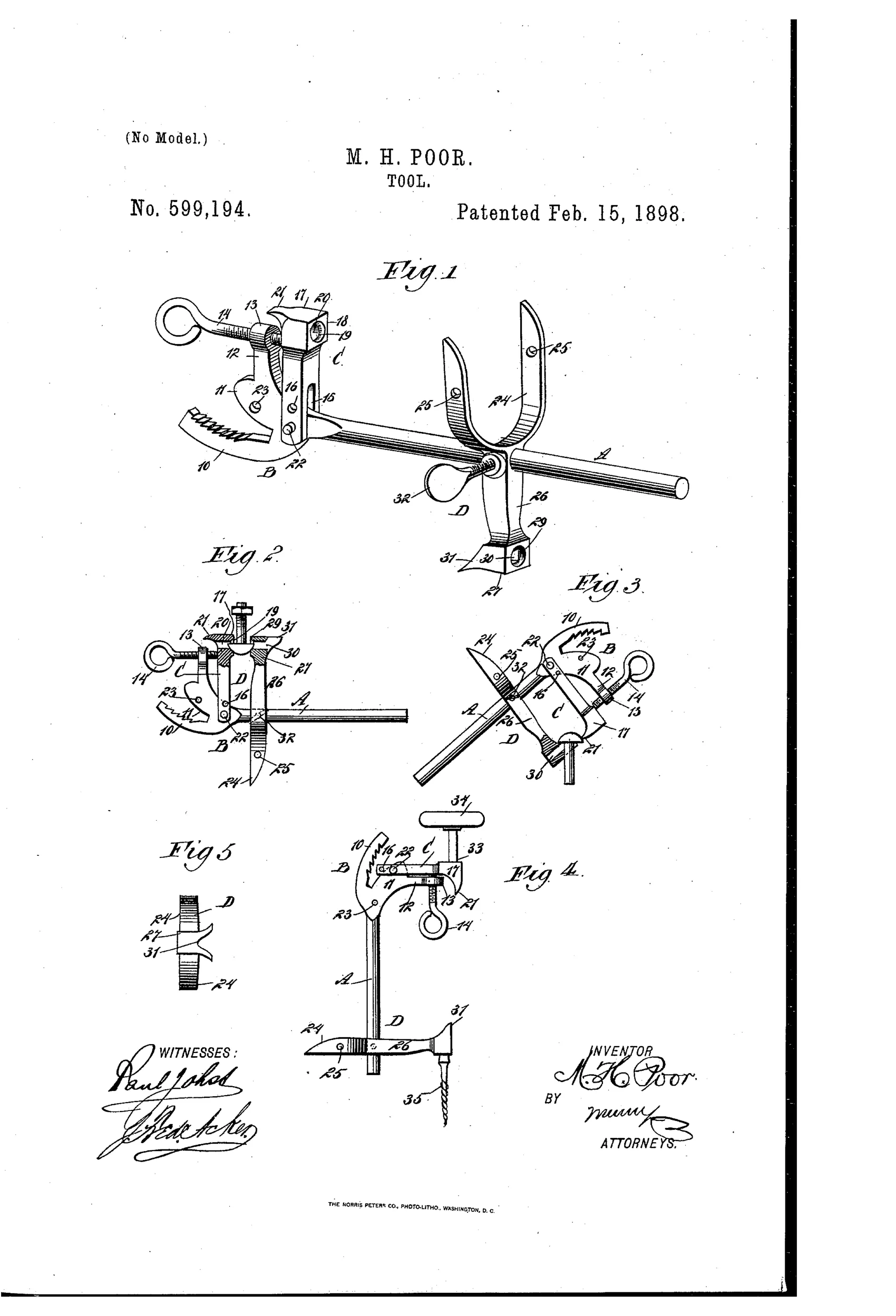
Multi-function combination tool: clamp, vise, brace, wrench
⚙ How it works
A round body-bar carries a pipe-wrench jaw at one end and two adjustable arms locked by set-screws along its length. Each arm terminates in a head with a roughened countersink and vise-jaw on one face and either a sharp point or a split jaw on the opposite face. By repositioning the arms and reversing which face is presented, the same body-bar can act as a vise for gripping bolt heads, a brace for boring wood, or a drill-stock for metal using an inserted bit shank. A separate handle and boring-bit can be fitted into polygonal or circular openings in the arm heads to convert the tool into a drill-stock or brace.
⚙ What was claimed
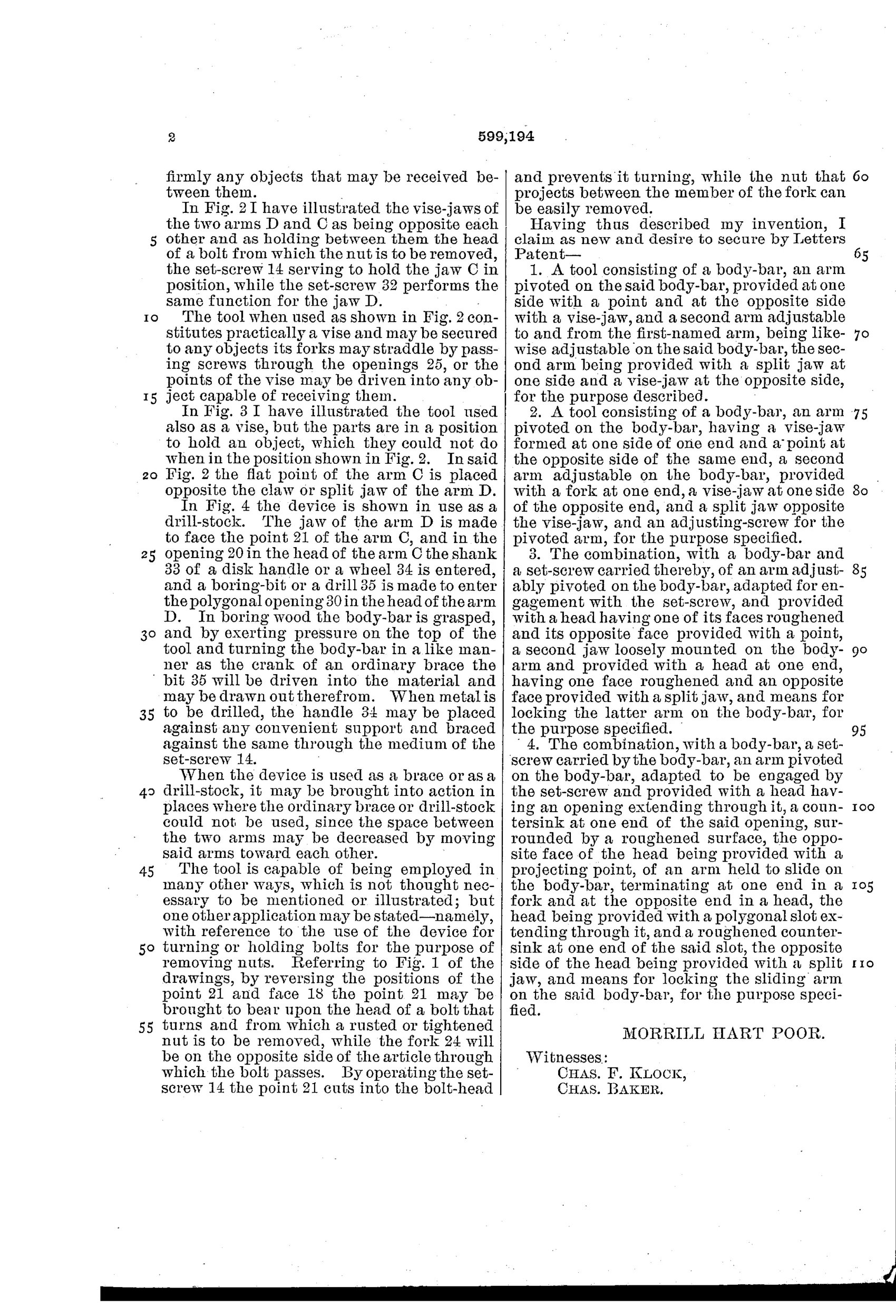
“A tool consisting of a body-bar, an arm pivoted on the said body-bar, provided at one side with a point and at the opposite side with a vise-jaw, and a second arm adjustable to and from the first-named arm, being likewise adjustable on the said body-bar, the second arm being provided with a split jaw at one side and a vise-jaw at the opposite side, for the purpose described.”
In plain English: The tool has a bar with one pivoting arm that has a point on one side and a gripping jaw on the other, plus a second sliding arm with a split jaw on one side and another gripping jaw on the other, so the two arms can be adjusted toward or away from each other along the bar.
⚙ In the inventor’s words
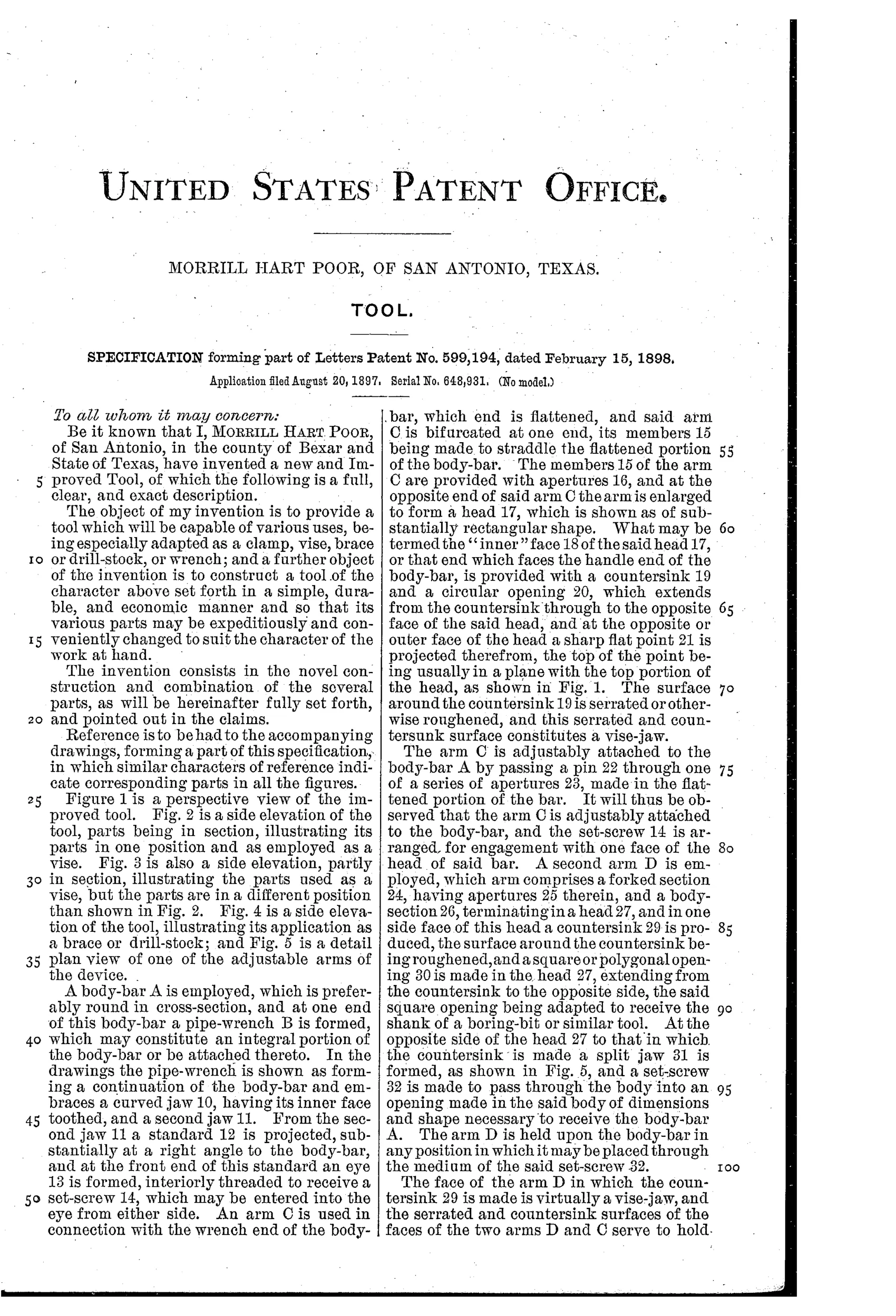
“The object of my invention is to provide a tool which will be capable of various uses, being especially adapted as a clamp, vise, brace or drill-stock, or wrench; and a further object of the invention is to construct a tool of the character above set forth in a simple, durable, and economic manner and so that its various parts may be expeditiously and conveniently changed to suit the character of the work at hand.”— Morrill Hart Poor, from the specification
Fate unknown
No manufactured example or catalog listing is documented at DATAMP; a marked specimen would settle it, though the complexity argues against volume production.
⚙ Commentary
Morrill Hart Poor of San Antonio filed this in 1897, and it reads like a farm-shop wish list compressed onto one round bar. Two arms slide along the body and lock with set-screws; each arm's head is double-faced, with a roughened vise-jaw on one side and either a sharp point or a split jaw on the other. Slide the arms together and you have a hand vise. Flip the arms, drop a bit into the polygonal socket, add the separate crank handle, and it becomes a brace or drill-stock. A pipe-wrench jaw rides at one end of the bar for good measure.
The drawing rewards a close look at Fig. 4, where the whole geometry rearranges into a boring tool — the same arms that clamped a bolt head now carry the bit and the breast point. That reversibility is the genuinely clever part, and also the weak one: every function depends on set-screws holding position under torque, and a brace that drills through friction-clamped arms is going to walk the moment the bit bites hard.
This sits in the 1890s combination-tool current that ran alongside the wrench trade proper — the same era Coes and Bemis & Call were refining single-purpose wrenches into cheap, rigid perfection. History mostly sided with the specialists. Poor's tool is an honest, well-drawn entry in the do-everything camp, which is exactly the camp that rarely made it past the patent office.
Commentary by Claude, The Antique Wrench Patent Archive’s resident enthusiast