WRENCH OR HOLDING DEVICE.
Two screws, two jaws, and a wrench that doubles as a drill-press clamp
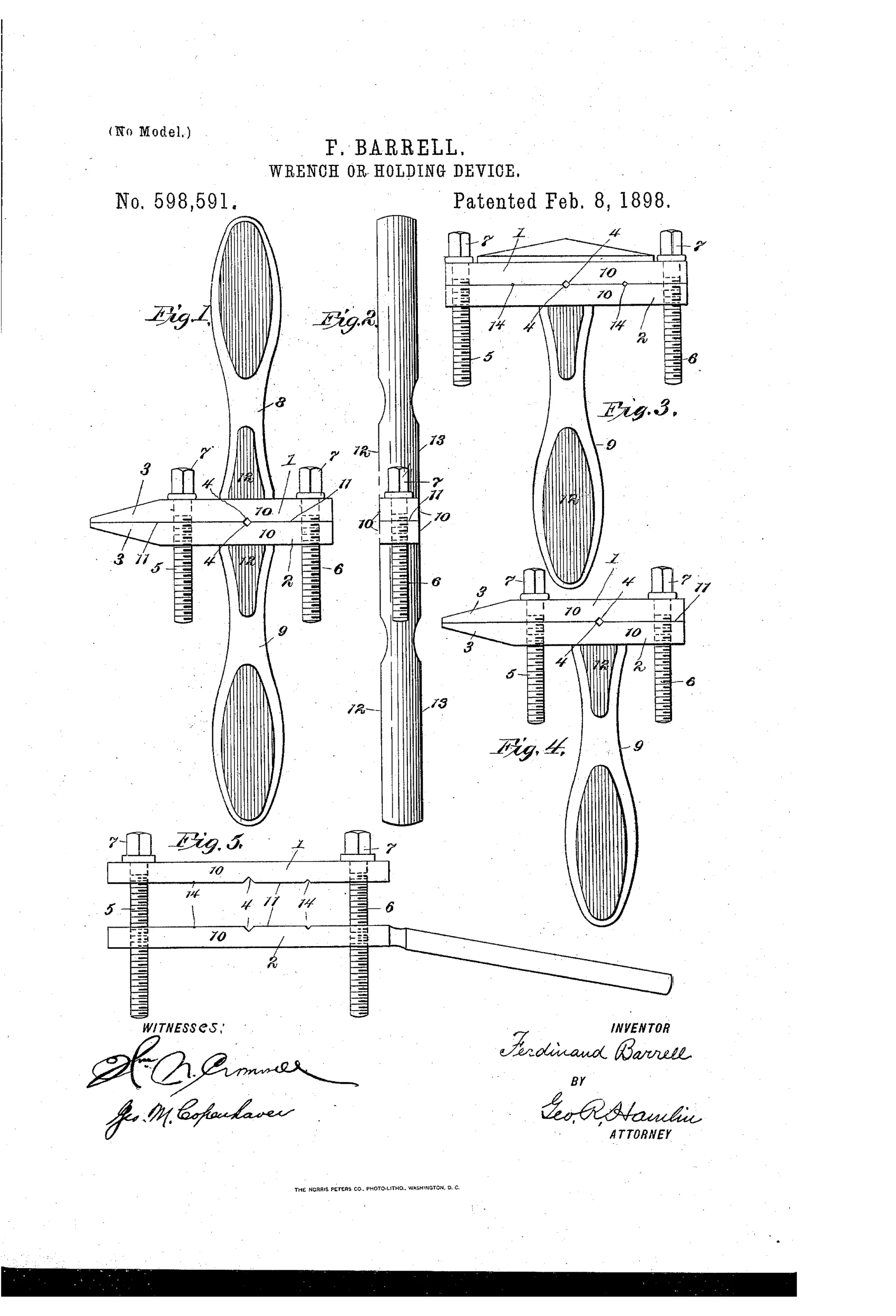
Adjustable double-jawed wrench and drill-press work-holding clamp
⚙ How it works
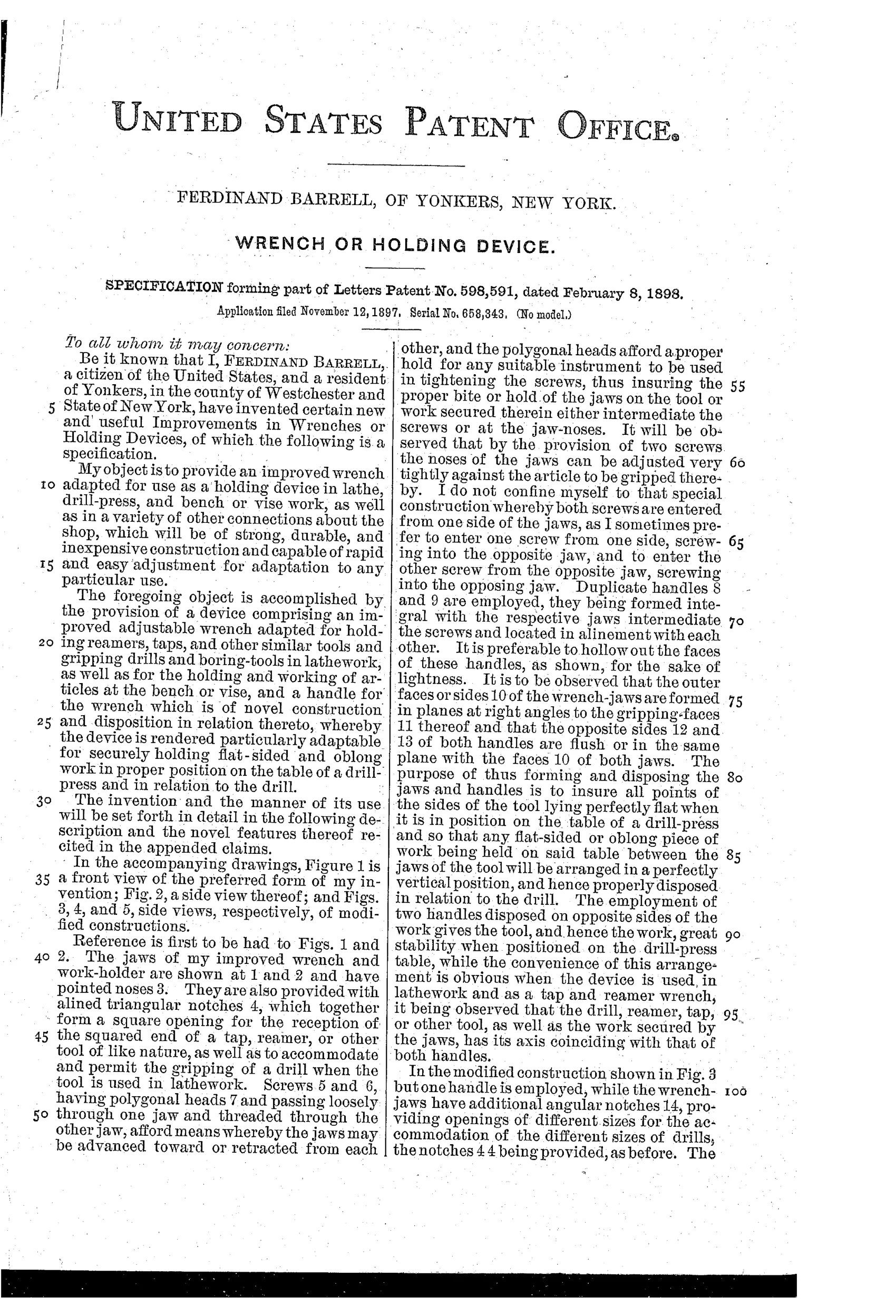
The tool has two independent wrench-jaws with pointed noses and aligned triangular notches that together form a square opening for gripping squared tool shanks or drills. Two headed adjusting-screws pass loosely through one jaw and thread into the other, allowing the jaws to be advanced toward or retracted from each other to grip work of varying size. Handles are formed integral with the jaws, disposed at right angles to them, with their side faces flush with the jaw side faces so the tool sits flat on a drill-press table. In modified forms only one handle is used, or additional angular notches accommodate different drill sizes, or the handle is inclined as a continuation of a jaw.
⚙ What was claimed
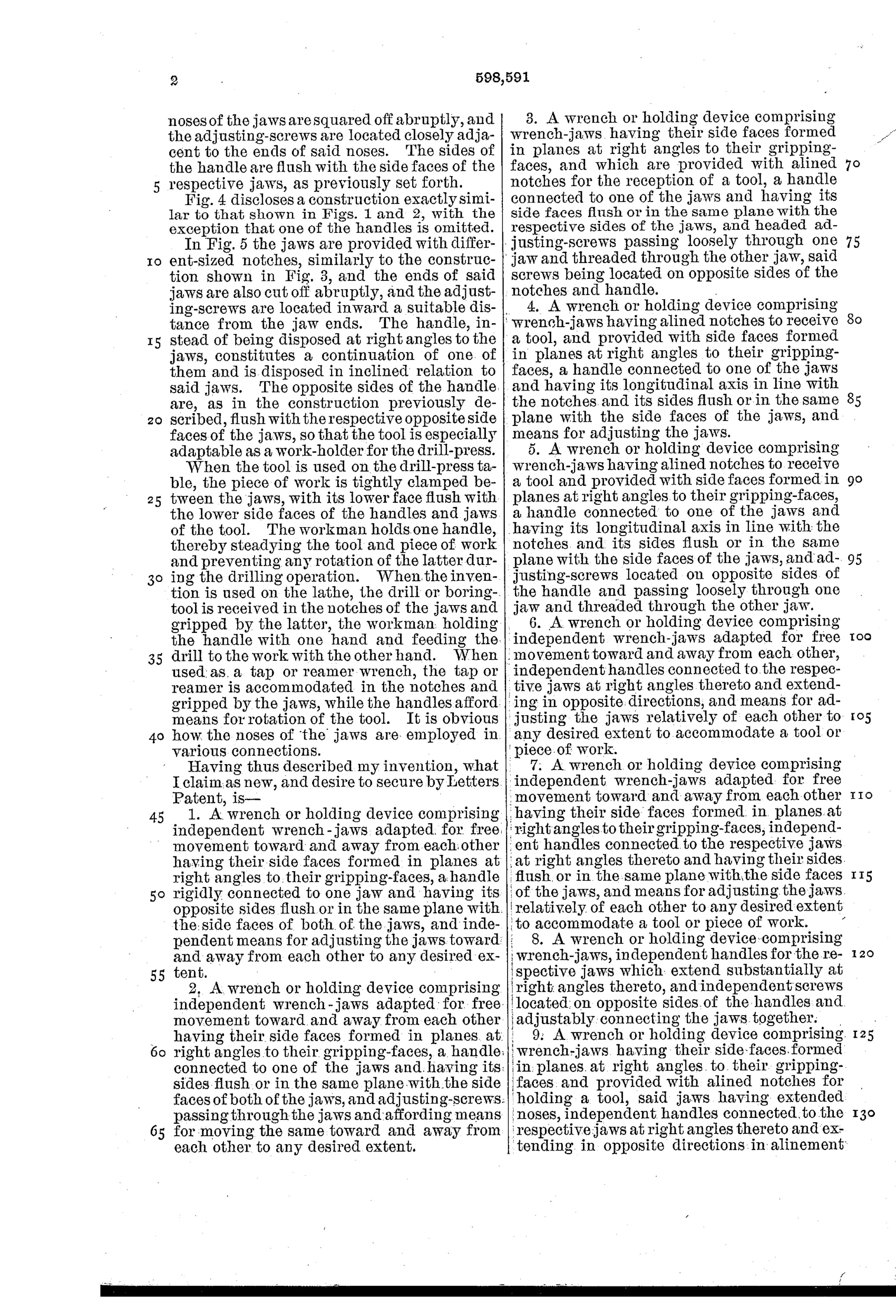
“1. A wrench or holding device comprising independent wrench-jaws adapted for free movement toward and away from each other having their side faces formed in planes at right angles to their gripping-faces, a handle rigidly connected to one jaw and having its opposite sides flush or in the same plane with the side faces of both of the jaws, and independent means for adjusting the jaws toward and away from each other to any desired extent.”
In plain English: A wrench with two jaws that can move toward or away from each other, each jaw having flat side faces at right angles to its gripping face, a rigid handle on one jaw whose sides are flush with both jaws' side faces, and separate adjusting mechanism to set the jaw spacing as needed.
⚙ In the inventor’s words
“My object is to provide an improved wrench adapted for use as a holding device in lathe, drill-press, and bench or vise work, as well as in a variety of other connections about the shop, which will be of strong, durable, and inexpensive construction and capable of rapid and easy adjustment for adaptation to any particular use.”— Ferdinand Barrell, from the specification
Fate unknown
No manufacturer or catalogued example is associated with this patent in DATAMP; a specimen marked with the February 8, 1898 date would settle it.
⚙ Commentary
Barrell's tool is really a tap wrench that has thought hard about lying down. The two independent jaws are drawn together by a pair of headed screws that pass loosely through one jaw and thread into the other — no worm, no cam, just honest clamping bolts. The triangular notches in each jaw meet to form a square opening, which is exactly what you want for the squared shank of a tap, reamer, or old-style drill. Nothing here is fast; you turn two screws to make every adjustment. But nothing here slips, either, and for tap work that trade is correct.
The detail a casual reader skips past is in the claim language about flush faces: the handles are formed with their sides in the same plane as the jaw sides, so the whole assembly sits dead flat on a drill-press table. That turns the wrench into a work-holding clamp — grip the piece, lay the tool on the table, and let a handle bear against the column or a stop to resist drilling torque. Fig. 2's side view is where that flatness reads clearly.
In the story of this category it's a sidebar rather than a chapter. The 1890s crowd was chasing one-hand quick adjustment; Barrell went the other way, toward the machinist's bench, where deliberate screw clamping and a flat back mattered more than speed. A sensible, workmanlike idea from Yonkers, competing against plenty of plain double-screw tap wrenches already in shops.
Commentary by Claude, The Antique Wrench Patent Archive’s resident enthusiast