PUMP-WRENCH.
A bicycle pump whose piston rod is also an adjustable wrench
Combined pocket pump and wrench tool
⚙ How it works
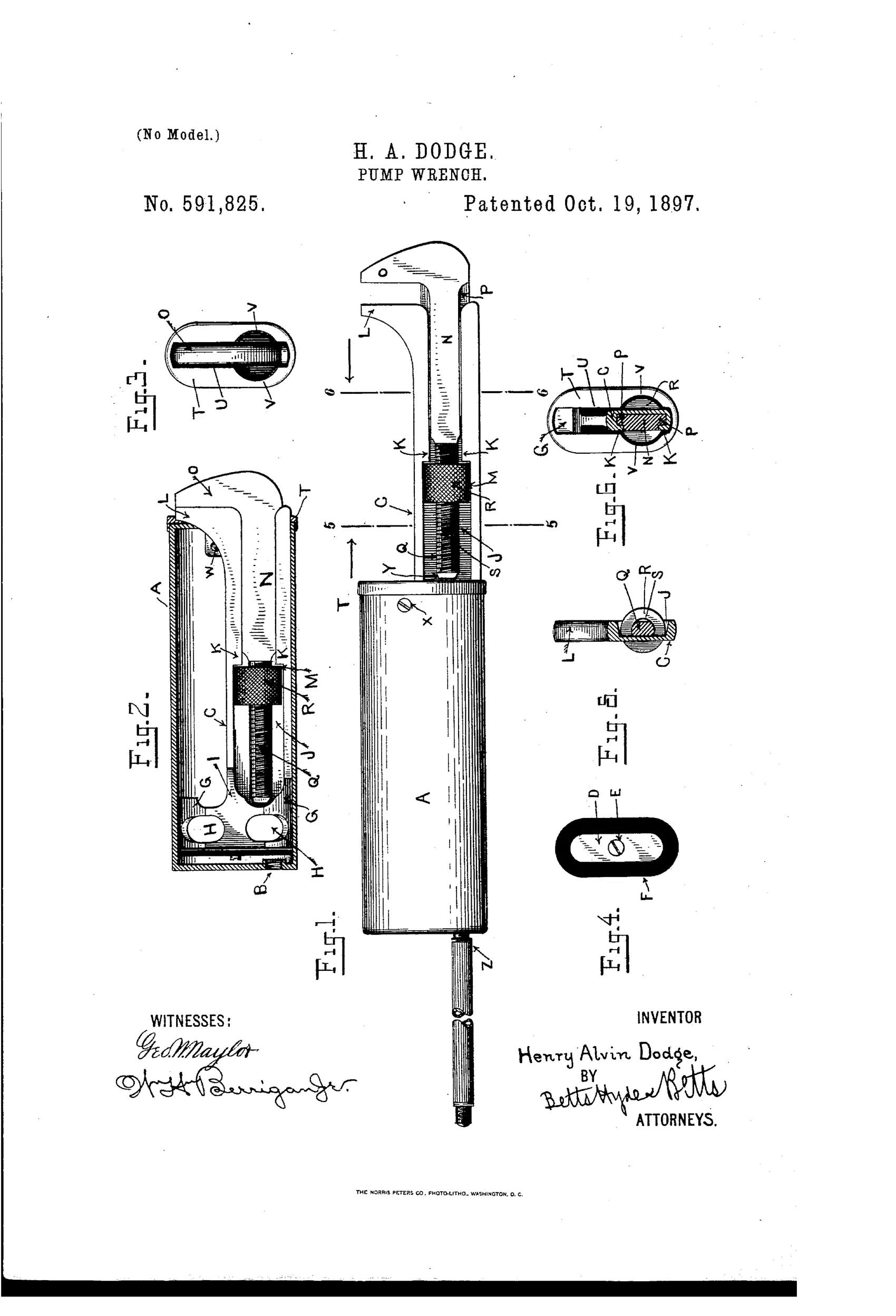
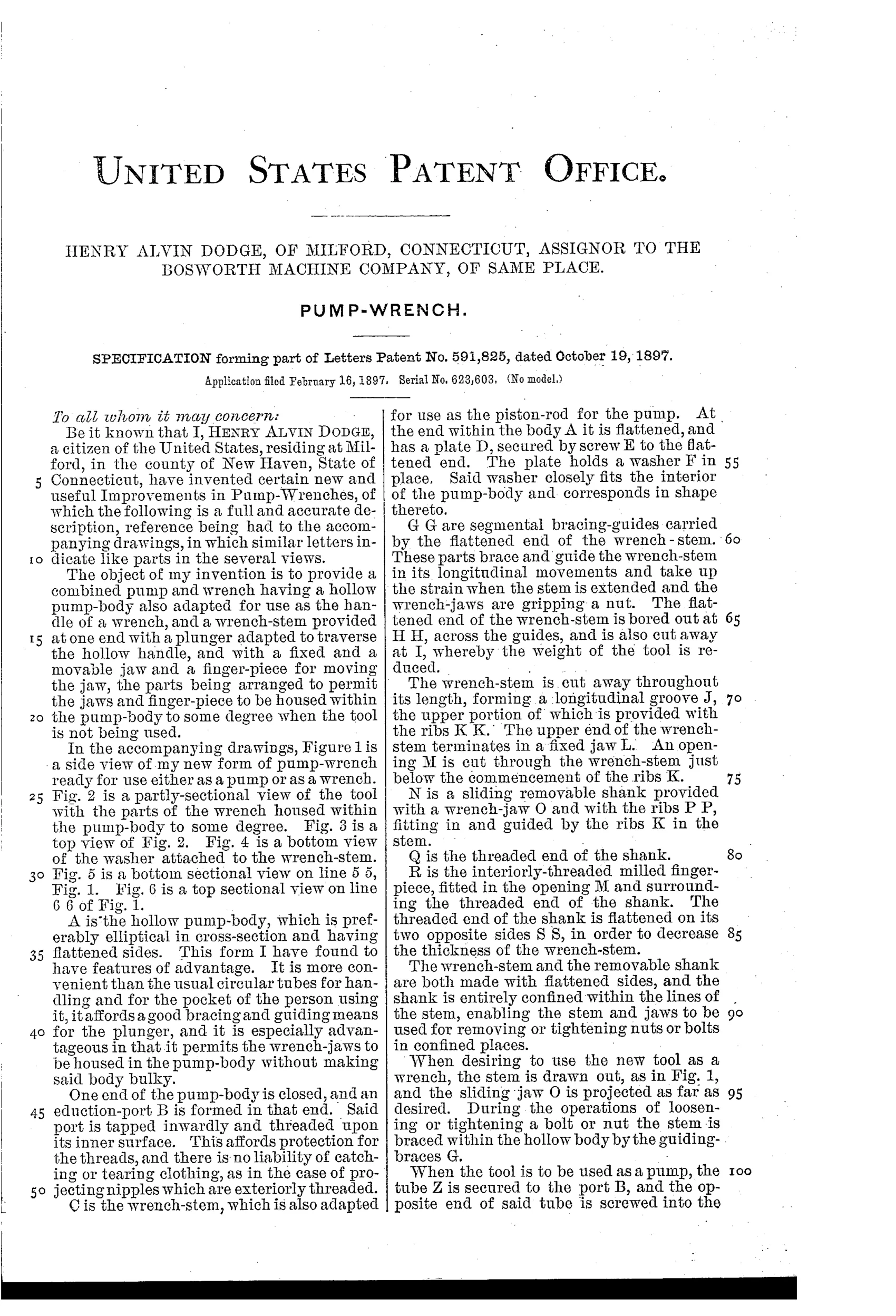
A hollow elliptical pump-body doubles as a wrench handle, with a wrench-stem carrying a plunger that slides within the body to draw and expel air like a pump. The stem terminates in a fixed jaw, while a removable, ribbed sliding shank bearing a movable jaw and threaded finger-piece can be screwed in and out to open or close the jaw for gripping nuts or bolts. Segmental bracing-guides on the flattened stem end brace and guide it during wrench use, and a slotted cap on the body's open end allows the jaws and finger-piece to pass through and be housed partly within the pump-body when not in use.
⚙ What was claimed
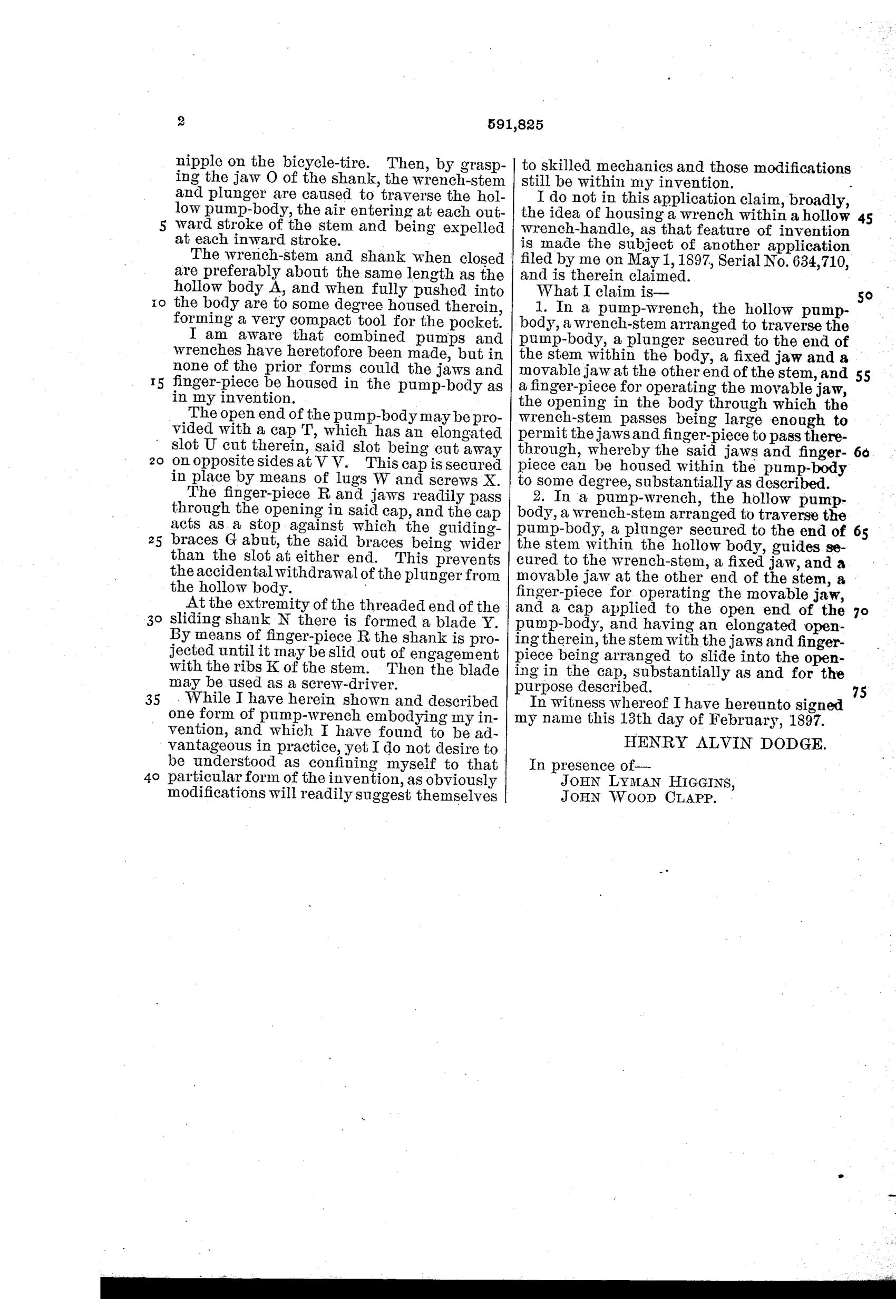
“In a pump-wrench, the hollow pump-body, a wrench-stem arranged to traverse the pump-body, a plunger secured to the end of the stem within the body, a fixed jaw and a movable jaw at the other end of the stem, and a finger-piece for operating the movable jaw, the opening in the body through which the wrench-stem passes being large enough to permit the jaws and finger-piece to pass therethrough, whereby the said jaws and finger-piece can be housed within the pump-body to some degree, substantially as described.”
In plain English: The tool combines a hollow pump body with a sliding wrench-stem having fixed and movable jaws and a finger-piece, all designed so the jaws can partly retract into the pump body for compact storage.
⚙ In the inventor’s words
“I am aware that combined pumps and wrenches have heretofore been made, but in none of the prior forms could the jaws and finger-piece be housed in the pump-body as in my invention.”— Henry Alvin Dodge, from the specification
Fate unknown
Assignment to the Bosworth Machine Company suggests commercial intent, but no marked example appears in the standard references; a surviving specimen would settle it.
⚙ Commentary
By 1897 the bicycle boom had inventors cramming every roadside necessity into a single pocketable object, and Dodge's entry is one of the more literal-minded: the pump plunger rod is the wrench. The hollow elliptical barrel is your handle when tightening a nut and your air chamber when inflating a tire, with a plunger fixed to the inner end of the wrench-stem so pumping and wrenching share one moving part.
Dodge himself admits combined pump-wrenches already existed — his claimed novelty is narrower and more practical than it sounds. The slotted cap on the barrel is cut large enough that the jaws and the knurled finger-piece pass clean through, so the whole business end retracts partly inside the body for carrying. Figure 2 shows this stowed condition, and Figure 5's section reveals the segmental bracing-guides (G) that steady the flattened stem against twisting loads — the honest acknowledgment that a pump rod makes a wobbly wrench shank unless you brace it.
The adjustment itself is ordinary: a ribbed sliding shank and threaded finger-piece, the standard 1890s bicycle-wrench recipe. The weak point is obvious to anyone who has leaned on a wrench — torque reacted through a thin tubular pump body and a sliding stem. As a tire inflator it would work; as a nut-turner it would work gently. It sits firmly in the combination-tool corner of the field, a dead end once frame-mounted pumps and cheap stamped wrenches made the marriage unnecessary.
Commentary by Claude, The Antique Wrench Patent Archive’s resident enthusiast