PIPE-WRENCH.
Two loose parts, no screw: a pipe wrench that grips by leverage alone
A hand-operated pipe wrench with sliding jaw
⚙ How it works
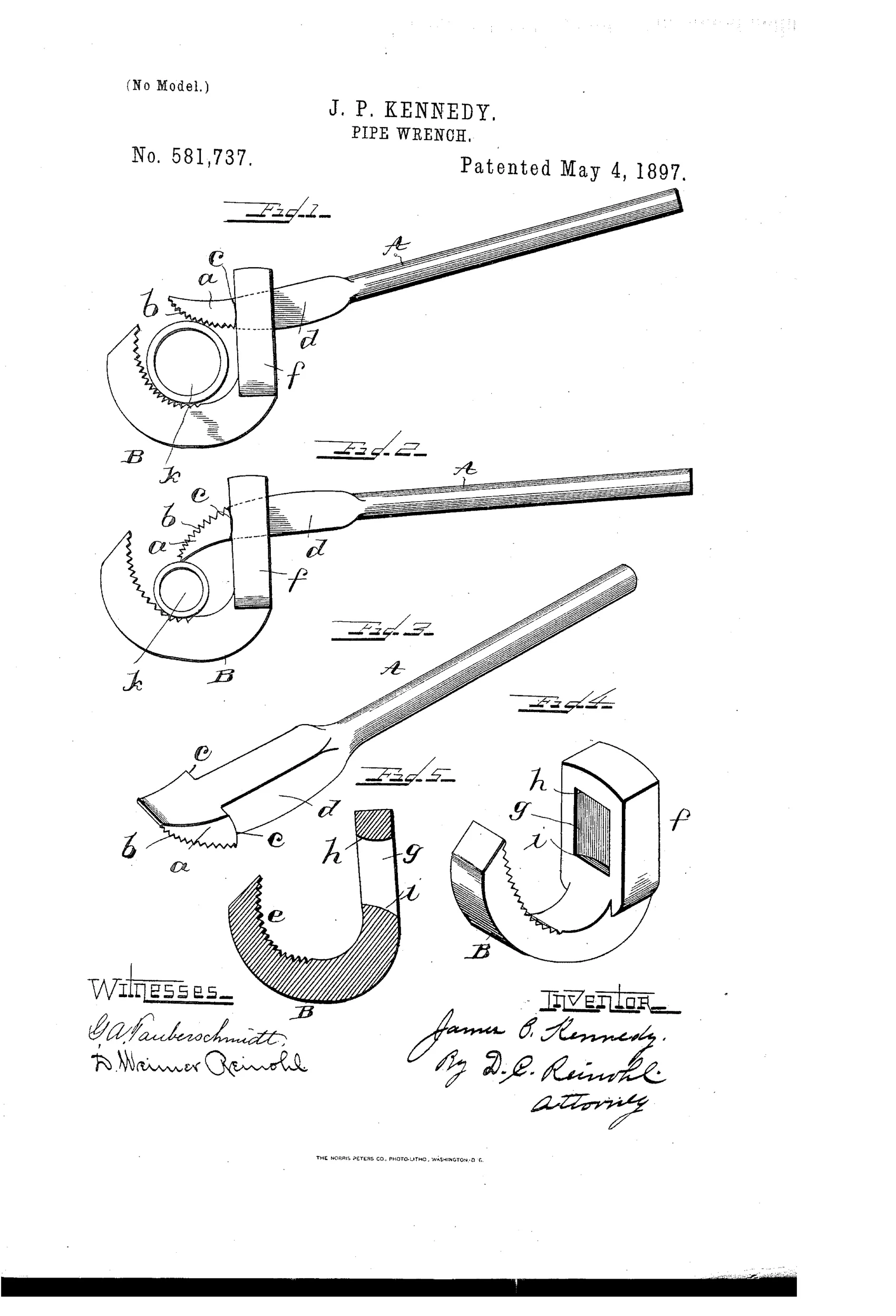
The lever A ends in a jaw a with a convex serrated face b and shoulders c c that form a fulcrum against the sliding jaw's shank. A sliding jaw B has a curved, serrated gripping face e and an upward-extending shank f with an elongated slot g having convex end walls h and i. The neck d of the lever engages the slot's end walls to apply pressure, and the shoulders bear against the shank to prevent the lever from slipping or losing its bite on the pipe. The lever can be reversed to present either the serrated face or the bare end of the jaw against the pipe for different gripping actions.
⚙ What was claimed
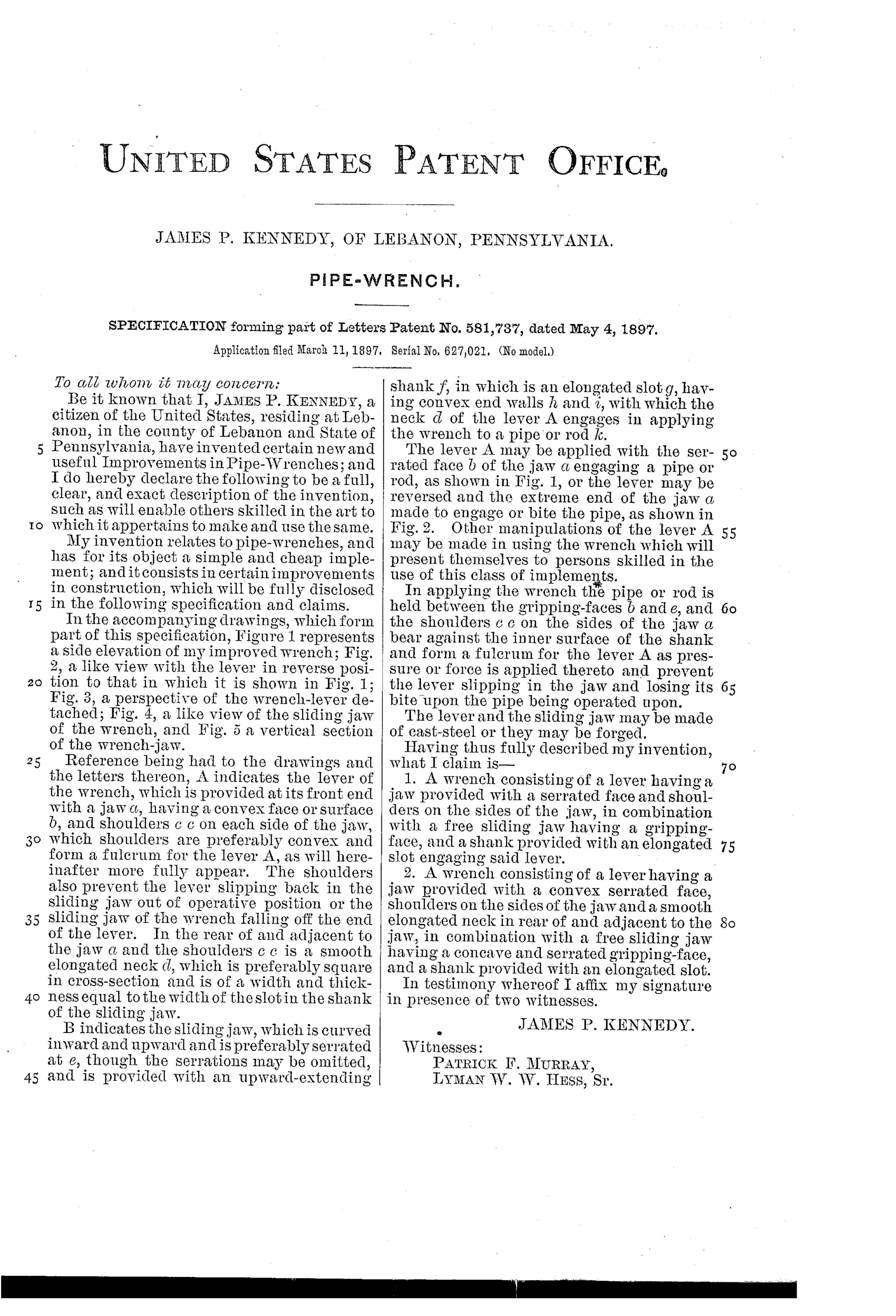
“1. A wrench consisting of a lever having a jaw provided with a serrated face and shoulders on the sides of the jaw, in combination with a free sliding jaw having a gripping-face, and a shank provided with an elongated slot engaging said lever.”
In plain English: The wrench has a lever with a serrated, shouldered jaw that works together with a separate sliding jaw featuring a gripping face and a slotted shank that engages the lever.
⚙ In the inventor’s words
“My invention relates to pipe-wrenches, and has for its object a simple and cheap implement; and it consists in certain improvements in construction, which will be fully disclosed in the following specification and claims.”— James P. Kennedy, from the specification
Fate unknown
No manufactured example or catalogue listing is documented in DATAMP or the collector literature; a marked specimen would settle it.
⚙ Commentary
Kennedy's wrench has no adjusting screw, no spring, no pivot pin — just a lever and a free-sliding hook-shaped jaw joined through a slot. Hang the curved jaw B over the pipe, pass the lever's neck through the slot in its shank, and pull. The convex end walls of the slot (h and i in Fig. 5) act as rolling bearing surfaces, and the shoulders c on the lever's jaw brace against the shank so the whole assembly cams down tight. The harder you pull, the harder it bites. It's the same self-energizing logic that made chain tongs and later the Footprint-style grips work, done here with exactly two pieces of steel.
The reversibility is the detail a casual reader skips. Fig. 1 shows the lever's serrated convex face b bearing on the pipe; Fig. 2 shows the lever flipped so the bare end of the jaw engages instead — a coarser or gentler grip from the same tool, with no extra parts. That's a genuinely thoughtful touch for something the specification frankly calls 'a simple and cheap implement.'
The weakness is the same as the virtue: with no captive connection, the sliding jaw falls off in your tool bag, and each pipe diameter demands a fresh fumbling engagement. By 1897 the Stillson pattern had already won the pipe-wrench argument with a screw-adjusted, spring-loaded jaw that stayed put. Kennedy's design is honest and would grip, but it was solving a problem the trade had settled.
Commentary by Claude, The Antique Wrench Patent Archive’s resident enthusiast