HOSE-STRAP AND SPANNER.
A fireman's spanner that folds its own hose-hanging strap into the handle
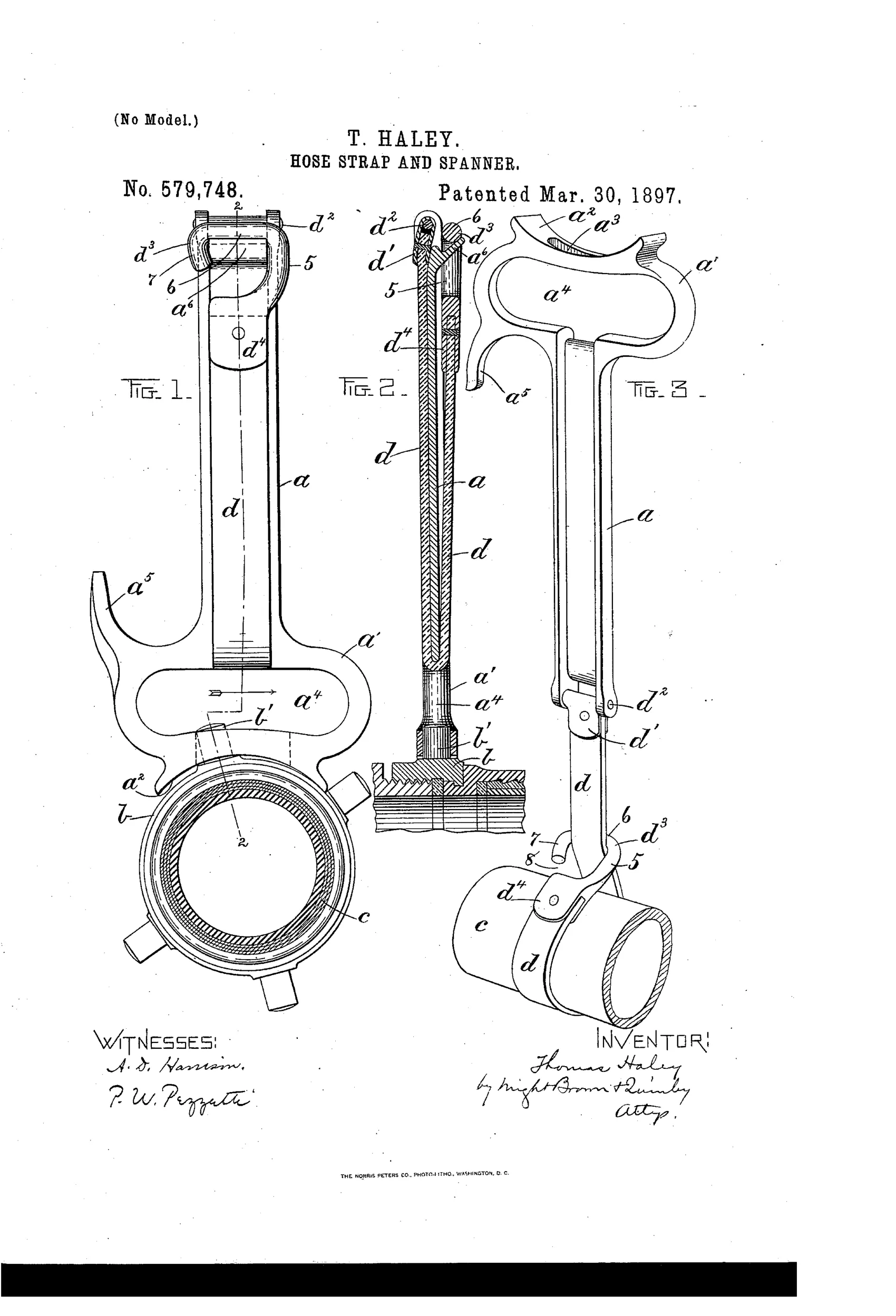
Combined firemen's hose strap and spanner tool
⚙ How it works
A metal shank has a hollow, hooked spanner-head at one end for turning hose-coupling members and for hanging on a ladder rung. A flexible strap is pivoted near the other end of the shank and carries a hook with a cross-bar and arm that can engage an ear on the shank to hold the strap folded against it for use as a spanner. When suspension is needed, the hook is instead engaged with a portion of the strap itself to form a loop or bight around the hose, allowing the tool to hang the hose from an elevated support.
⚙ What was claimed
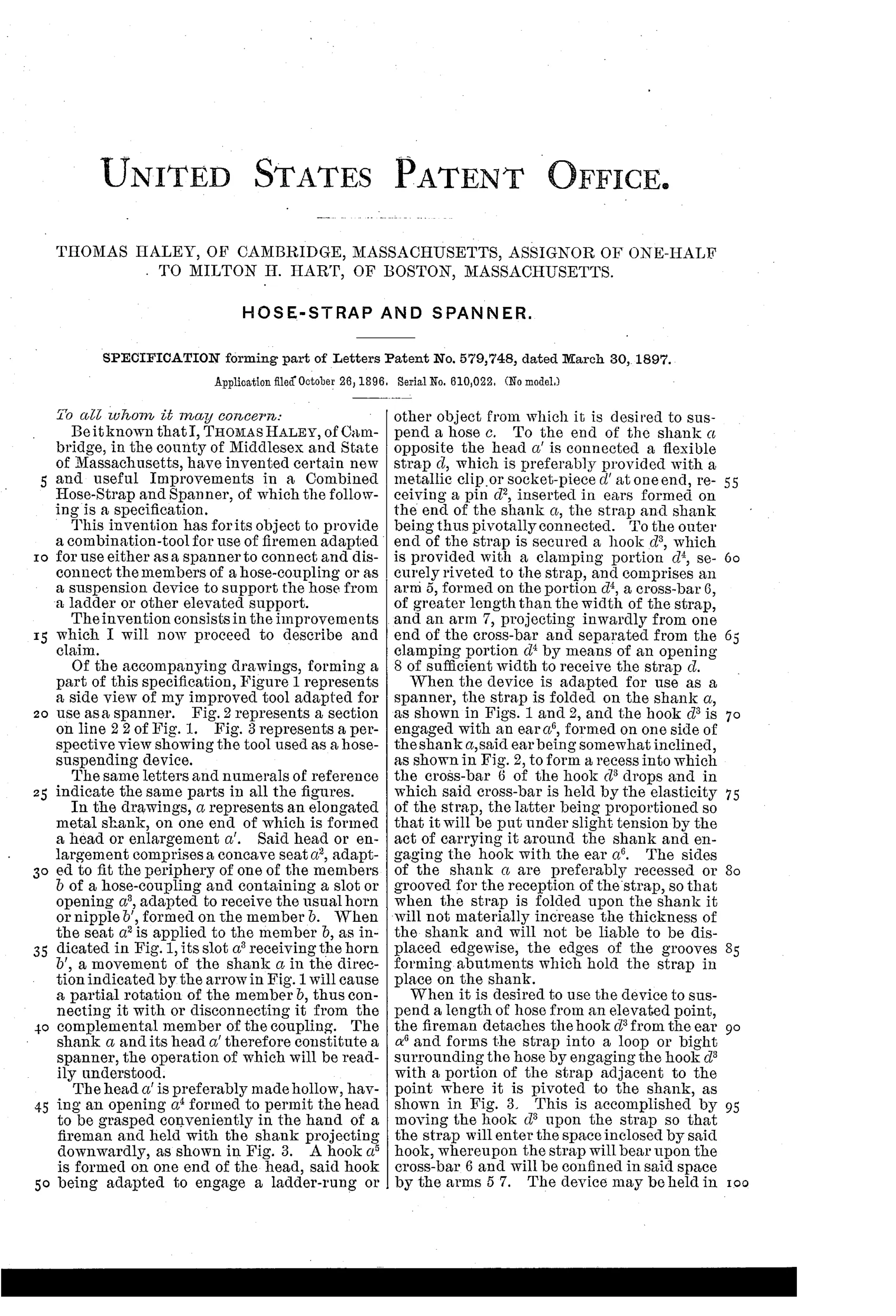
“A tool of the character specified, comprising a shank having at one end a spanner-head formed also as a handle, and a hook adapted to engage a support, and at the other end an ear or detent; and a flexible strap secured to the shank near said detent and provided at its free end with a bight-forming hook or eye adapted also to engage the detent, the sides of the shank being recessed to receive the strap when the latter is folded and engaged with the detent.”
In plain English: The tool is a shank with a handle-shaped spanner head and support hook on one end, a detent on the other end, and a strap with a hook that can either fold flat against the recessed shank or loop into a bight to hang hose.
⚙ In the inventor’s words
“This invention has for its object to provide a combination-tool for use of firemen adapted for use either as a spanner to connect and disconnect the members of a hose-coupling or as a suspension device to support the hose from a ladder or other elevated support.”— Thomas Haley, from the specification
Fate unknown
Combined hose strap-and-spanner tools were common fire equipment, but no example marked to Haley's patent is documented; a marked specimen or a fire-supply catalog listing would settle it. Fig. 3 is the drawing's payoff: the tool hanging vertically, strap looped around the hose, head hooked over an unseen support. The half-interest assignment to Milton Hart of Boston suggests real intent to commercialize — Boston-area fire departments were a plausible market, and hose straps and spanners were standard-issue kit sold by every fire-supply house of the 1890s. As a wrench, it's simple: a fixed hooked head sized to hose-coupling lugs, no adjustment at all. That's honest for the job, since fire couplings were increasingly standardized. The mechanical risk is the pivot and detent — a strap that shakes loose while you're wrenching would be an annoyance, and Haley's recessed sides show he thought about that. A workmanlike combination tool, and one of the more genuinely useful pairings the combination-tool craze produced, per DATAMP's record of the patent.
⚙ Commentary
Most wrenches in this era chase adjustability. Haley is chasing something different: pocket count. A fireman climbing a ladder with a charged line needs a spanner to break couplings and a strap to hang the hose off a rung so its weight doesn't drag him down. Haley puts both in one shank, and the trick worth noticing is the detent-and-recess arrangement — the strap's hook can grab an ear on the shank so the strap lies flat in side recesses, making the tool feel like a solid one-piece spanner in the hand. Unhook it, catch the strap's own body instead, and you've formed a bight around the hose, with the spanner head's hook doubling as the ladder catch.
Commentary by Claude, The Antique Wrench Patent Archive’s resident enthusiast