PIPE-WRENCH.
A pipe wrench whose chain is a string of geared, ratchet-toothed jaws
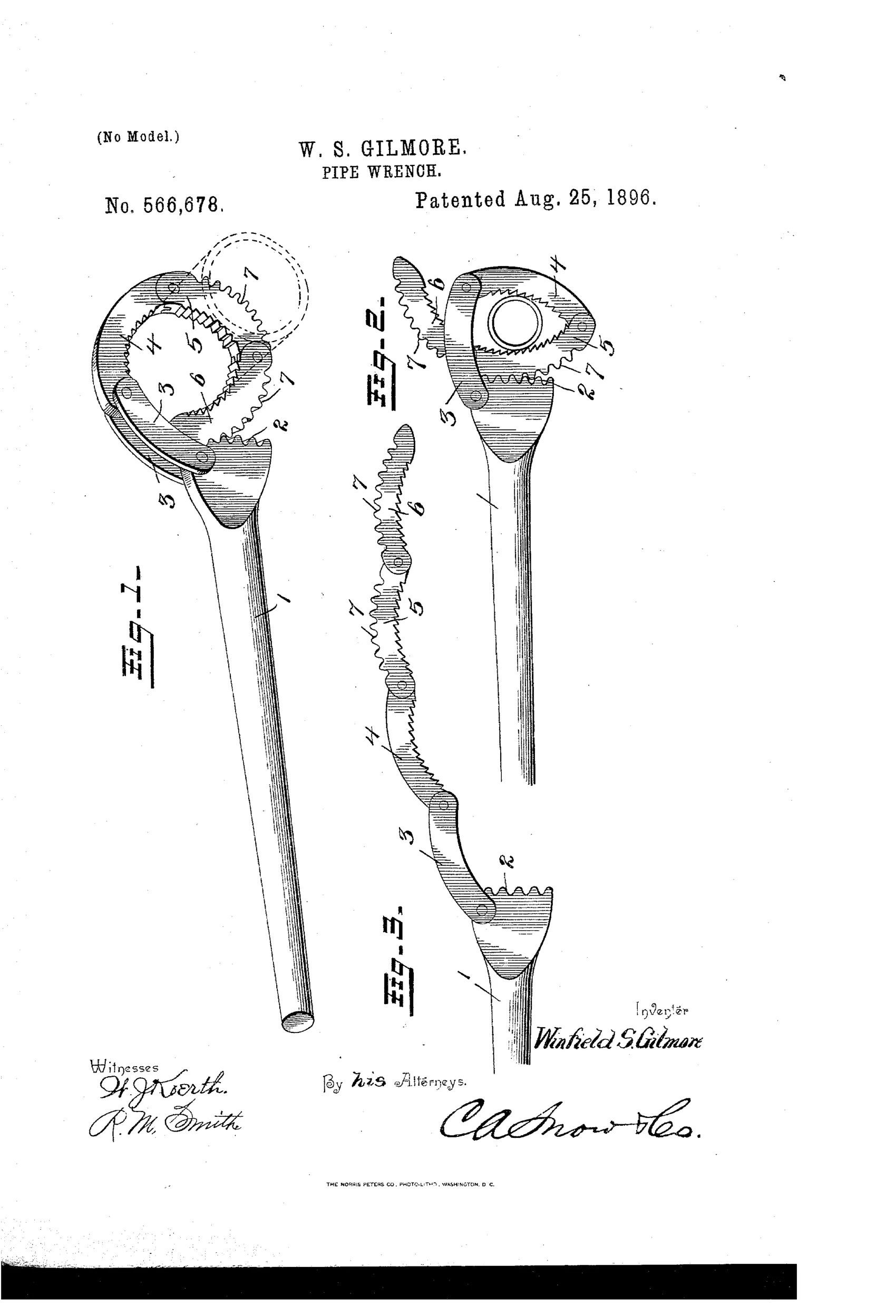
Chain-type pipe wrench with ratcheting segmental links
⚙ How it works
A hand-lever handle has a beveled, expanded head with a straight row of cogs across its outer edge. Twin segmental link-plates pivot from one corner of the head and connect a chain of curved segmental links, each having ratchet-teeth on the inner face and, on some links, cogs on the outer face. The links fold around a pipe and the terminal link is inserted between the twin plates; vibrating the handle engages the head's cogs with the outer cogs of the links, drawing the ratchet-teeth on the inner faces tightly against the pipe. Because the links can pass between the twin plates, the same chain adapts to pipes of widely different diameters.
⚙ What was claimed
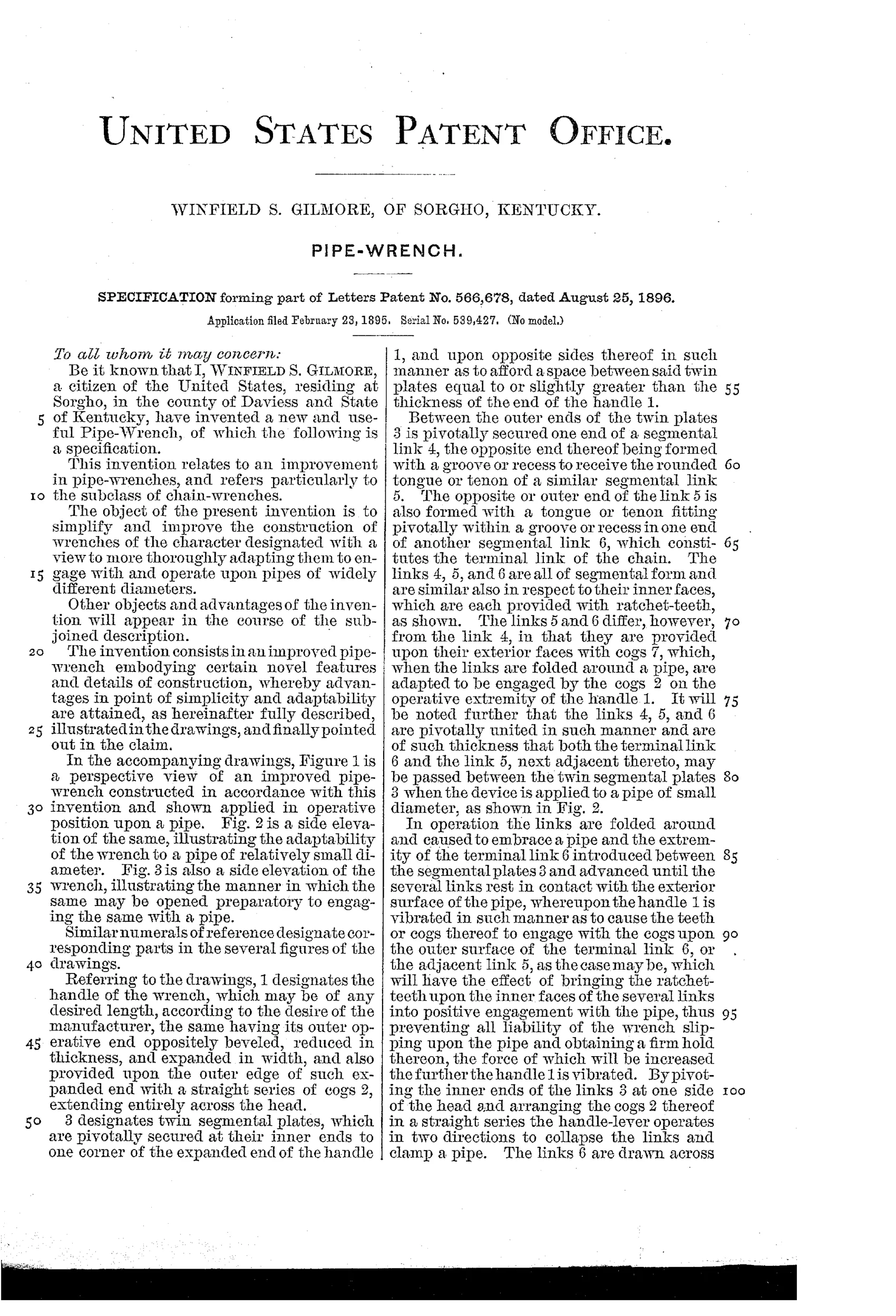
“A pipe-wrench comprising a hand-lever having a head beveled at opposite sides and provided with a straight outer transverse edge having a series of cogs or teeth extending entirely across the head, a pair of curved link-plates 3 having smooth inner and outer edges arranged parallel with each other and pivoted at their inner ends to the said head at one end of a series of teeth, a curved link 4 having a smooth outer edge and provided at its inner edge with ratchet-teeth and pivoted at one end between the outer ends of the link-plates 3, and a series of curved links 6, pivotally connected together and with the link 4 provided at their inner edges with ratchet-teeth and having at their outer edges cogs or teeth to mesh with the cogs or teeth of the head, the latter being capable of drawing the links 6 across it and of forcing them outward from the pivot of the head, substantially as and for the purpose described.”
In plain English: The wrench uses a toothed lever head, a pair of smooth pivoting link-plates, and a chain of ratchet-toothed curved links that mesh with the head's cogs so the handle can draw and force the chain tight around a pipe of any size.
⚙ In the inventor’s words
“The object of the present invention is to simplify and improve the construction of wrenches of the character designated with a view to more thoroughly adapting them to engage with and operate upon pipes of widely different diameters.”— Winfield S. Gilmore, from the specification
Fate unknown
No catalogued or surviving example is documented at DATAMP or elsewhere; a marked specimen would settle it, though the machining cost argues against production.
⚙ Commentary
Chain pipe wrenches were already a known idea by 1896 — wrap a chain around the pipe, hook it, lever it over. Gilmore's twist from Sorgho, Kentucky is that his chain isn't passive. Each curved link carries ratchet teeth on its inner face to bite the pipe, and several links carry cogs on their outer face that mesh with a straight row of teeth across the lever head. Rocking the handle doesn't just pry against the chain; it actively gears the links across the head, drawing the whole loop tighter. The chain is effectively a flexible rack, and the handle is the pinion.
Figures 2 and 3 show the payoff a casual reader might miss: the terminal links pass between the twin pivoted link-plates rather than hooking to a fixed anchor, so the same chain closes down to a small pipe or opens wide for a large one with no pins to relocate. That's the whole game in this corner of the field — self-adjusting grip over a wide diameter range.
The dubious part is manufacturing. Every link needs machined cogs matched to the head's pitch, and grit or wear in any one link degrades the mesh. A plain chain with a cam anchor does most of the same work for a fraction of the cost, which is roughly the direction the trade actually went. Ingenious, but expensive ingenuity.
Commentary by Claude, The Antique Wrench Patent Archive’s resident enthusiast