COMBINED PIPE AND NUT WRENCH.
A toggle-joint wrench from Missouri that grips harder the more you pull
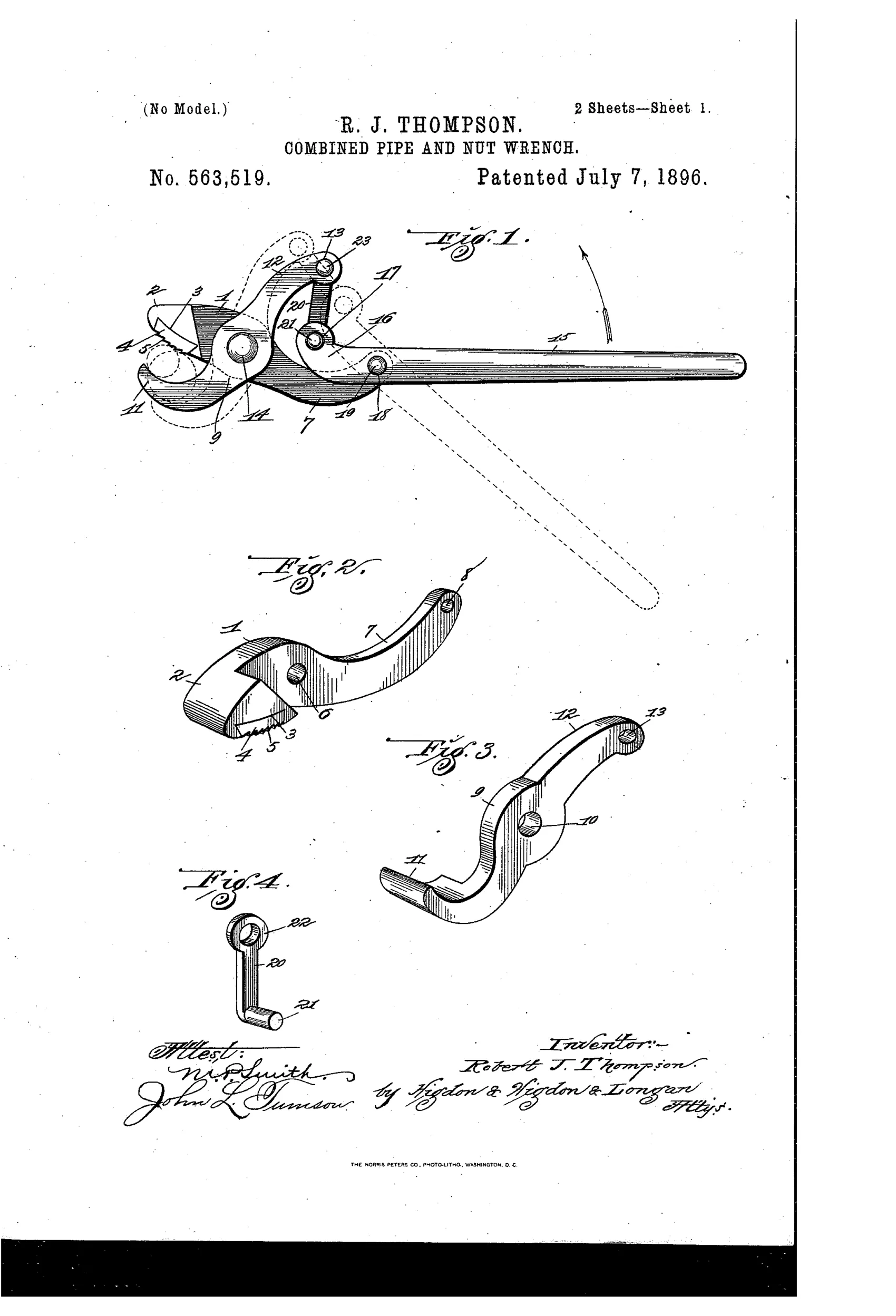
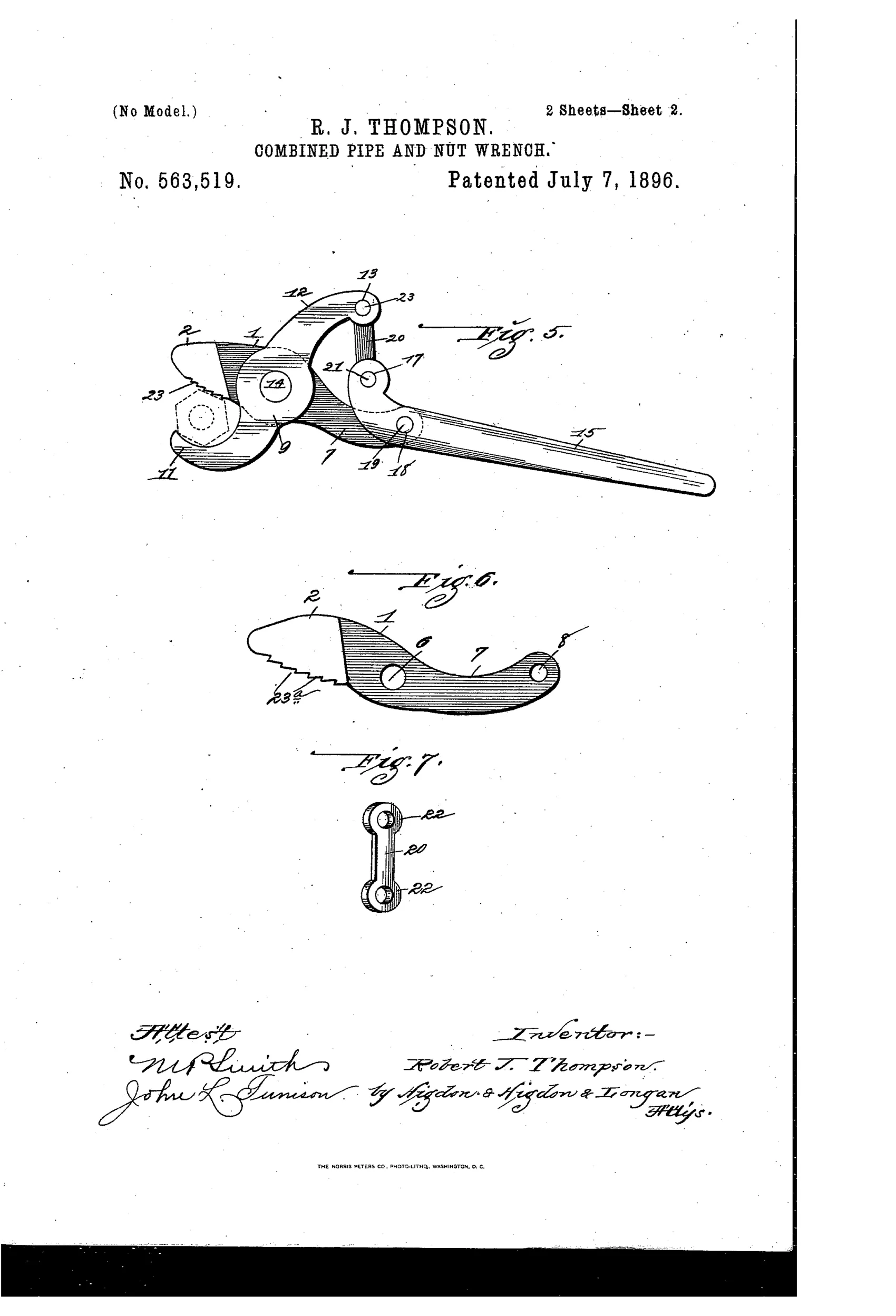
Self-adjusting toggle-action combined pipe and nut wrench
⚙ How it works
The wrench has two hinged jaws pivoted together by a bolt, one jaw with a smooth curved gripping face and the other fitted with a removable corrugated or toothed face-plate. A handle is pivoted to the rear arm of the toothed jaw and connected by a link and pin to the rear arm of the curved jaw, forming a toggle joint. Moving the handle upward straightens or bends the toggle, drawing the rear ends of the jaws together or apart, which correspondingly closes or opens the forward gripping ends onto a pipe, round shaft, or square, six-, or eight-cornered nut. Because the jaws close by bending the toggle rather than straightening it, the force applied to the handle is greatly multiplied at the gripping faces, and the pinching force itself helps rotate the work.
⚙ What was claimed
“In a combined pipe and nut wrench, the jaw 1 having the arm 7 and the corrugated removable face-plate 4, in combination with the smooth curved jaw 11 having the arm 12, the bolt 14 pivoting the jaws together, the lever 15 and 16, the bolt 19, connecting the lever to the corrugated jaw, the link 20 having the pin 21 for insertion in the aperture 17, and the bolt 23 connecting the link 20 to the arm of the curved jaw, thus forming a toggle between the rear end of the said arm, the bending of which operates the jaws of the wrench.”
In plain English: The wrench combines a toothed jaw with a replaceable corrugated face-plate and a smooth curved jaw, both pivoted together and linked to a handle through a toggle mechanism so that bending the toggle closes and opens the jaws.
⚙ In the inventor’s words
“The larger the nut or pipe the greater the angle of the lines of force.”— Robert James Thompson, from the specification
Fate unknown
No manufactured example of this Grandin, Missouri design is documented in DATAMP or collector literature; a marked specimen would settle it.
⚙ Commentary
Thompson's idea is the pliers-wrench in embryo: two jaws pivoted together, with the handle acting not directly on either jaw but through a toggle link connecting their rear arms. Pull the handle and the toggle bends, drawing the rear ends together and clamping the front ends onto the work. It's self-energizing — the same pull that turns the pipe is the pull that tightens the grip — which is exactly the property every pipe wrench inventor of the 1890s was chasing, usually with spring-loaded pawls or eccentric cams. Thompson gets it with three pins and a link.
Look at Fig. 1 closely and you'll see the dotted handle swung far away from the jaws: that's the tell. To open the jaws for a large pipe, the handle has to travel through a huge arc, and the link pin (21) apparently has to be repositioned in aperture 17 to change capacity ranges. So the 'self-adjusting' claim comes with a manual coarse adjustment hiding inside it. The removable corrugated face-plate is a sensible touch — toothed jaws wear, and Thompson planned for it.
His best line — 'the larger the nut or pipe the greater the angle of the lines of force' — shows he understood toggle geometry, not just borrowed it. As a design it sits in the crowd of clever unproduced 1890s grip-wrenches, a mechanically honest dead end that later plier-wrenches would vindicate.
Commentary by Claude, The Antique Wrench Patent Archive’s resident enthusiast