WRENCH.
Squeeze-to-grip lever wrench with offset jaws, built to reach under rail flanges
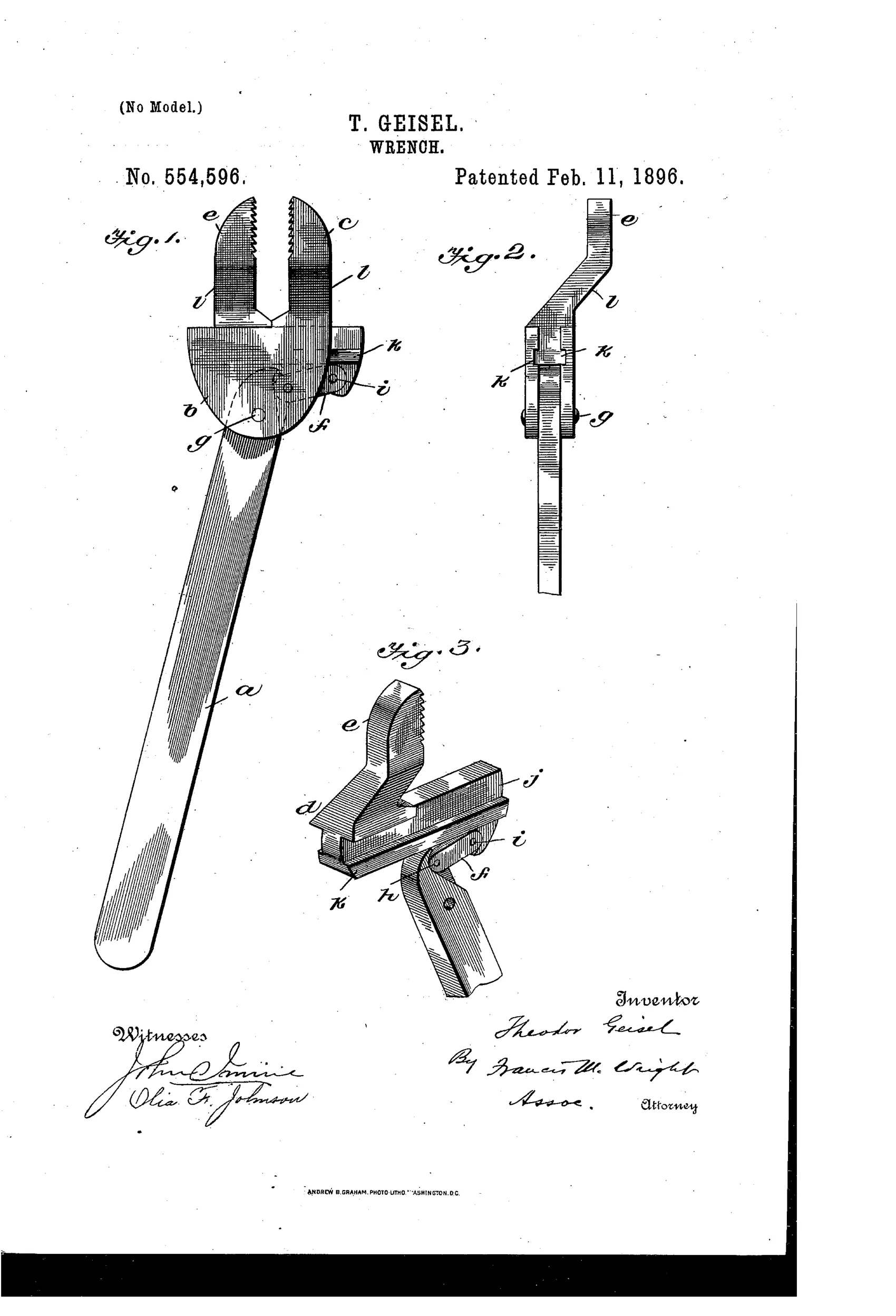
Self-gripping automatic wrench with offset jaws
⚙ How it works
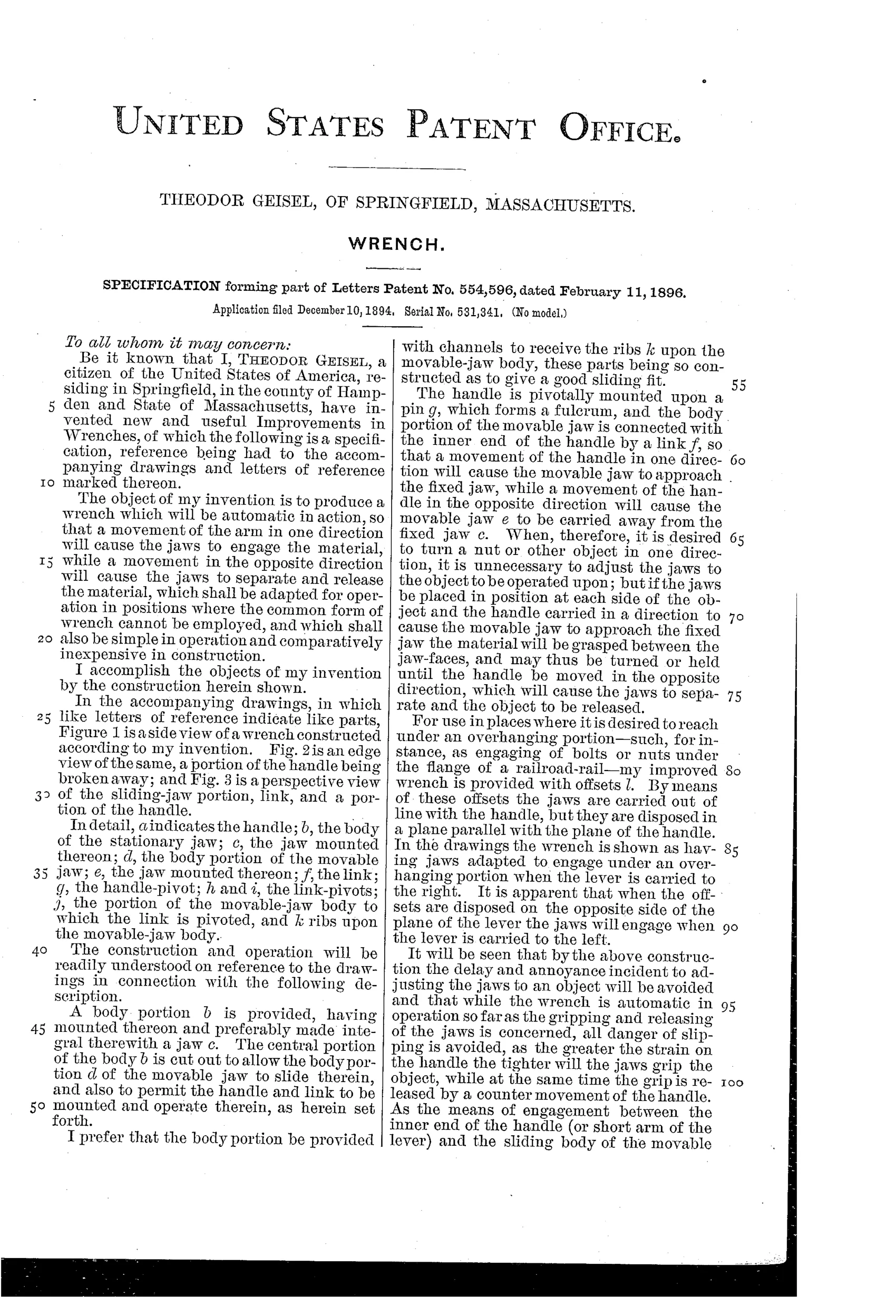
A stationary jaw body carries a sliding movable-jaw body that moves in and out via a pivoting handle linked through a connecting rod. Moving the handle one way closes the jaws to grip an object; moving it the other way opens them to release it. Ribs on the movable jaw body slide within channels in the stationary body for a smooth fit. The jaws are offset out of line with the handle but kept parallel to its plane, letting the wrench reach under overhanging flanges, such as under a railroad-rail.
⚙ What was claimed
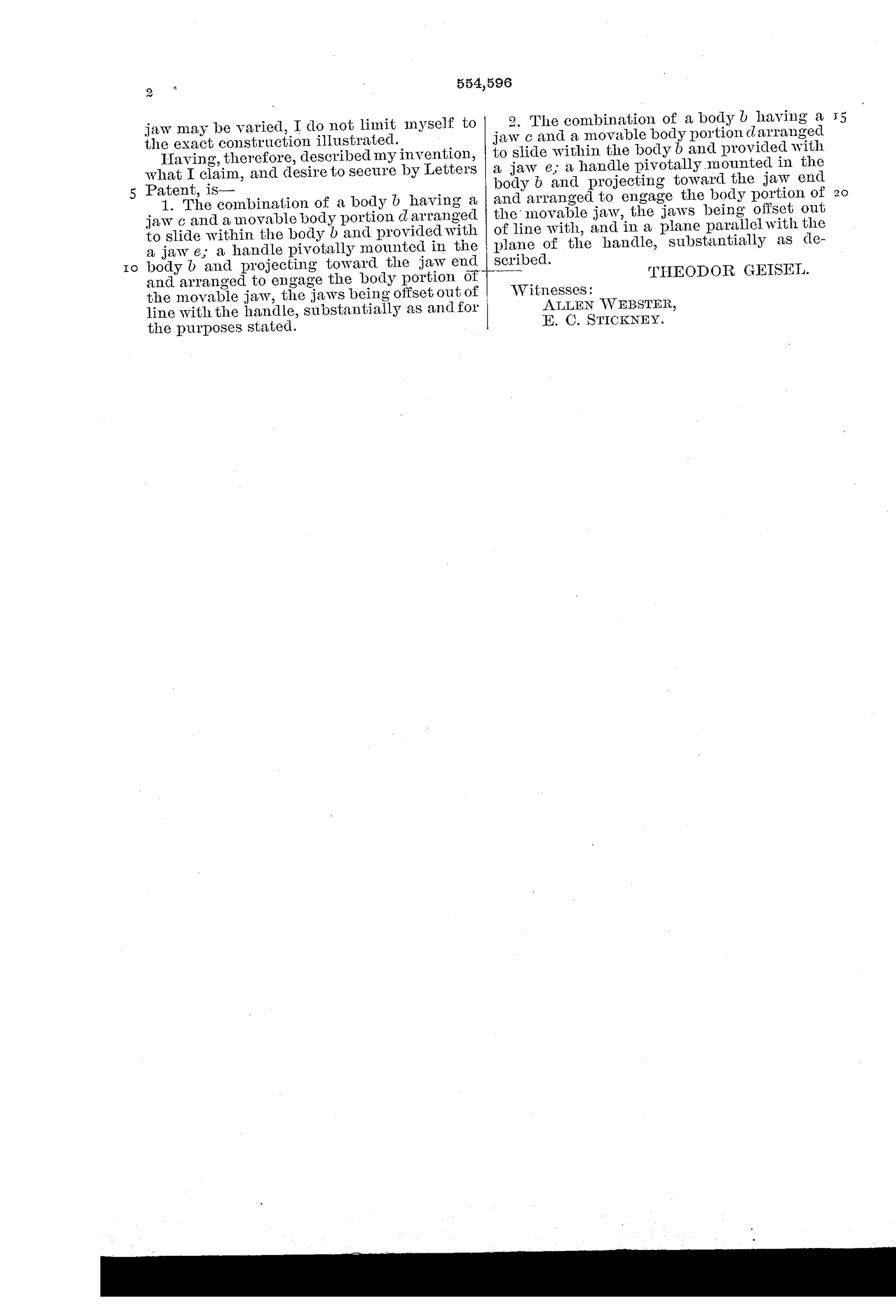
“The combination of a body b having a jaw c and a movable body portion d arranged to slide within the body b and provided with a jaw e; a handle pivotally mounted in the body b and projecting toward the jaw end and arranged to engage the body portion of the movable jaw, the jaws being offset out of line with the handle, substantially as and for the purposes stated.”
In plain English: The wrench combines a fixed jaw body with a sliding movable jaw operated by a pivoting handle, with both jaws offset from the handle's line to reach into tight or overhanging spots.
⚙ In the inventor’s words
“The object of my invention is to produce a wrench which will be automatic in action, so that a movement of the arm in one direction will cause the jaws to engage the material, while a movement in the opposite direction will cause the jaws to separate and release the material.”— Theodor Geisel, from the specification
Fate unknown
No manufactured example of this design is catalogued to my knowledge; a marked specimen or a period hardware listing would settle it.
⚙ Commentary
Geisel's wrench belongs to the self-gripping branch of the family — the tools that traded the screw and knurl of the Coes pattern for pure leverage. The handle pivots in the fixed body and drives the sliding jaw through a short connecting rod: pull one way and the toothed jaws bite down proportionally to your effort; push the other way and they release. It is essentially a one-hand ratcheting grip without a ratchet, closer in spirit to the alligator and pipe-tong tribe than to a nut wrench, since the grip depends on continuous handle pressure.
The detail worth pausing on is the offset. Both jaws are cranked out of line with the handle but kept parallel to its plane — Fig. 2 shows the dogleg clearly. That is a deliberate concession to track work: you can hook the jaws under a railroad-rail flange or an overhanging edge while your hand and the long handle swing clear. The ribs-in-channels guide on the sliding body, drawn carefully in Fig. 3, shows the inventor thinking about slop, which is where lever-grip wrenches usually die.
The weakness is inherent to the type: toothed jaws that grip only while you pull will chew a hex nut's corners, so this is really a pipe-and-rail tool. As such it is a competent, honest entry in the 1890s quick-grip crowd. Collectors will also note the name — a Theodor Geisel of Springfield, Massachusetts, a coincidence Dr. Seuss fans enjoy pointing out. DATAMP is the place to check the record.
Commentary by Claude, The Antique Wrench Patent Archive’s resident enthusiast