WRENCH.
A Kansas farmer's answer to the Stillson: swinging jaw, toothed pawl, one screw
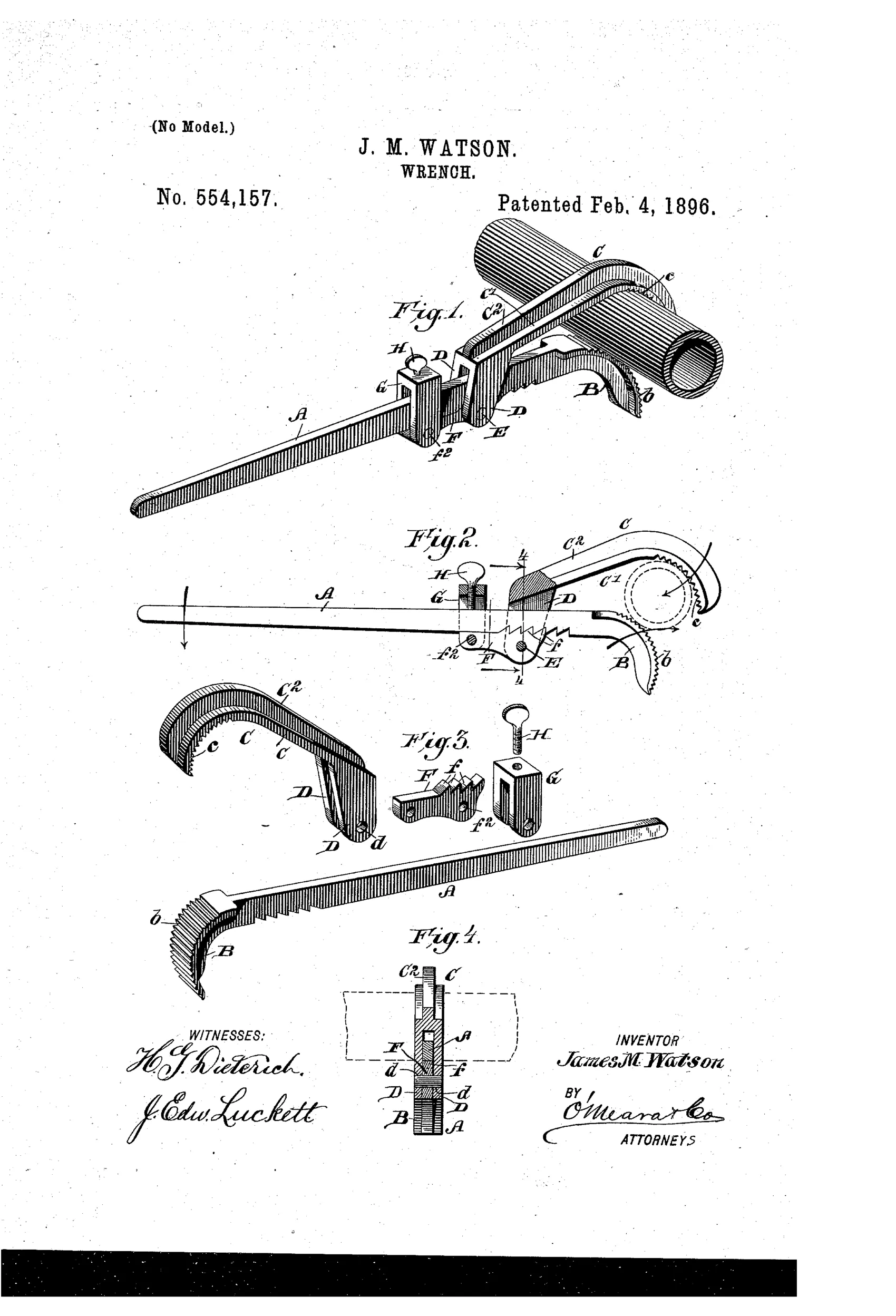
Self-adjusting pipe and nut wrench
⚙ How it works
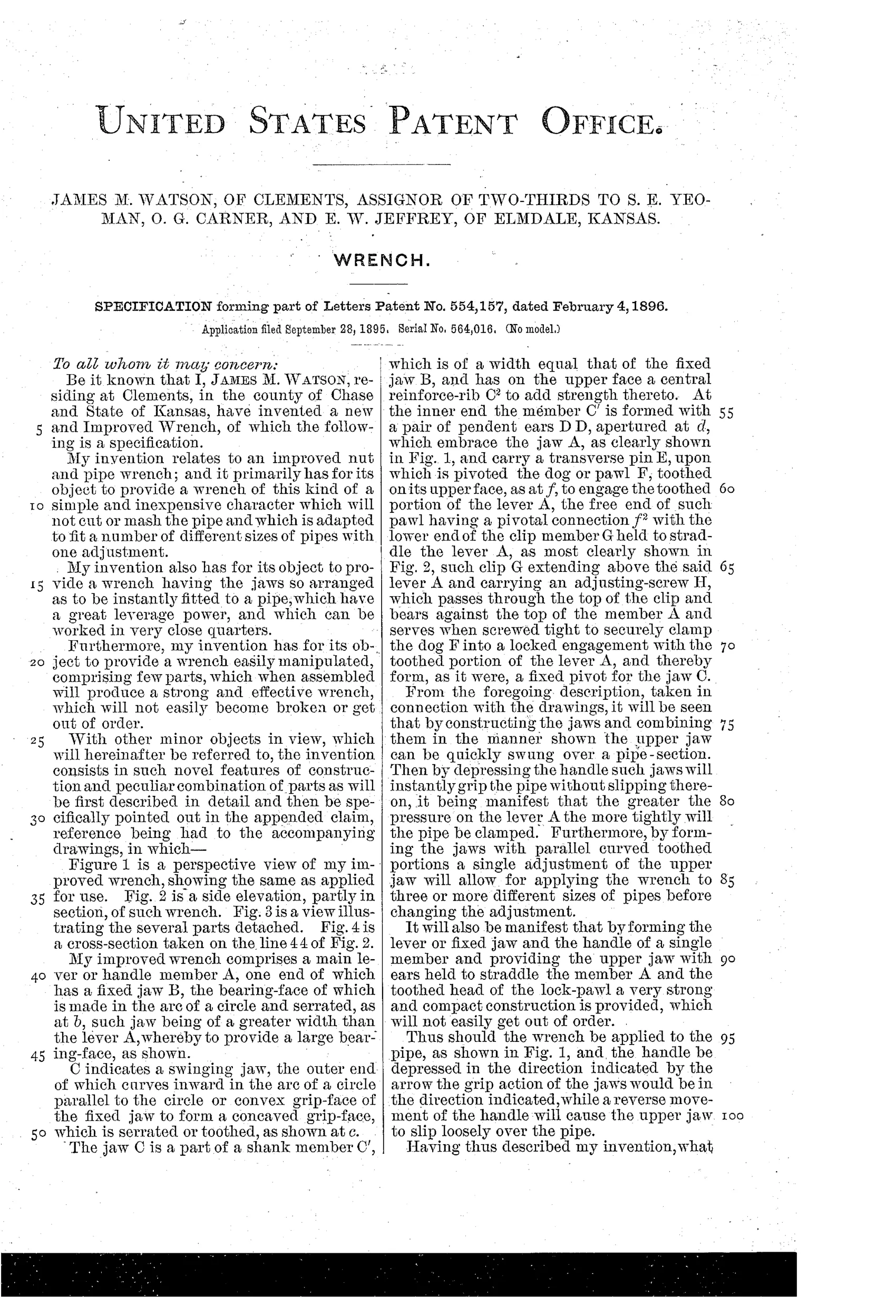
The wrench has a main lever/handle A ending in a fixed jaw B with a curved, serrated bearing face. A swinging upper jaw C, mounted on shank C' with pendent ears D D, straddles the lever A and pivots on pin E carrying a toothed pawl F that engages teeth on the lever. A clip member G straddling the lever carries an adjusting screw H that locks the pawl against the toothed lever, fixing the pivot point of jaw C so that depressing the handle causes the jaws to grip the pipe tightly, while a reverse motion releases it.
⚙ What was claimed
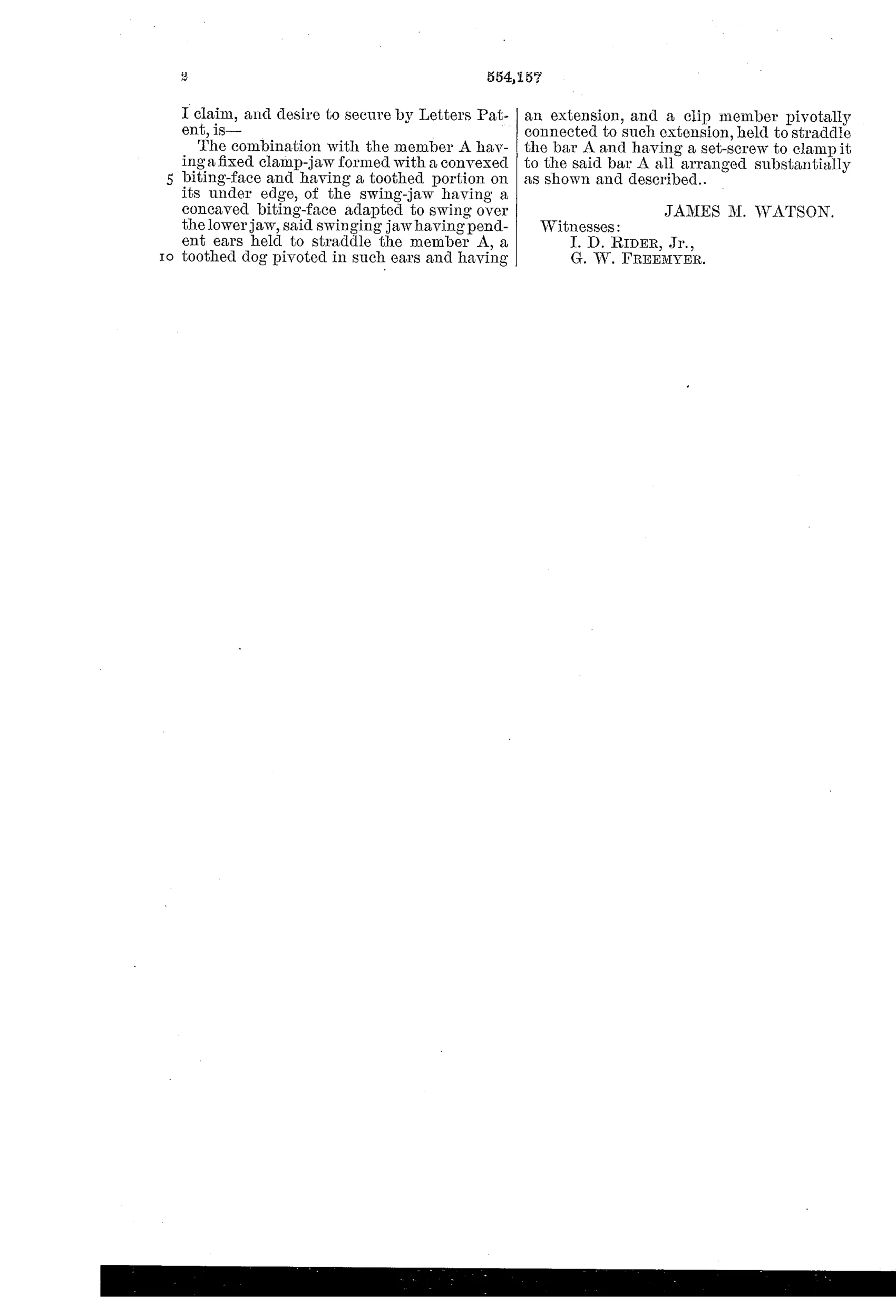
“The combination with the member A having a fixed clamp-jaw formed with a convexed biting-face and having a toothed portion on its under edge, of the swing-jaw having a concaved biting-face adapted to swing over the lower jaw, said swinging jaw having pendent ears held to straddle the member A, a toothed dog pivoted in such ears and having an extension, and a clip member pivotally connected to such extension, held to straddle the bar A and having a set-screw to clamp it to the said bar A all arranged substantially as shown and described.”
In plain English: The wrench combines a fixed jaw with a convex toothed face on the handle bar and a swinging jaw with a concave face that straddles the bar, is locked in position by a pivoted toothed dog and a clip with a set-screw, all working together as described.
⚙ In the inventor’s words
“Furthermore, my invention has for its object to provide a wrench easily manipulated, comprising few parts, which when assembled will produce a strong and effective wrench, which will not easily become broken or get out of order.”— James M. Watson, from the specification
Fate unknown
No manufactured example or catalog listing is documented in DATAMP or the collector literature; a marked specimen would settle it.
⚙ Commentary
Watson's wrench belongs to the self-tightening pipe wrench family that the Stillson patent of 1869 had already made famous, but he takes a different route to the same effect. Instead of a loose-fitting nut on a threaded shank, he hangs the whole upper jaw from a pivot pin that can be relocated anywhere along the toothed underside of the handle. A toothed dog grabs the rack, a straddling clip and set-screw lock the dog, and from there the geometry does the work: pull down on the handle and the curved, serrated jaws roll into the pipe and bite harder.
The drawing rewards a close look at Fig. 2. The upper jaw's biting face is concave and the fixed jaw's is convex, so the pipe is cradled between two opposed curves — a genuinely thoughtful detail, since it gives multiple tooth contact on a range of pipe diameters without re-setting the clip. Fig. 3, the exploded view, shows how few parts there really are: bar, jaw, dog, clip, screw. Watson's boast about simplicity is fair.
The weak point is the adjustment itself. Every change of pipe size means loosening a set-screw, sliding the clip, and re-tightening — slower than spinning a Stillson nut with a thumb. Coming a quarter-century after Stillson, it's a workmanlike variation rather than an advance, which is likely why it stayed in Chase County. The two-thirds interest assigned to three Elmdale neighbors suggests local hopes that history doesn't record being repaid.
Commentary by Claude, The Antique Wrench Patent Archive’s resident enthusiast