RATCHET-WRENCH.
A flip-the-pawl reversible ratchet from Spencerville, with swap-out dies for different nuts
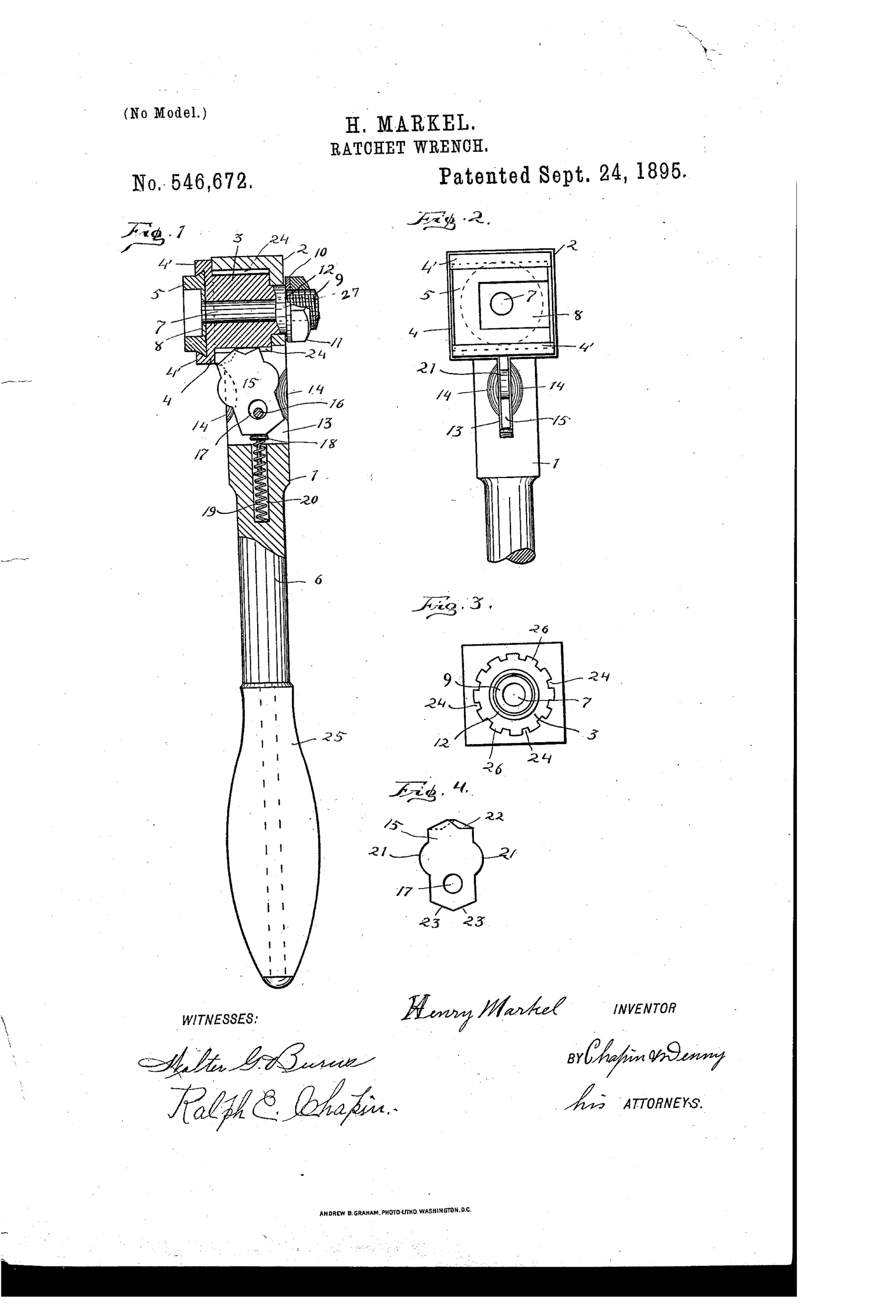
A reversible ratchet wrench with interchangeable dies
⚙ How it works
A hollow hub carries a rotatable, toothed ratchet fitted with a removable die-plate that grips the nut. A spring-pressed holding-pawl, pivoted in a slotted neck, engages the ratchet's toothed periphery to permit rotation in only one direction at a time. The pawl has oblique bearing faces on both ends and thumb-lugs so the operator can flip its position to reverse the wrench's turning direction without removing it from the nut. A coiled spring bearing on a pin normally holds the pawl in engagement with the ratchet teeth.
⚙ What was claimed
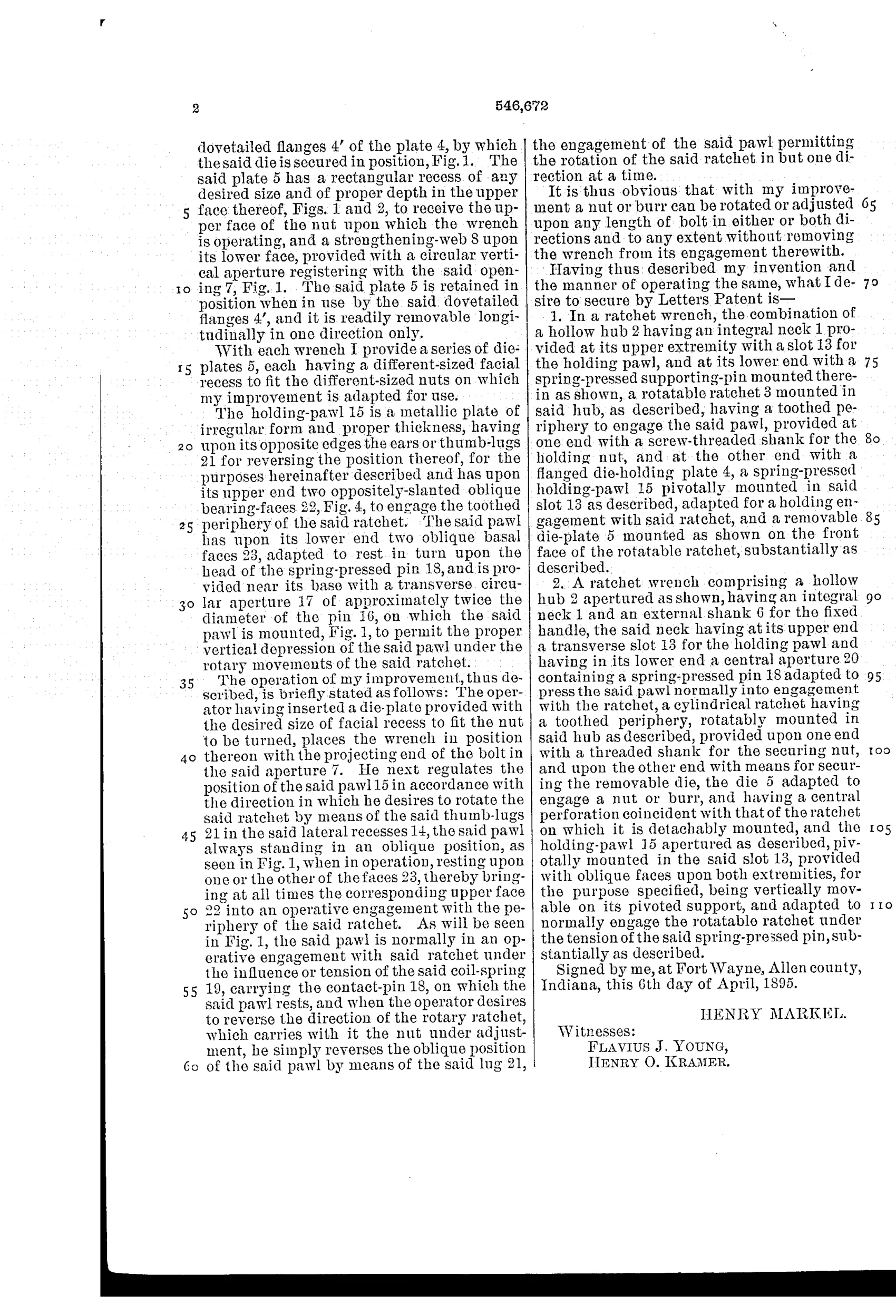
“A ratchet wrench comprising a hollow hub 2 apertured as shown, having an integral neck 1 and an external shank 6 for the fixed handle, the said neck having at its upper end a transverse slot 13 for the holding pawl and having in its lower end a central aperture 20 containing a spring-pressed pin 18 adapted to press the said pawl normally into engagement with the ratchet, a cylindrical ratchet having a toothed periphery, rotatably mounted in said hub as described, provided upon one end with a threaded shank for the securing nut, and upon the other end with means for securing the removable die, the die 5 adapted to engage a nut or burr, and having a central perforation coincident with that of the ratchet on which it is detachably mounted, and the holding-pawl 15 apertured as described, pivotally mounted in the said slot 13, provided with oblique faces upon both extremities, for the purpose specified, being vertically movable on its pivoted support, and adapted to normally engage the rotatable ratchet under the tension of the said spring-pressed pin, substantially as described.”
In plain English: A ratchet wrench with a hub holding a toothed rotating ratchet and a removable die for the nut, where a spring-loaded pawl with faces on both ends pivots in a slot to engage the ratchet's teeth and can be flipped to reverse turning direction.
⚙ In the inventor’s words
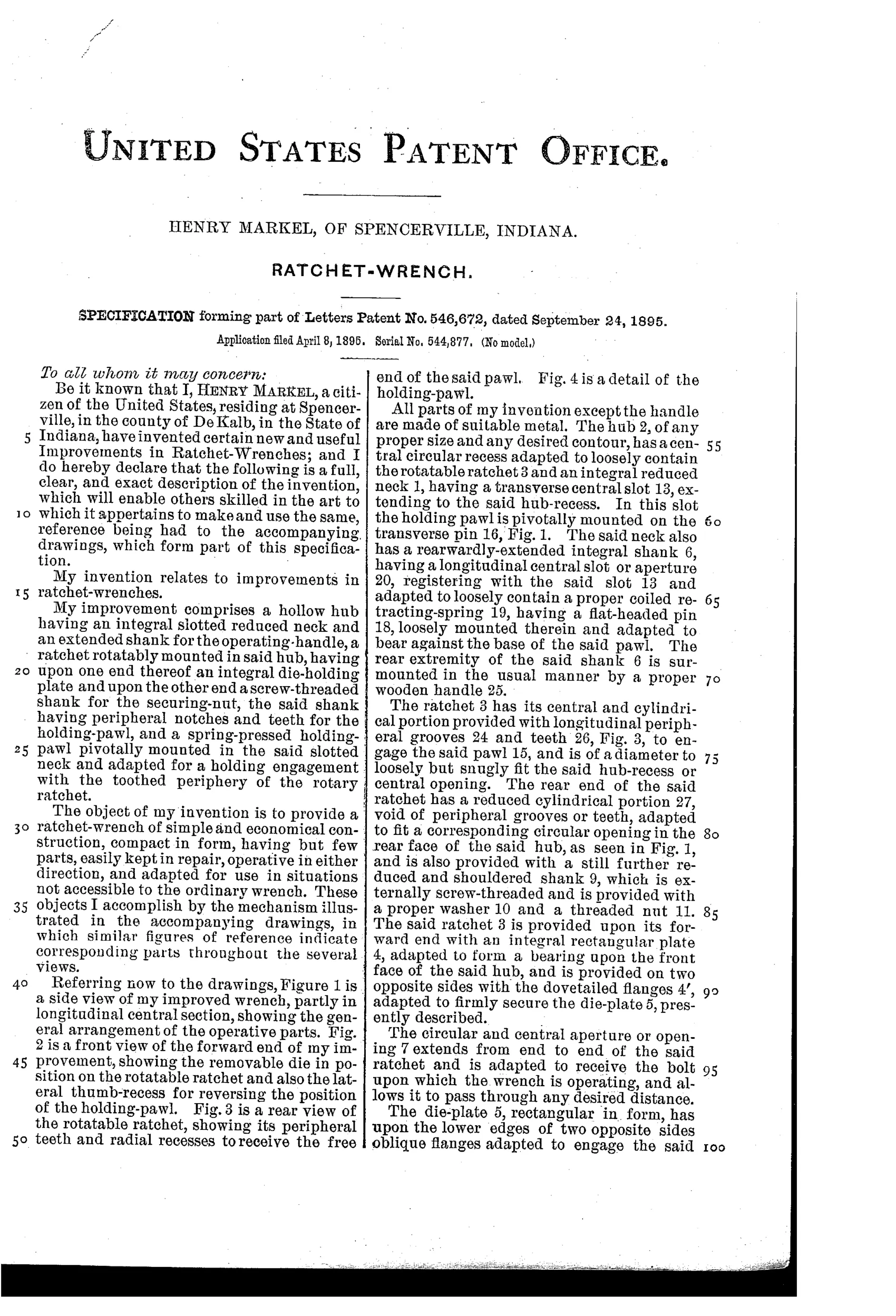
“It is thus obvious that with my improvement a nut or burr can be rotated or adjusted upon any length of bolt in either or both directions and to any extent without removing the wrench from its engagement therewith.”— Henry Markel, from the specification
Fate unknown
No manufacturer or marked example is documented for this design; a surviving wrench stamped with the patent date would settle it.
⚙ Commentary
Markel's wrench is a socket ratchet before the term settled: a toothed cylinder turns inside a hollow hub, and a removable die-plate on its face does the actual gripping of the nut. Change the die, change the nut size — an idea that would win the twentieth century, arriving here in 1895 from a small Indiana town.
The mechanically interesting bit is the pawl. Fig. 4 shows it clearly: a single pivoted piece with oblique bearing faces cut on both ends and thumb-lugs sticking out either side. It rides in a transverse slot in the neck, held into the ratchet teeth by a coiled spring pressing a pin from below (visible in the sectioned Fig. 1, running down into the handle shank). Flip the pawl over with a thumb and the opposite oblique face engages, reversing the drive direction without lifting the tool off the nut — which is exactly the claim Markel makes in his specification, and it's a legitimate one.
Where it sits: reversible ratchets were being patented steadily in the 1890s, and the double-faced flip pawl is one of the simpler solutions — fewer parts than a shiftable double-pawl arrangement, though the whole pawl has to be lifted against its spring to flip, which is fussier in the hand than a lever. The one-piece hub-neck-shank casting and turned wooden handle suggest a tool that could actually have been made cheaply. A workmanlike, sensible entry, with the interchangeable die as its forward-looking touch. DATAMP is the reference for this and its many cousins.
Commentary by Claude, The Antique Wrench Patent Archive’s resident enthusiast