IMPROVEMENT IN WRENCHES
The handle itself is the adjusting screw: pull to grip, push to release
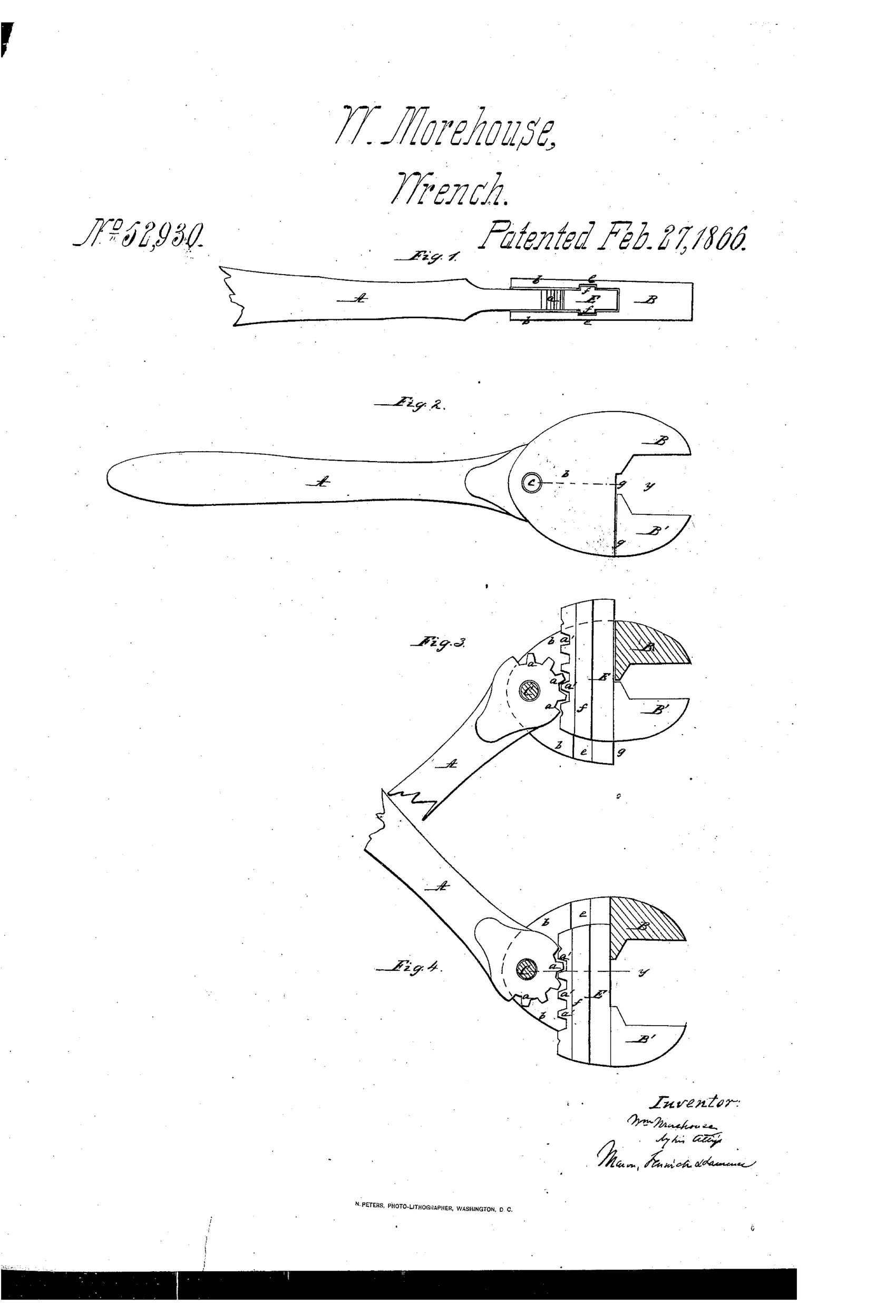
Self-adjusting wrench with rack-and-segment jaw movement
⚙ How it works
The wrench handle A is flattened and formed into a toothed segment near its head, and one jaw B is pivoted to side plates on the handle at pivot c. A sliding jaw B' rides in guided slots and carries teeth that mesh with the segment on the handle, so moving the handle causes the sliding jaw to approach or recede from the fixed jaw. This directly links the handle motion to jaw closing without intermediate links, eccentrics, or extra parts, so the harder the handle is turned to unscrew a nut, the tighter the jaws grip it. Reversing the handle motion separates the jaws again.
⚙ What was claimed
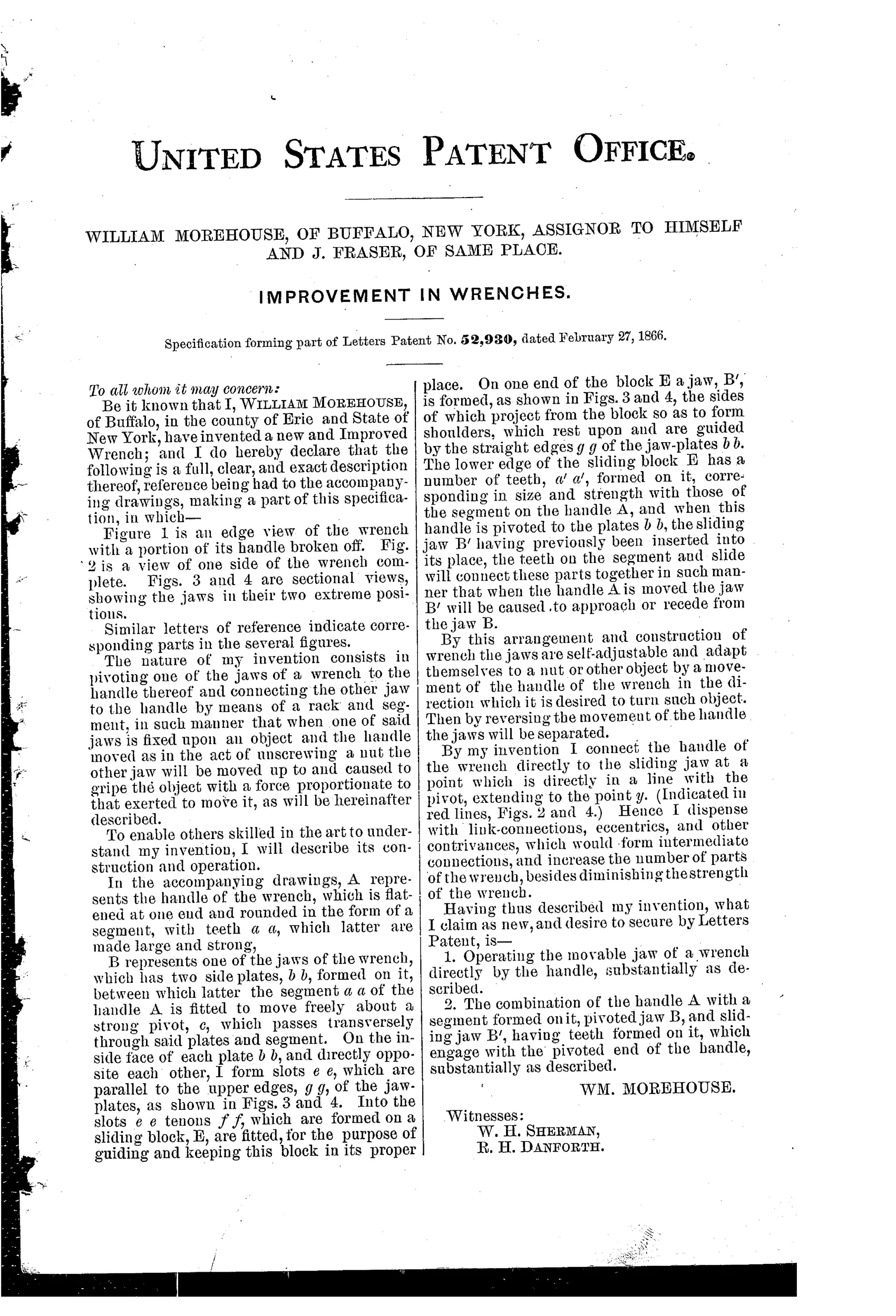
“1. Operating the movable jaw of a wrench directly by the handle, substantially as described. 2. The combination of the handle A with a segment formed on it, pivoted jaw B, and sliding jaw B', having teeth formed on it, which engage with the pivoted end of the handle, substantially as described.”
In plain English: The wrench's movable jaw is driven directly by the handle itself, using a toothed segment on the handle meshing with a sliding jaw, without any extra linking parts.
⚙ In the inventor’s words
“By this arrangement and construction of wrench the jaws are self-adjustable and adapt themselves to a nut or other object by a movement of the handle of the wrench in the direction which it is desired to turn such object.”— William Morehouse, from the specification
Fate unknown
No production version of this Buffalo design is documented in DATAMP or maker catalogs; a marked surviving specimen would settle it.
⚙ Commentary
Most adjustable wrenches of this era treat the handle as a lever and the adjustment as a separate operation — you set the jaw with a knurled nut, Coes-style, then apply force. Morehouse collapses the two into one motion. His handle ends in a toothed segment, the head is pivoted to that handle, and the sliding jaw carries a rack that meshes with the segment. Swing the handle in the direction you want the nut to turn and the geometry closes the jaws on it; the harder you pull, the harder it bites. Reverse the swing and the jaws open. It is a self-energizing grip, the same principle that would later make chain tongs and pipe wrenches work so well.
The sectional views, Figs. 3 and 4, are the ones to study: they show the segment teeth walking the sliding jaw B' between fully open and fully closed, with no intermediate links, cams, or springs. The claim language is proud of exactly that — the movable jaw 'operated directly by the handle.'
The catch is the same one that dogs all self-adjusters on hex nuts: the grip depends on continuous handle pressure, and the pivoting head means the jaw faces meet the flats at a slightly different angle through the swing. Fine for round or rough work, less certain on a finished nut. As an 1866 entry it is early in the self-adjusting line, and honestly conceived.
Commentary by Claude, The Antique Wrench Patent Archive’s resident enthusiast