MONKEY-WRENCH.
Two staggered pawls bite two notches at once — a quick-adjust with redundancy
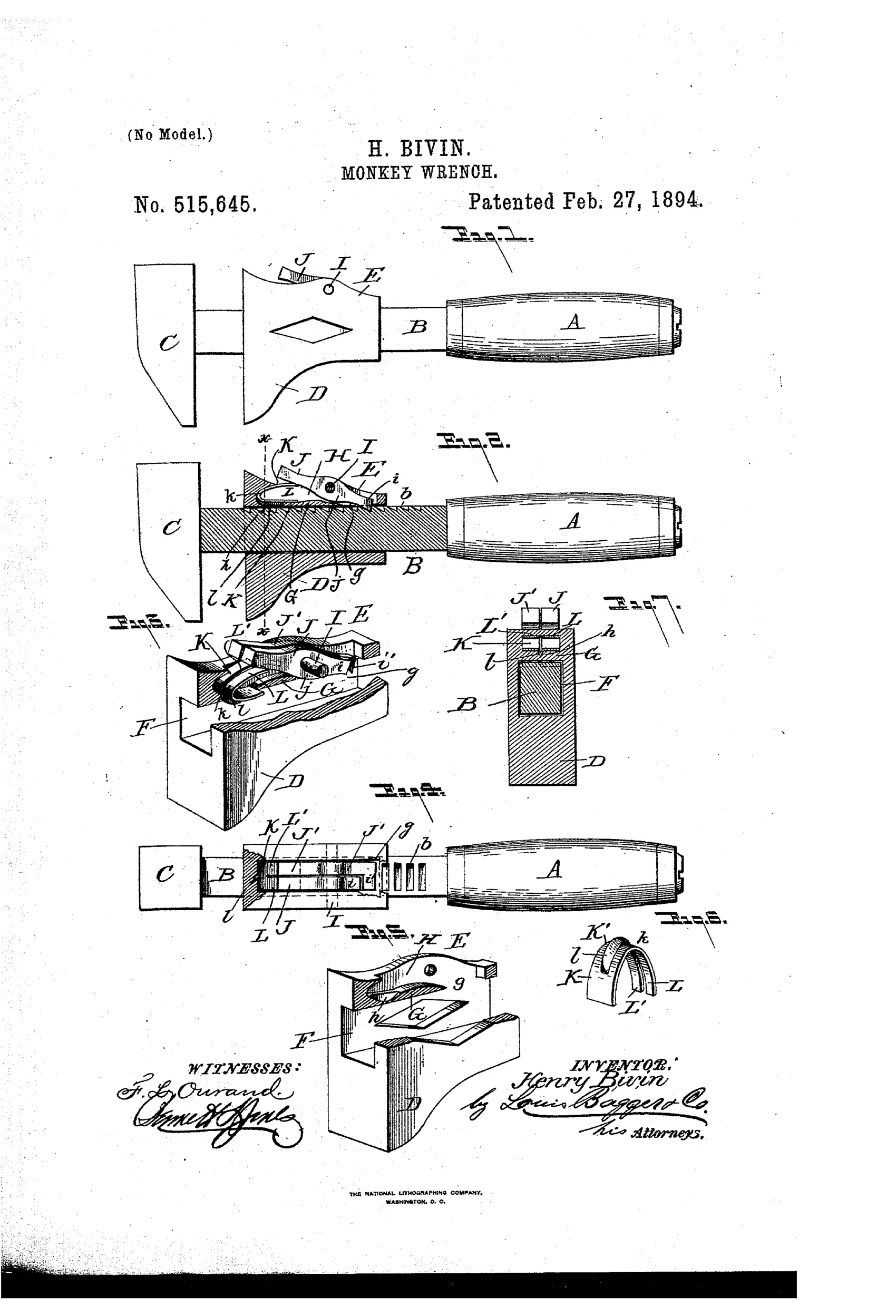
Adjustable monkey wrench with dual-pawl locking mechanism.
⚙ How it works
The movable jaw slides on a notched shank and carries a hollow box housing two independently pivoted retaining pawls. A bifurcated bent spring forces the pawls' upper arms outward and their lower ends against the notched shank, with one pawl's lower end bent into a shoe that overlaps and engages a notch below the one engaged by the adjacent pawl. This dual-notch engagement gives the jaw a firmer two-point bearing on the shank so it resists slipping under strain, while pressing the exposed upper ends of both pawls releases them from the notches to allow the jaw to be repositioned.
⚙ What was claimed
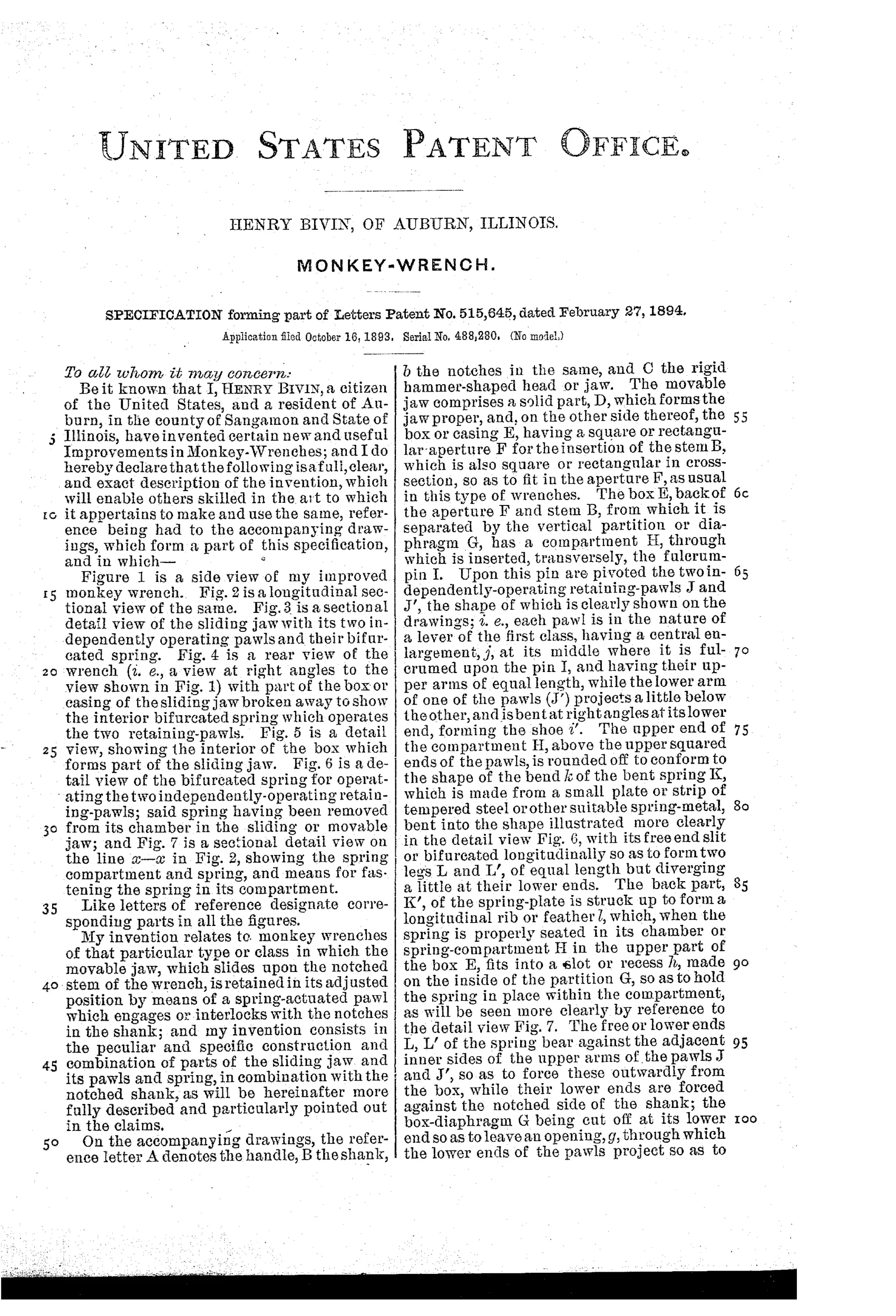
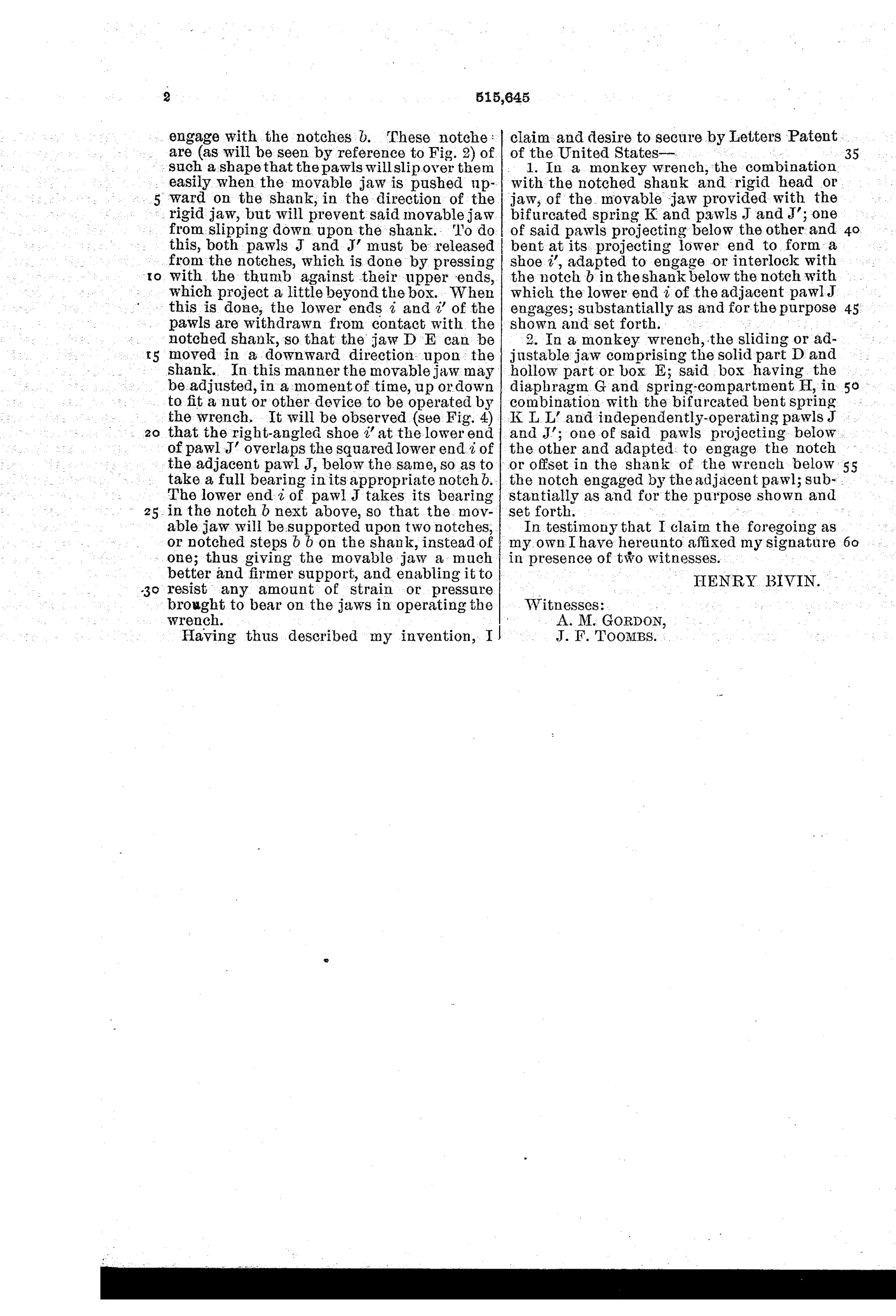
“1. In a monkey wrench, the combination with the notched shank and rigid head or jaw, of the movable jaw provided with the bifurcated spring K and pawls J and J'; one of said pawls projecting below the other and bent at its projecting lower end to form a shoe i', adapted to engage or interlock with the notch b in the shank below the notch with which the lower end i of the adjacent pawl J engages; substantially as and for the purpose shown and set forth.”
In plain English: The wrench's sliding jaw uses two spring-loaded pawls, one longer than the other with a bent shoe, so they lock into two separate notches on the shank at once for a stronger grip.
⚙ In the inventor’s words
“In this manner the movable jaw may be adjusted, in a moment of time, up or down to fit a nut or other device to be operated by the wrench.”— Henry Bivin, from the specification
Fate unknown
No manufactured example of Bivin's dual-pawl wrench is documented; a marked specimen or catalog listing would settle it.
⚙ Commentary
Henry Bivin of Auburn, Illinois joined the 1890s rush toward one-hand quick-adjust wrenches, and his answer to the standard objection — that a spring pawl on a notched shank slips under load — is honest and mechanical: use two pawls, not one. His sliding jaw carries a hollow box with two independently pivoted pawls fed by a single bifurcated spring. One pawl is longer than the other and bent at its foot into a shoe, so it seats in the notch below the one its neighbor engages. Press both exposed heads with your thumb and the jaw slides free; let go and the jaw bears on the shank at two points instead of one.
Fig. 2 is the view worth studying. The section shows the staggered engagement clearly — the shoe i' hooked into a lower notch while the plain pawl end i sits in the one above. Fig. 6, the little forked spring by itself, tells you how cheaply the doubling was bought: one piece of bent steel drives both pawls. Note also the hammer-poll head in Fig. 1, a farm-tool touch typical of Illinois implement country.
The weakness is the weakness of all notched-shank wrenches: adjustment comes only in notch-sized steps, where the Coes screw gives you a continuum. Two pawls double the holding surface but don't fix that. It's a thoughtful refinement of an approach the market ultimately declined. DATAMP records the patent; a production example is another matter.
Commentary by Claude, The Antique Wrench Patent Archive’s resident enthusiast