COMBINATION-WRENCH
A fan of fixed wrenches, spring-loaded to unlock like a folding jackknife
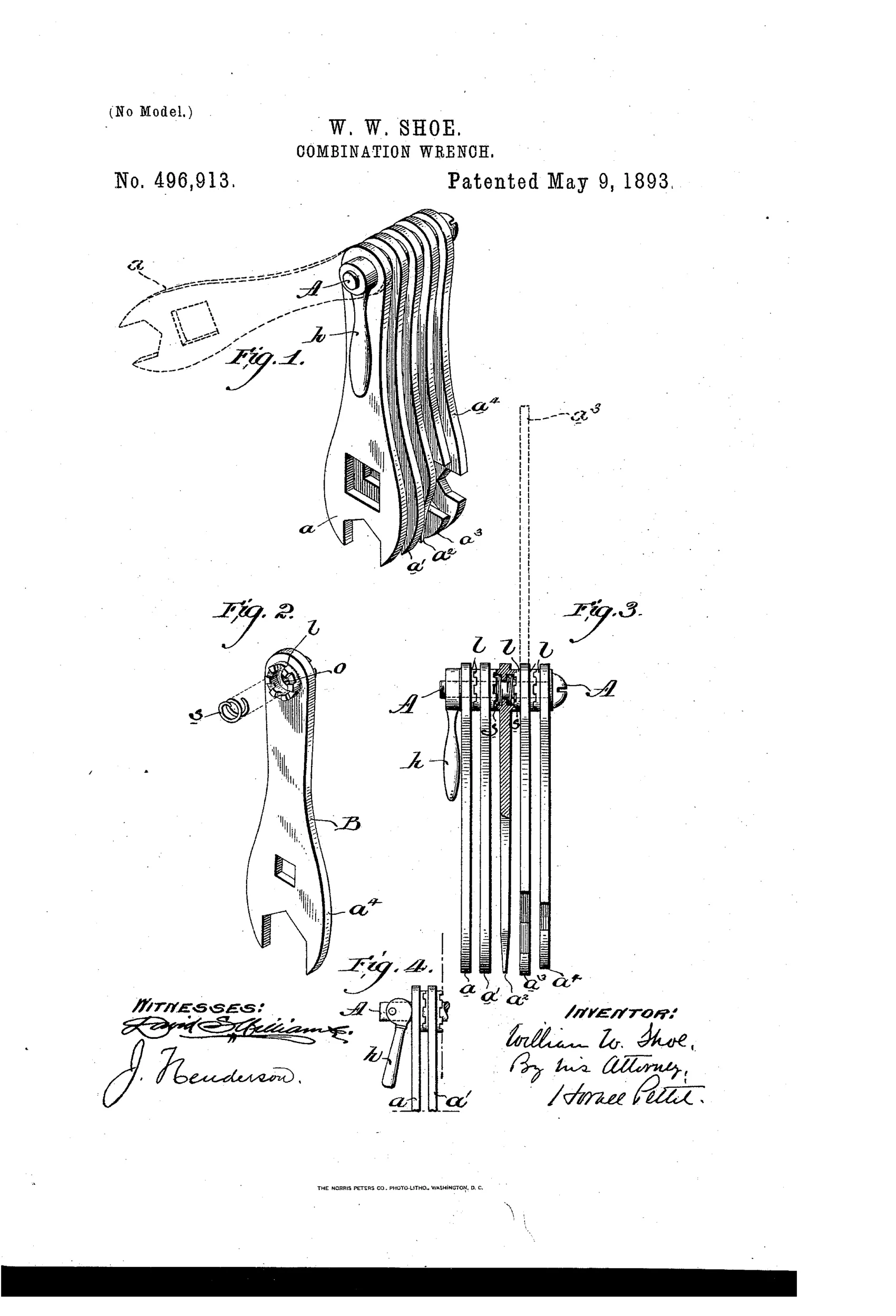
Folding pocket wrench with multiple nested blades
⚙ How it works
Two or more wrench blades are pivoted together at one end on a transverse headed bolt, each blade having an orifice for the bolt and a circular arrangement of lugs or teeth around it. Adjacent blades' lugs interlock to lock the blades rigidly at a chosen angle when a screw-threaded lever is tightened on the bolt. Coiled springs placed between the blades around the bolt automatically push the blades apart and disengage the lugs when the lever is loosened, allowing free readjustment. The unused blades fold together to form a compact handle for the blade in use, increasing leverage and portability.
⚙ What was claimed
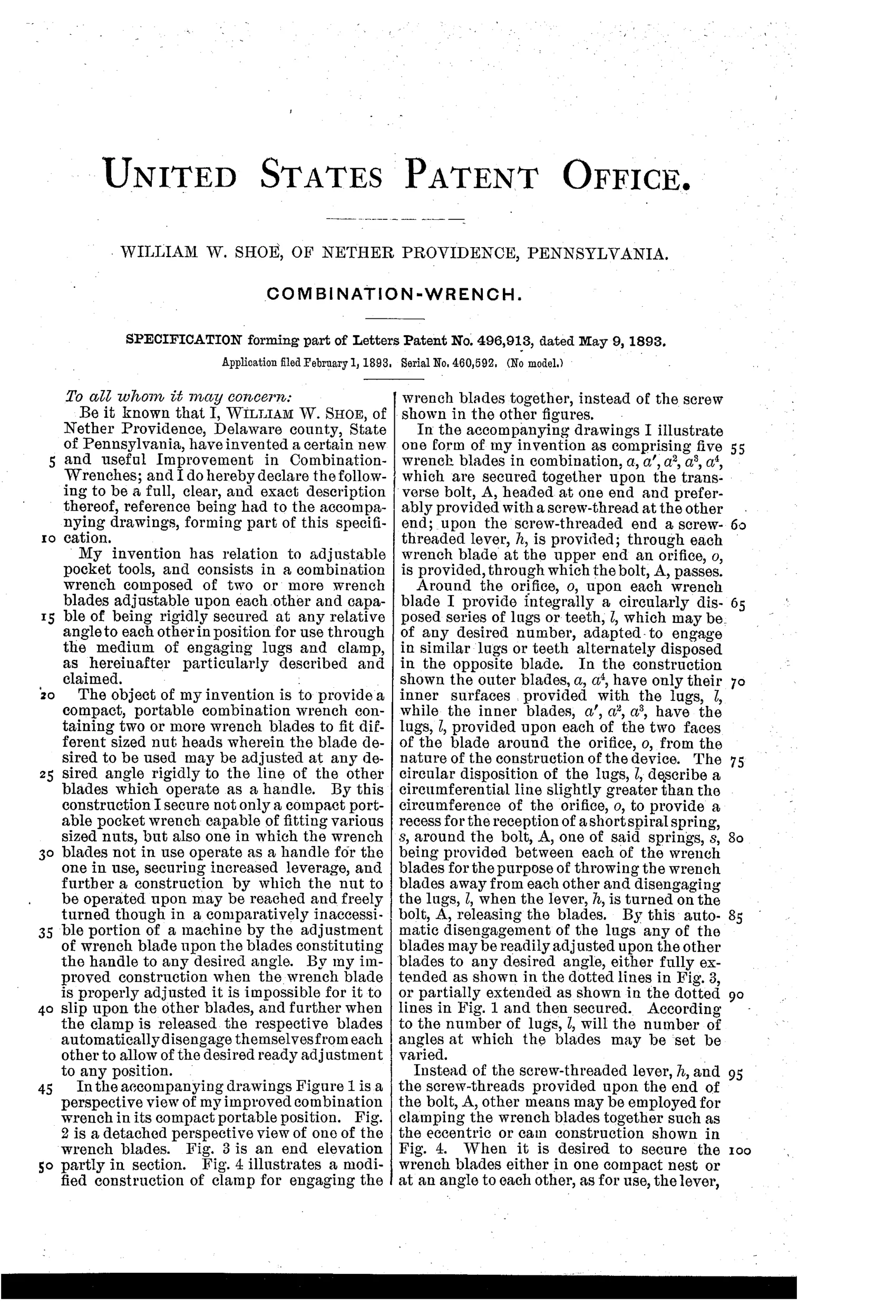
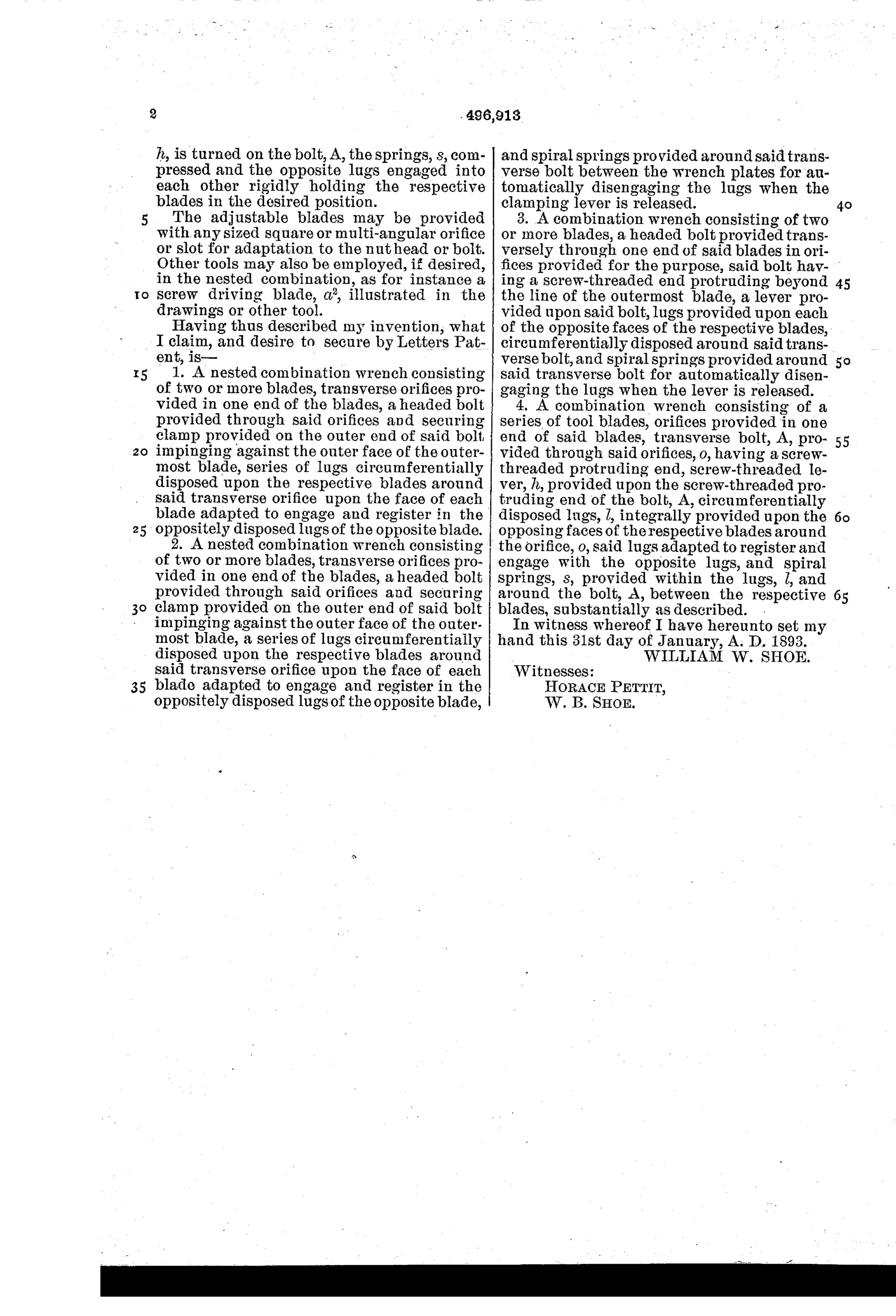
“A nested combination wrench consisting of two or more blades, transverse orifices provided in one end of the blades, a headed bolt provided through said orifices and securing clamp provided on the outer end of said bolt impinging against the outer face of the outermost blade, series of lugs circumferentially disposed upon the respective blades around said transverse orifice upon the face of each blade adapted to engage and register in the oppositely disposed lugs of the opposite blade.”
In plain English: A folding combination wrench with several blades pivoted on a common bolt, each having interlocking teeth around the pivot hole so they can be locked at different angles.
⚙ In the inventor’s words
“By this construction I secure not only a compact portable pocket wrench capable of fitting various sized nuts, but also one in which the wrench blades not in use operate as a handle for the one in use, securing increased leverage.”— William W. Shoe, from the specification
Fate unknown
No manufactured example of Shoe's nested-blade wrench is documented in DATAMP or collector literature; a marked specimen would settle it.
⚙ Commentary
Shoe's answer to the adjustable-wrench craze was to refuse to adjust at all. Instead of one wrench with a moving jaw, he stacks several fixed open-end blades on a single headed bolt, like the leaves of a pocket knife. Pick the blade that fits your nut, swing the rest around to trail behind it as a handle, and tighten the lever. The unproduced insight is in his own words: the idle blades aren't dead weight, they're leverage.
The locking detail is the part worth studying in Fig. 2 and Fig. 3. Each blade carries a ring of lugs around its pivot hole, and adjacent rings mesh face-to-face — a serrated clutch, essentially, so the blades lock rigidly at any of several angles rather than flopping on the pivot. The coiled springs between blades (the little 's' in Fig. 2) are the refinement: loosen the lever and the springs push the stack apart, disengaging the teeth automatically. Fig. 4 offers an eccentric cam as a quicker alternative to the threaded lever, which shows Shoe thinking about one-hand operation.
The weakness is the same one every fixed-opening multi-tool has: you get four or five sizes, and the nut in front of you is the sixth. That's why the adjustable jaw won this era. Still, as a piece of pocket-tool engineering — compact, rigid when locked, self-releasing — it's a tidy dead end, the kind of thing that resurfaced decades later in folding bicycle tools.
Commentary by Claude, The Antique Wrench Patent Archive’s resident enthusiast