WRENCH.
A Honolulu inventor's answer to rusted nuts: a spring pawl that bites back
Adjustable monkey-style wrench with nut-gripping pawl
⚙ How it works
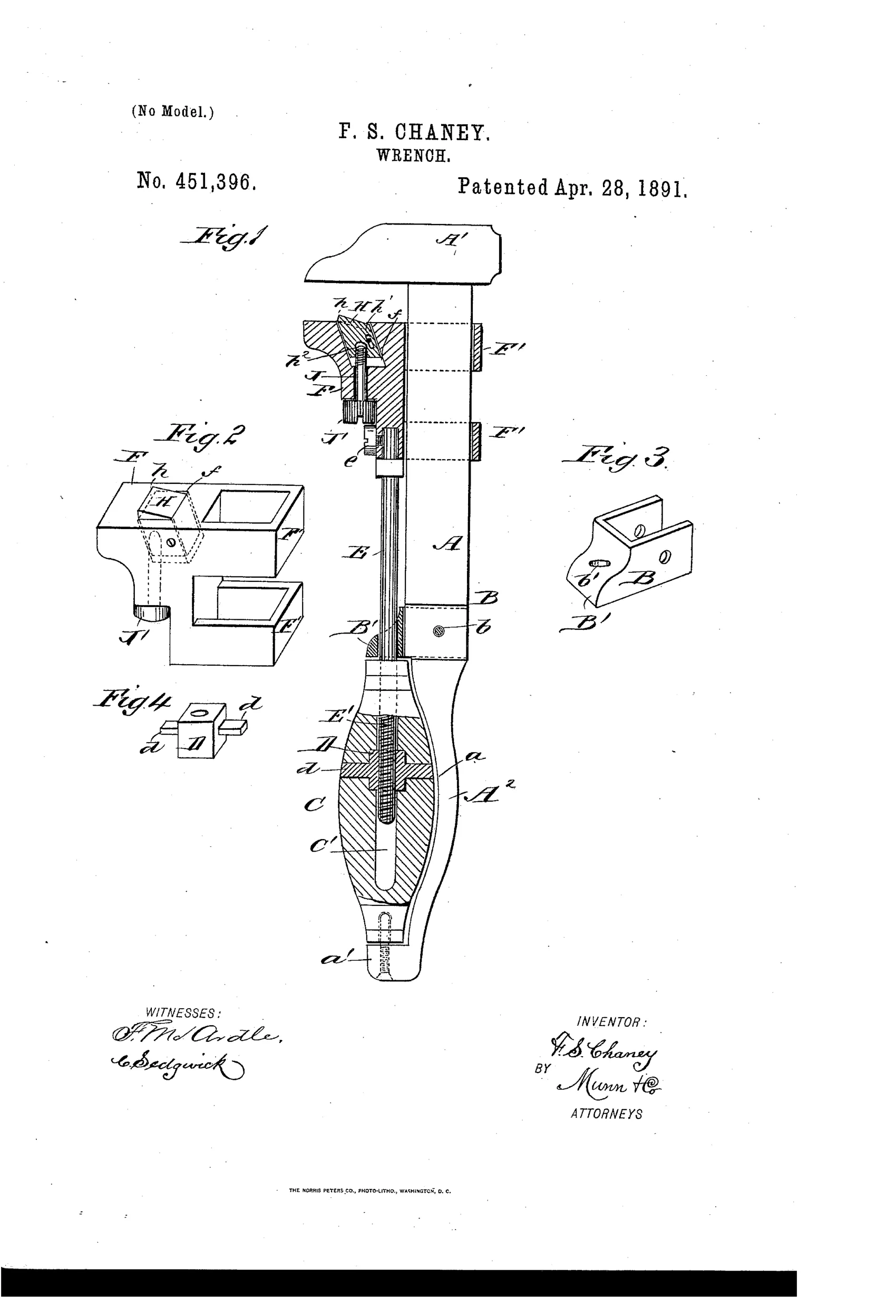
The wrench has a long shank ending in a fixed jaw, with a movable jaw sliding along the shank and adjusted by a screw-bolt and internal nut set in a pivoting hollow handle. Turning the handle rotates the screw-bolt in the nut, moving the movable jaw toward or away from the fixed jaw to grip a nut. A spring-loaded pawl mounted in an inclined recess of the movable jaw's face can be forced outward by a thumb-screw so its edge digs into an incision cut in a rusted or stuck nut, preventing the wrench from slipping and rounding the corners. A stay-block fixed to the shank supports the pivoted handle and guides the screw-bolt.
⚙ What was claimed
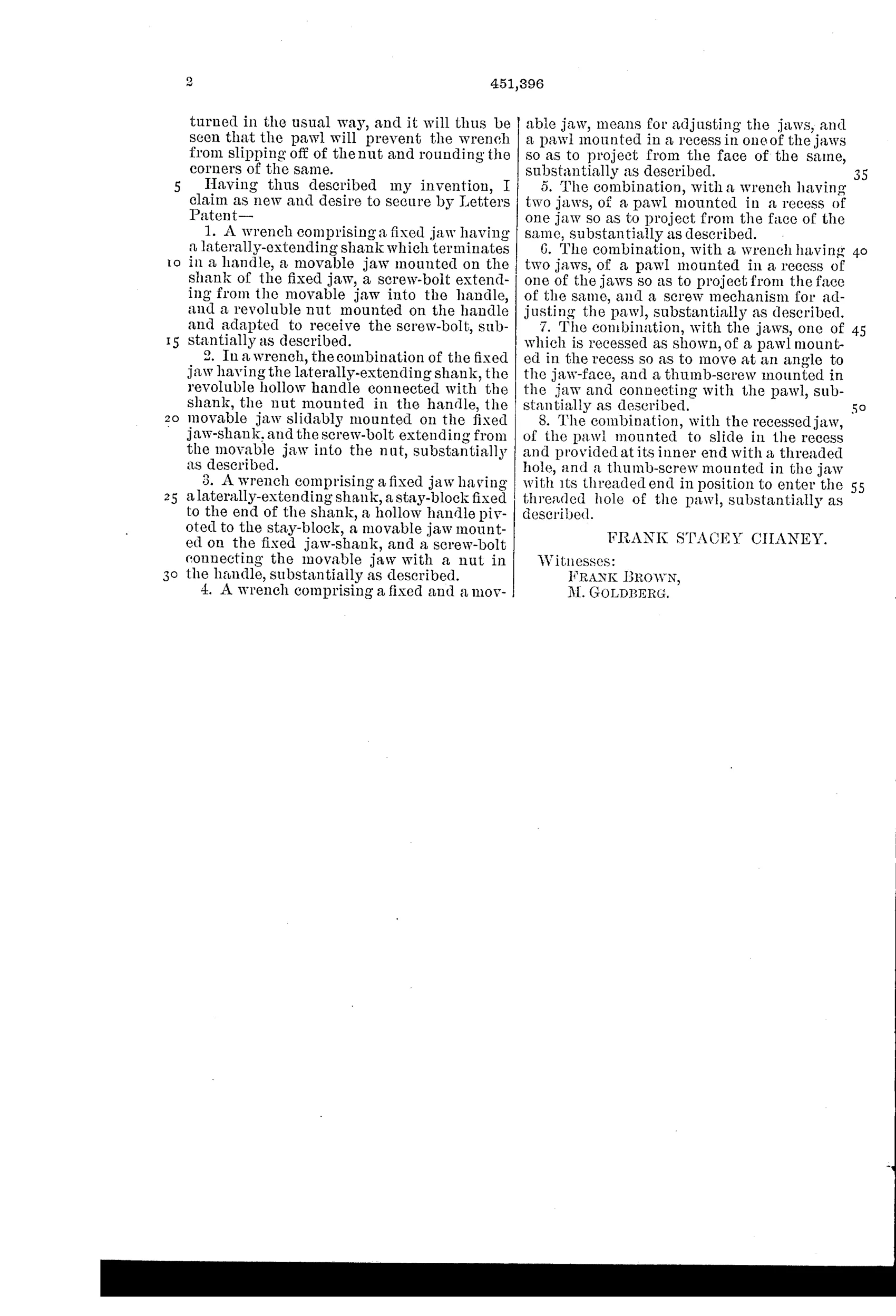
“1. A wrench comprising a fixed jaw having a laterally-extending shank which terminates in a handle, a movable jaw mounted on the shank of the fixed jaw, a screw-bolt extending from the movable jaw into the handle, and a revoluble nut mounted on the handle and adapted to receive the screw-bolt, substantially as described.”
In plain English: The wrench has a fixed jaw with a shank ending in a handle, a movable jaw on that shank, and a screw-bolt running into a rotating nut in the handle to adjust the jaw's position.
⚙ In the inventor’s words
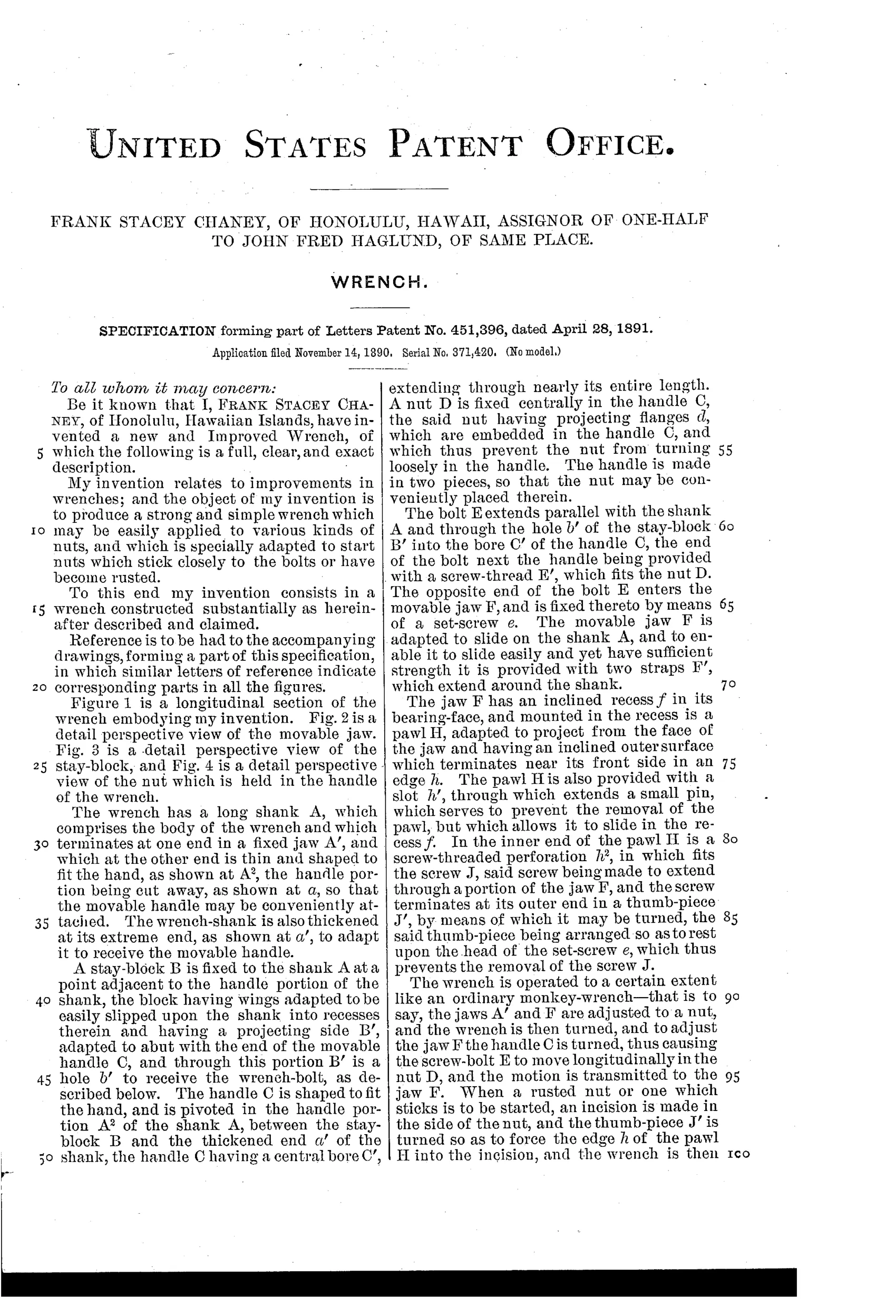
“the object of my invention is to produce a strong and simple wrench which may be easily applied to various kinds of nuts, and which is specially adapted to start nuts which stick closely to the bolts or have become rusted.”— Frank Stacey Chaney, from the specification
Fate unknown
No manufactured example is documented in DATAMP or collector literature; a marked specimen, especially one surfacing in Hawaii, would settle it.
⚙ Commentary
Two things make this one worth a pause. The first is the address: a wrench patent filed from Honolulu in 1890, three years before the overthrow of the Hawaiian Kingdom, and assigned to a fellow islander. Tool patents from Hawaii in this era are genuinely scarce, and Chaney's is a proper, fully worked-out design, not a sketch.
The mechanism itself is a variation on the Coes theme — jaw adjustment driven from the handle — but Chaney runs a screw-bolt from the movable jaw down into a revoluble nut seated in a pivoted hollow handle. Twist the handle, the nut turns on the bolt, the jaw walks. Fig. 1 shows how much machinery this takes: the stay-block (Fig. 3) has to guide the bolt and carry the pivoted handle, which is a lot of parts doing what Coes's knurled worm does with one.
The honest novelty is the spring pawl set in an inclined recess of the jaw face, forced out by a thumb-screw so its edge digs into 'an incision cut' in a stuck nut. Read that carefully: you must first chisel a notch into the rusted nut for the pawl to engage. That is a real workshop trick — mechanics did cut slots into rounded nuts — but building it into the wrench adds cost for a rare emergency. A clever, earnest solution to a genuine annoyance, and almost certainly a dead end against the simpler wrenches already flooding the market.
Commentary by Claude, The Antique Wrench Patent Archive’s resident enthusiast