WRENCH.
A Georgia brace-style ratchet wrench with opposed sliding jaws and a quarter-turn reversing pawl
Ratchet wrench with adjustable jaws and reversible pawl
⚙ How it works
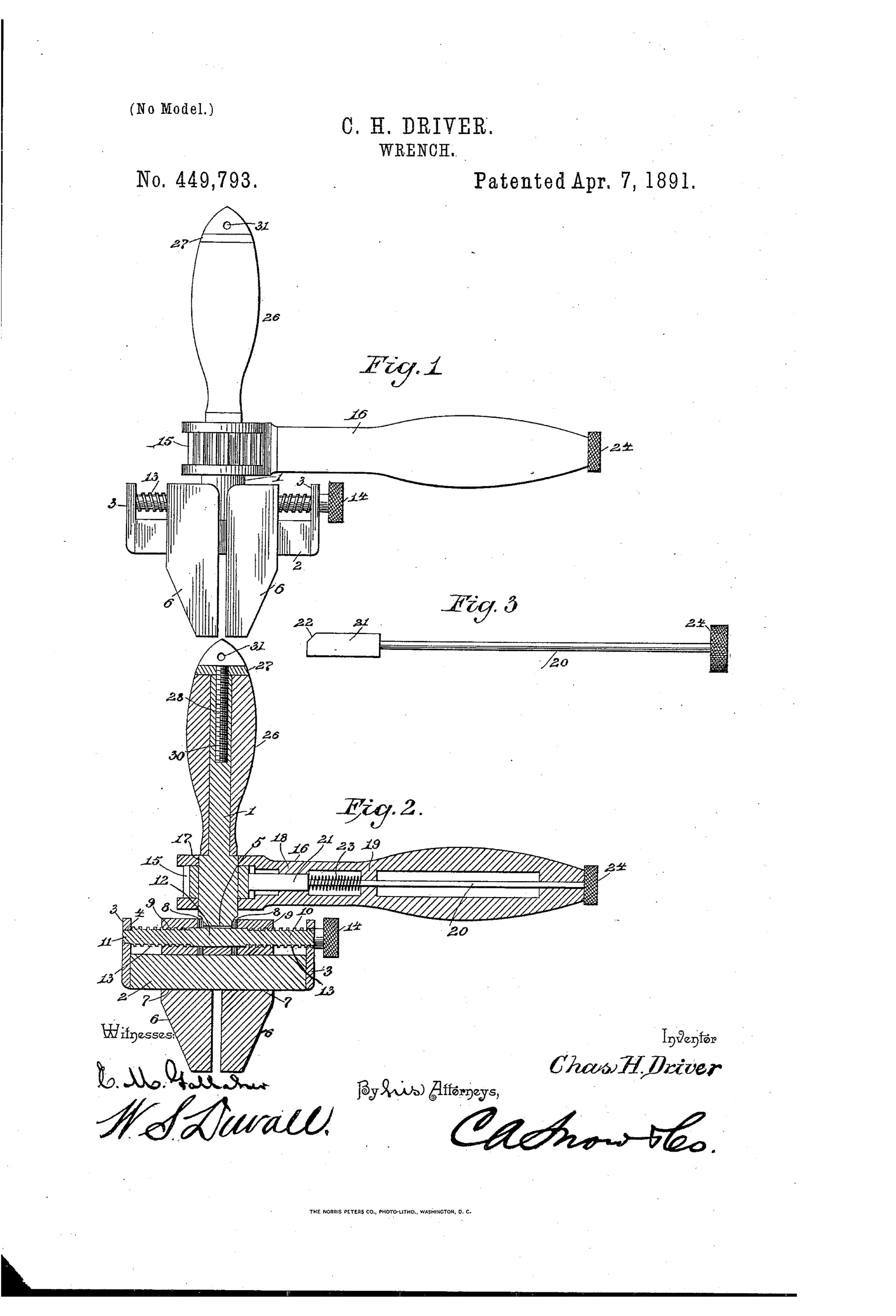
A cylindrical shank carries a pair of sliding jaws driven by an oppositely-threaded adjusting bolt so the jaws open or close together to fit various nut or drill sizes. A ratchet fixed to the shank is engaged by a spring-pressed, beveled pawl mounted in the bifurcated end of a ratchet-handle, allowing the handle to be swung back and forth to rotate the shank in one direction. The pawl rod can be withdrawn and given a quarter turn to disengage it, reversing the working direction, or the rear hand-grip handle can be locked tight to the shank via a screw and washer so the tool works as an ordinary rigid wrench.
⚙ What was claimed
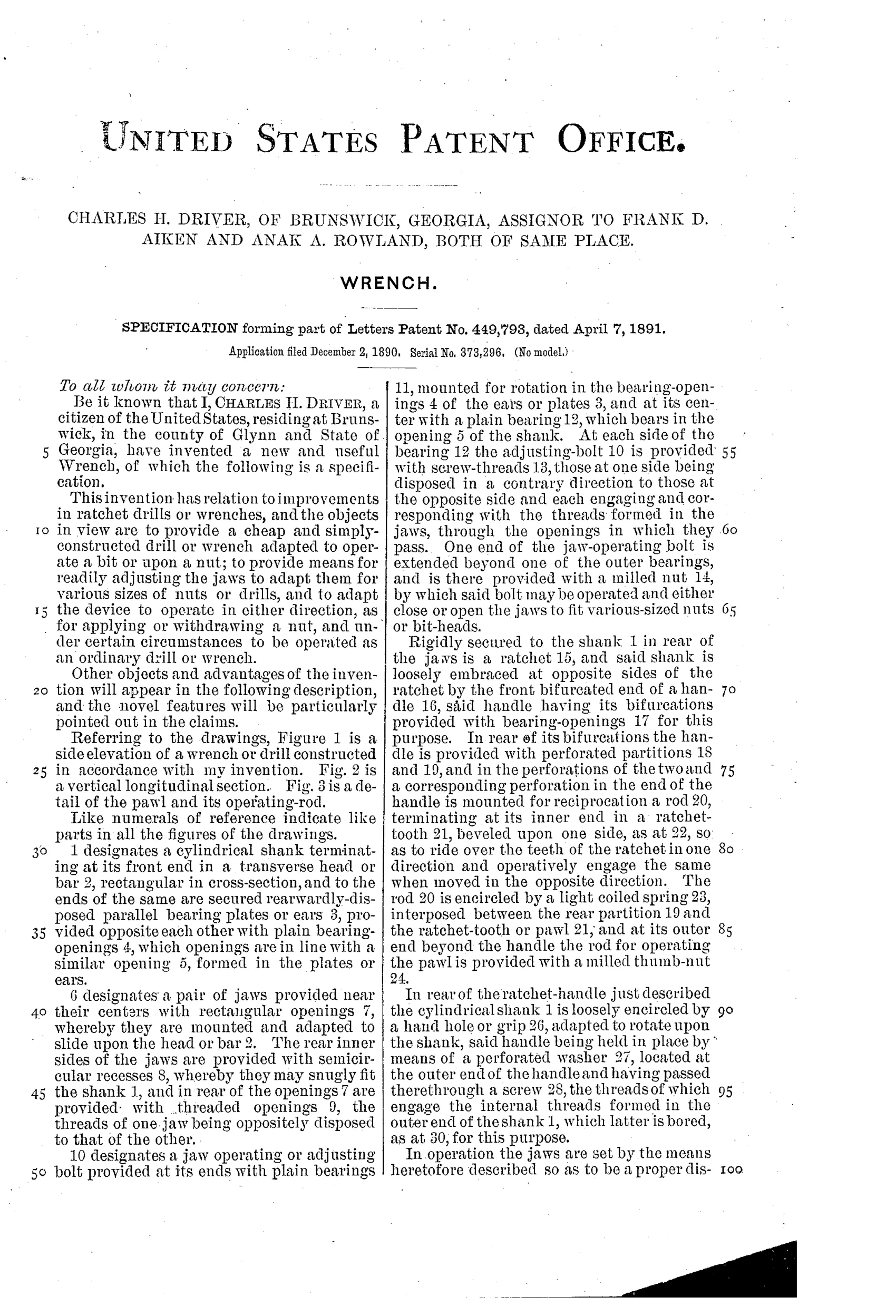
“In a wrench, the combination, with the ratchet-handle terminating at its inner end in bifurcations provided with bearing-openings, a spring-pressed pawl located at one side of the openings, a cylindrical shank provided at its outer end with an internally-threaded bore or opening, a handle loosely mounted upon the shank, a screw inserted in the bore, and a washer interposed between the end of the handle and the head of the screw, of a pair of clamping-jaws located at the inner end of the shank, and means for adjusting the same, substantially as specified.”
In plain English: The wrench combines a ratchet handle with a spring-loaded pawl, a shank with a separate loosely mounted grip handle that can be locked tight via a screw and washer, and adjustable clamping jaws at the shank's inner end.
⚙ In the inventor’s words
“By withdrawing the pawl and giving it a quarter-turn, so that it is out of engagement with the teeth of the ratchet and then tightening the screw 28 by means of a nail or rod passed through an opening 31, formed in the head thereof, the handle 26 will be bound snugly in position and immovable, except with the shank 1, and thus the device may be used as an ordinary wrench.”— Charles H. Driver, from the specification
Fate unknown
No manufactured example or catalog listing is documented; a marked specimen with the opposed-jaw shank and pull-and-turn pawl would settle it.
⚙ Commentary
Driver's wrench reads more like a bit-brace crossed with a monkey wrench than either tool alone. The upright layout in Fig. 1 gives it away: a bulbous palm-grip on top of a cylindrical shank, a ratchet handle swinging off to the side, and a pair of jaws at the bottom driven by an oppositely-threaded bolt so they close on a nut from both sides at once. Centering jaws like that are common on drill chucks, less so on wrenches, and here the patent explicitly covers both uses — turning nuts or turning drills.
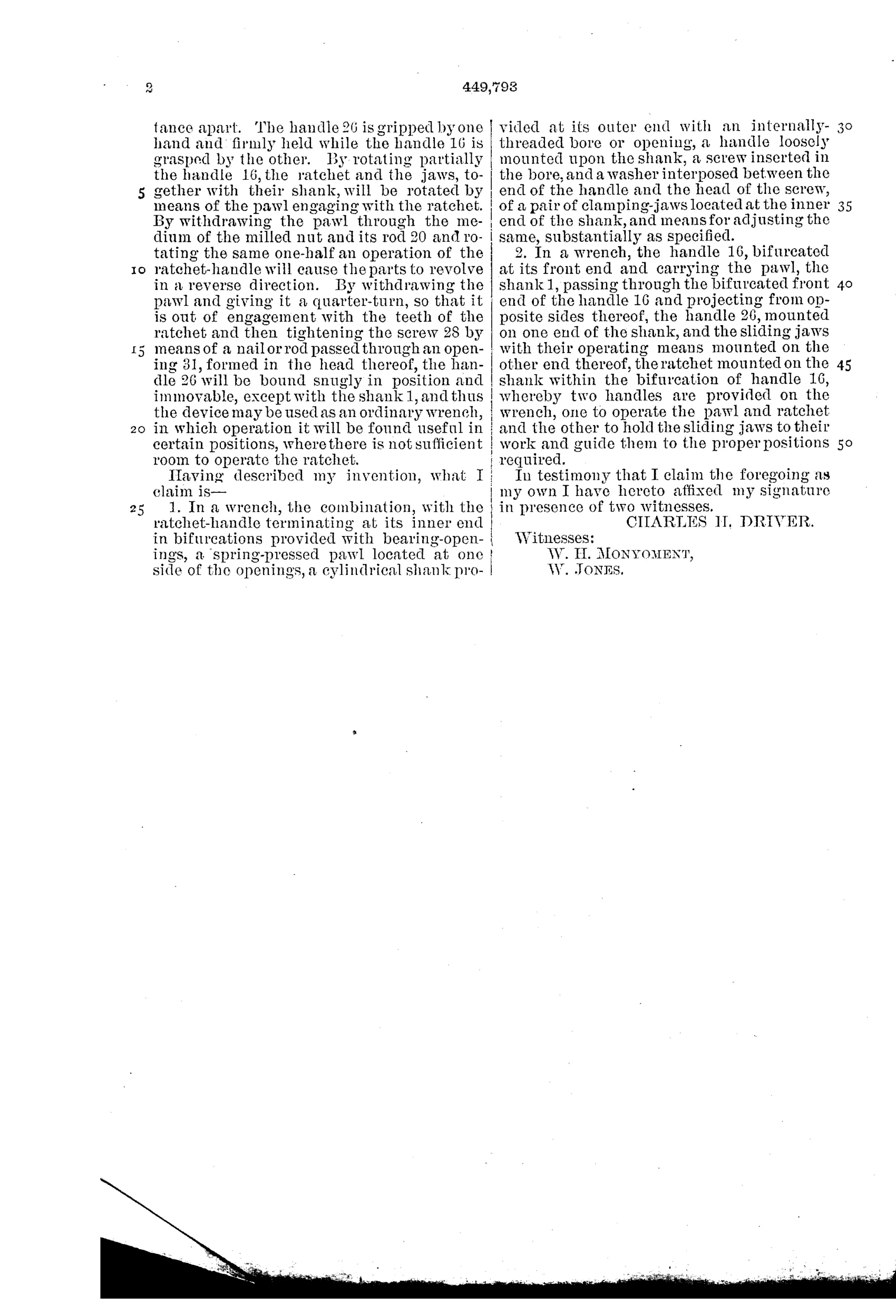
The cleverest and cheapest detail is the reversing pawl. Instead of a shifting lever or a second pawl, Driver has you pull the pawl rod out and rotate it a quarter turn so its beveled face engages the ratchet teeth from the other side — Fig. 3 shows the whole rod as a separate part. It works, but every reversal means fingers on a small sliding rod, and a lost pawl kills the tool.
The fallback mode is telling: tighten screw 28 'by means of a nail or rod' through the head and the loose grip binds solid, turning the ratchet tool into a rigid wrench. That improvised-key detail suggests a farm-and-shop mindset rather than factory polish. It sits in the crowded 1890s ratchet-adjustable field as an honest combination rather than a breakthrough — assigned to two backers, which shows someone believed in it, per DATAMP's record.
Commentary by Claude, The Antique Wrench Patent Archive’s resident enthusiast