WRENCH
A Georgia farmer's pipe wrench: pivoted hook jaw that self-tightens under torque
Adjustable sliding-jaw wrench with pivoted hook jaw
⚙ How it works
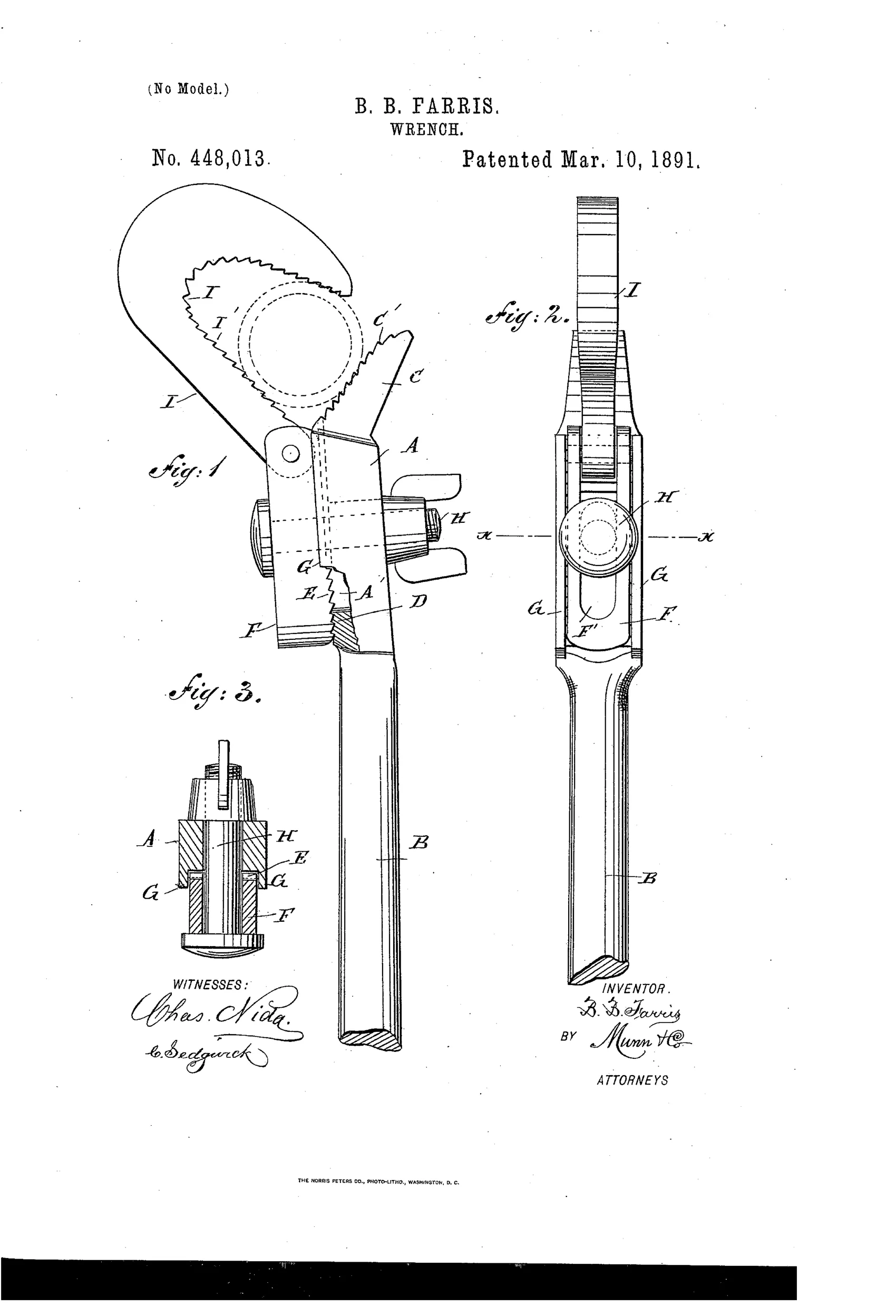
A handled stock has an angular fixed jaw on one end with serrations, and a sliding head fitted between parallel flanges on the stock that can be locked at various positions with a bolt through slots in both stock and head. A hook-shaped jaw with its own serrations is pivoted on the sliding head so it can swing to grip the work opposite the fixed jaw or at two opposite points. Loosening the bolt lets the head slide along the stock to fit larger or smaller work, and tightening it secures the head in place. When the operator turns the handle, the hooked jaw is drawn firmly toward the fixed jaw so the wrench does not slip.
⚙ What was claimed
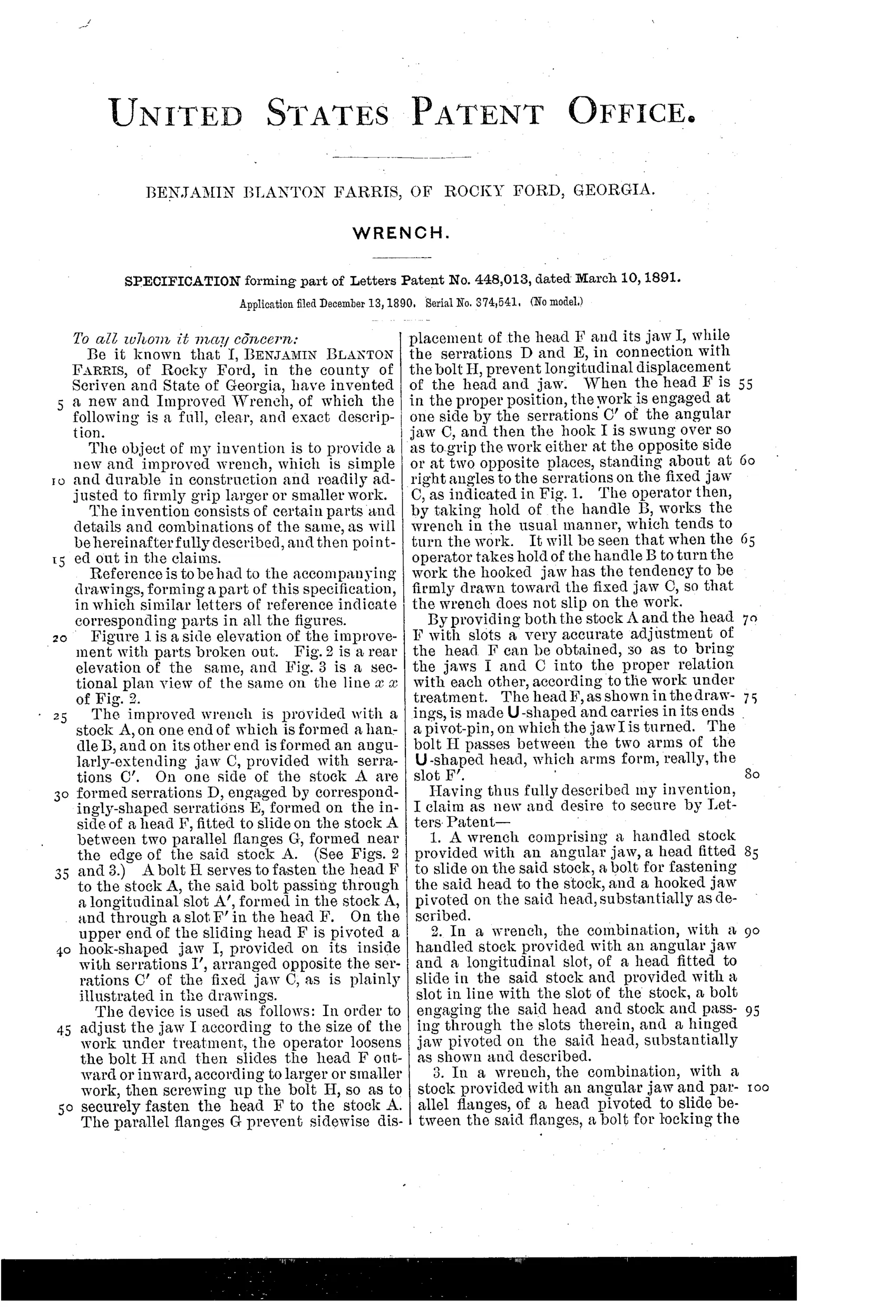
“A wrench comprising a handled stock provided with an angular jaw, a head fitted to slide on the said stock, a bolt for fastening the said head to the stock, and a hooked jaw pivoted on the said head, substantially as described.”
In plain English: The wrench has a handle with a fixed angled jaw, a sliding head locked to the handle by a bolt, and a hook-shaped jaw pivoted on that head.
⚙ In the inventor’s words
“It will be seen that when the operator takes hold of the handle B to turn the work the hooked jaw has the tendency to be firmly drawn toward the fixed jaw C, so that the wrench does not slip on the work.”— Benjamin Blanton Farris, from the specification
Fate unknown
No manufactured example or catalog listing is documented; a marked specimen surfacing would settle it.
⚙ Commentary
Farris's design is really a pipe wrench wearing monkey-wrench clothes. The essential move is in Fig. 1: the hooked, serrated jaw isn't rigidly fixed to the sliding head — it pivots on it. Pull on the handle and the geometry drags that hook toward the fixed jaw, biting harder as you apply more torque. That's the same self-energizing principle that made the Stillson wrench (1869) the pipe fitter's standard, here achieved with a swinging hook instead of a floating jaw on a loose nut.
The adjustment side is cruder. A bolt passes through slots in both the stock and the sliding head; you loosen it, slide the head to size, and cinch it down. Compare that to the Coes screw or even a decent cam lock and it's slow — two hands and a moment of fiddling for every change of pipe size. The cross-section in Fig. 3 shows the head nested between parallel flanges on the stock, which at least keeps the assembly from racking under load.
So: sound gripping geometry, clumsy adjustment. By 1891 the Stillson pattern was already entrenched and cheaply made, and a bolt-and-slot lock offered nothing over it. This reads as an independent rediscovery of a good principle by an inventor far from the Connecticut Valley tool towns — honest work, but arriving after the market had settled. DATAMP records the patent; the trail seems to end there.
Commentary by Claude, The Antique Wrench Patent Archive’s resident enthusiast