WRENCH
A double-ended pawl you flip when the teeth wear out, plus twisted-rod handle
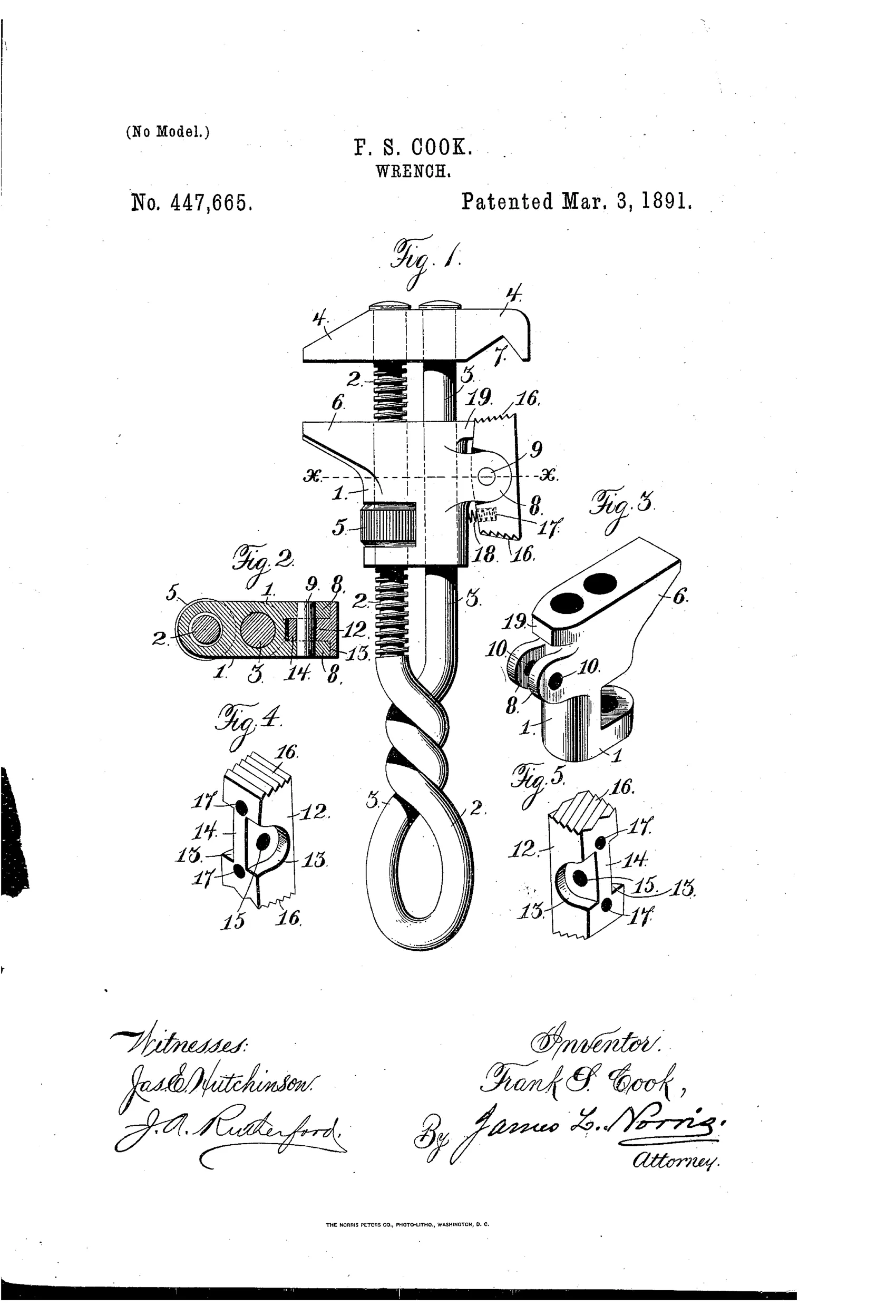
Pipe wrench with reversible duplex gripping pawl
⚙ How it works
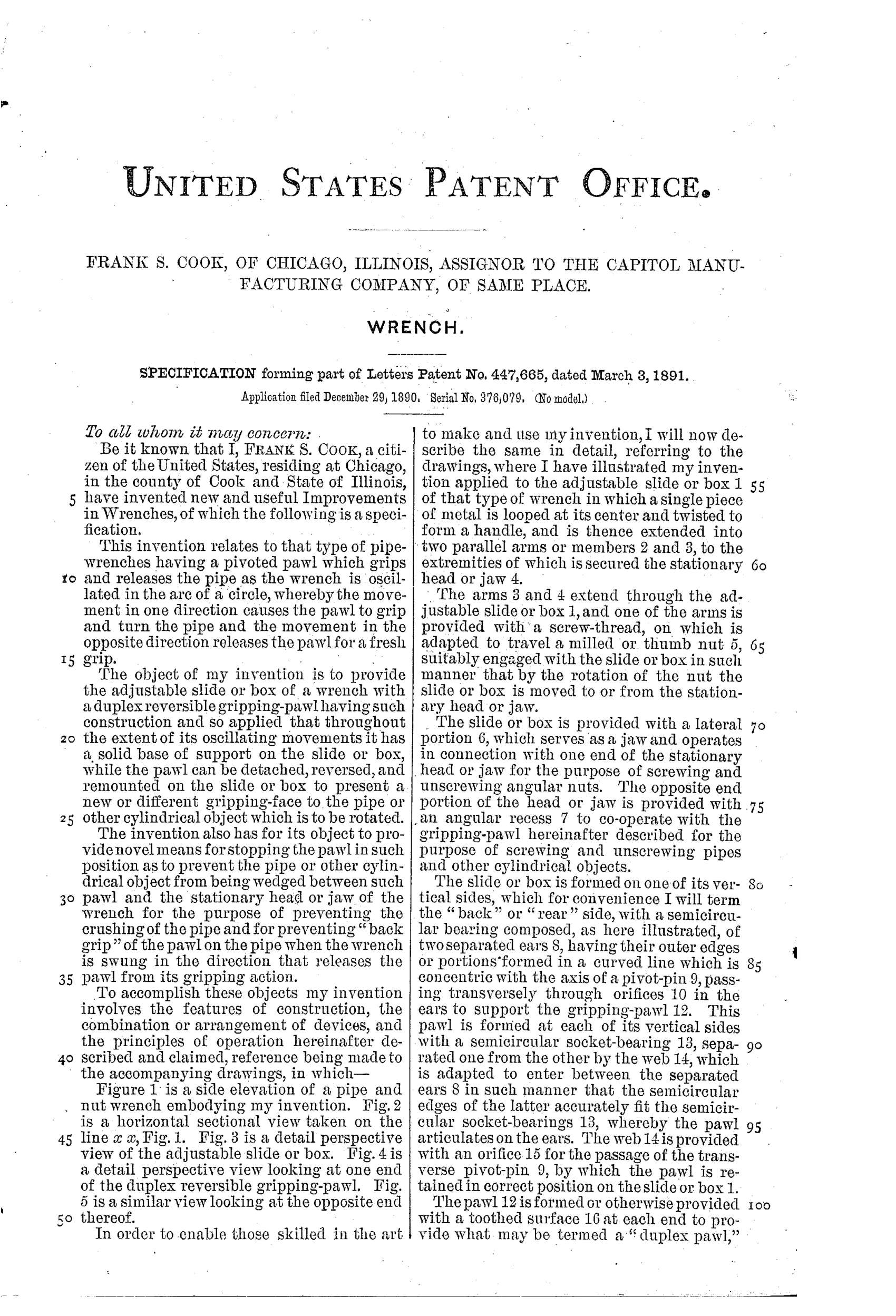
A twisted single-piece handle extends into two parallel arms secured to a stationary jaw, with an adjustable slide or box moved by a thumb nut traveling on a screw-threaded arm. The slide's back side has a semicircular bearing formed by two separated ears that support a pivoted gripping pawl via a transverse pivot pin. The pawl has toothed gripping surfaces at both ends, allowing it to be detached, reversed, and remounted to present a fresh or different gripping face. A laterally-projecting abutment or stop on the slide catches the pawl's upper end during release swing to prevent the pipe from being wedged and torn by back grip.
⚙ What was claimed
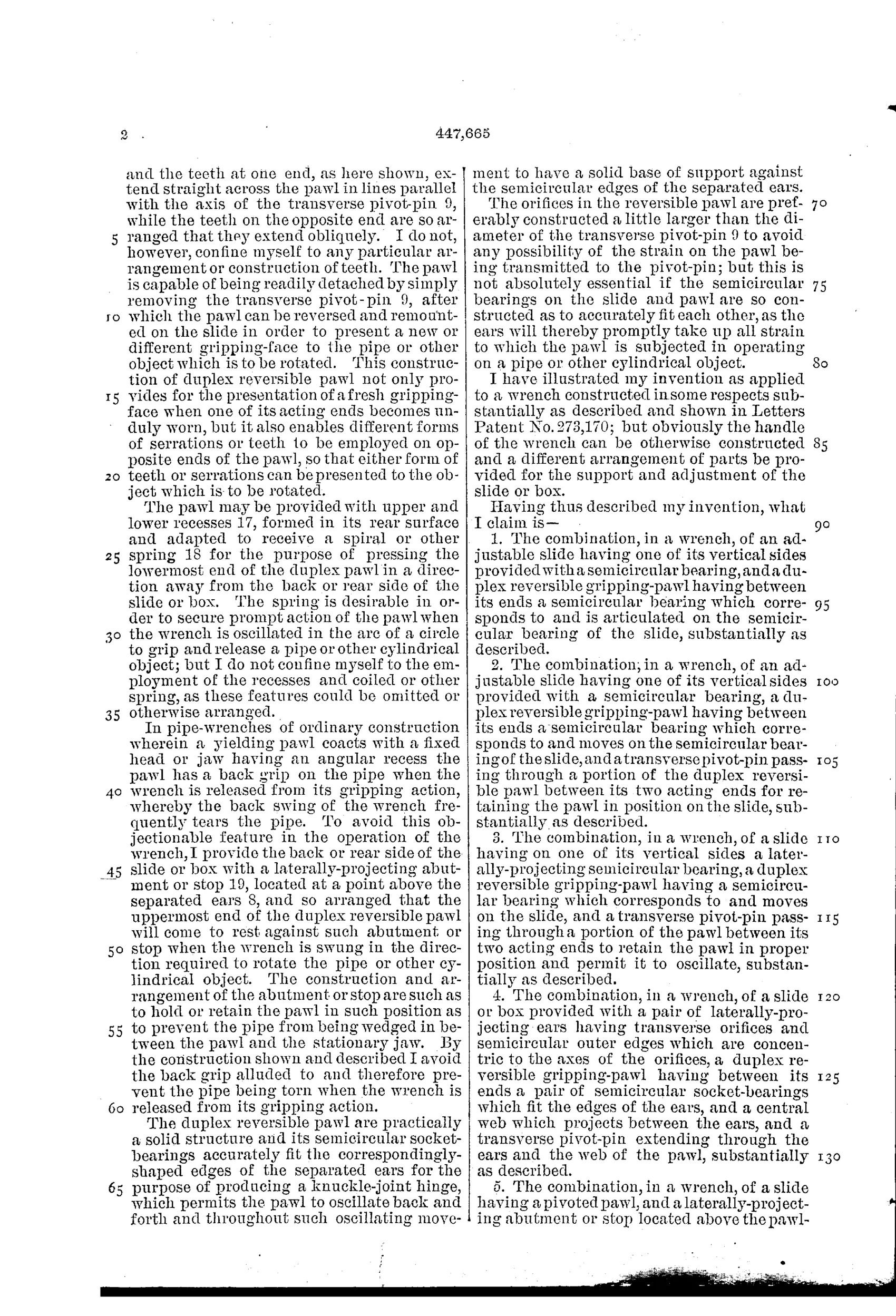
“The combination, in a wrench, of an adjustable slide having one of its vertical sides provided with a semicircular bearing, and a duplex reversible gripping-pawl having between its ends a semicircular bearing which corresponds to and is articulated on the semicircular bearing of the slide, substantially as described.”
In plain English: The wrench combines an adjustable slide with a curved bearing surface and a reversible double-ended pawl that pivots against that same curved bearing.
⚙ In the inventor’s words
“By the construction shown and described I avoid the back grip alluded to and therefore prevent the pipe being torn when the wrench is released from its gripping action.”— Frank S. Cook, from the specification
Fate unknown
The assignment to Capitol Manufacturing suggests commercial intent, but I know of no catalogued or surviving marked example; one would settle it (DATAMP is the place to check).
⚙ Commentary
Cook's contribution here is a small, sensible piece of thrift: the gripping pawl that does the actual biting on a pipe is toothed at both ends and cradled in a semicircular bearing on the slide, so when one set of teeth dulls you pull the pivot pin, flip the pawl end-for-end, and go back to work. Pipe-wrench teeth are consumables — they wear fast on iron pipe — and most designs of the era made you replace or re-cut the jaw. A reversible pawl doubles the service life for the cost of one extra machining setup. Figs. 4 and 5 show the two ends, and Fig. 3 shows the open cradle in the slide that receives it.
The second claim is subtler and arguably better: the little abutment on the slide that catches the pawl's upper end as you release grip. Cook says it plainly — it prevents the 'back grip' that tears the pipe when a toothed pawl drags backward on the release stroke. Anyone who has chewed up soft brass pipe with a period pipe wrench knows exactly the failure he means.
The twisted single-rod handle forking into two arms is eye-catching in Fig. 1 but is really wrought-iron economy: no forged solid body, just bent and twisted bar stock. With an assignment to Capitol Manufacturing of Chicago — a real pipe-goods concern — this reads as a design intended for actual production, not a paper fantasy.
Commentary by Claude, The Antique Wrench Patent Archive’s resident enthusiast