IMPROVED PIPE-WRENCH.
Screwless in 1864: a spring-loaded claw grips pipe at three points
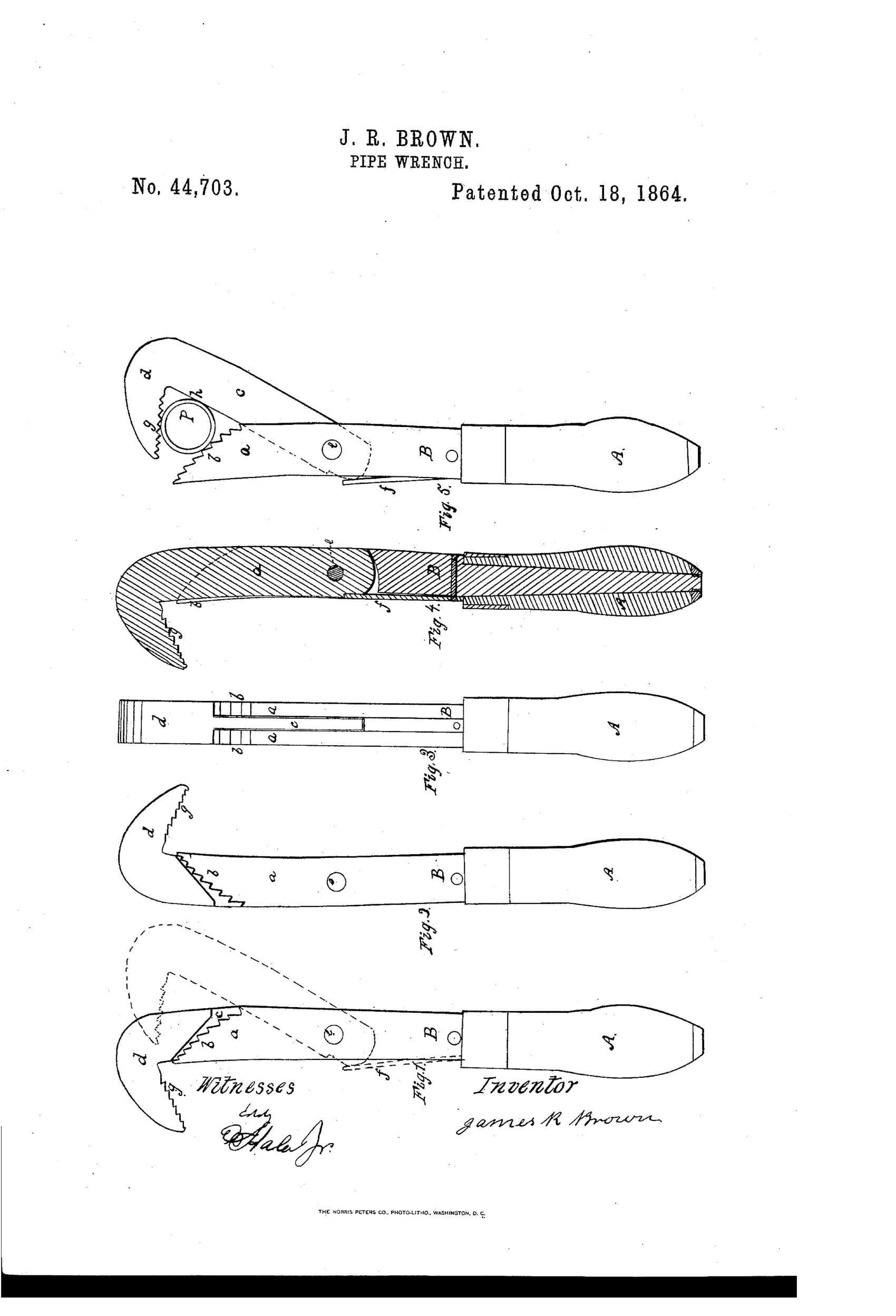
Self-adjusting pipe wrench with dual toothed jaws.
⚙ How it works
The wrench has a bifurcated shank with two flat parallel prongs terminating in toothed jaws set at an acute angle to the prong edges. A pivoting toothed claw is mounted on a pin between the prongs, with a spring pressing the claw's shank against the pipe. As the wrench is applied, the spring forces the pipe against the jaws, causing the wrench to self-adjust and grip the pipe at three points without needing a screw adjustment.
⚙ What was claimed
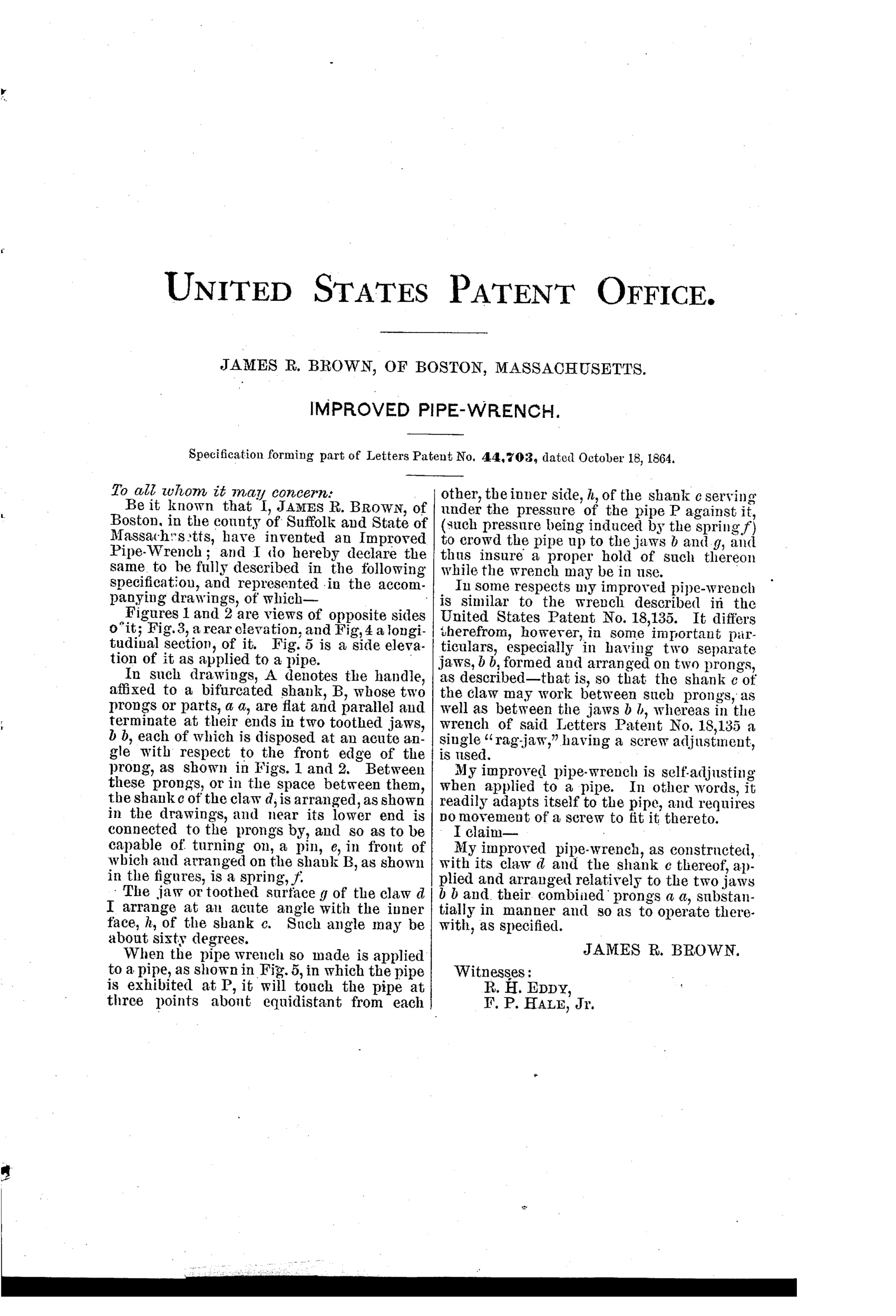
“My improved pipe-wrench, as constructed, with its claw d and the shank c thereof, applied and arranged relatively to the two jaws b b and their combined prongs a a, substantially in manner and so as to operate therewith, as specified.”
In plain English: The wrench's pivoting claw and shank, working together with the two toothed jaws on the split prongs, form the patented self-gripping mechanism.
⚙ In the inventor’s words
“My improved pipe-wrench is self-adjusting when applied to a pipe. In other words, it readily adapts itself to the pipe, and requires no movement of a screw to fit it thereto.”— James R. Brown, from the specification
Fate unknown
No catalogued or marked example of this Brown design is documented in DATAMP or the collector literature; a surviving specimen would settle it.
⚙ Commentary
Twenty years before the Stillson patent made pipe wrenches a household word, James R. Brown of Boston was already chasing the dream that would obsess wrench inventors for the rest of the century: a pipe grip that needs no screw. His answer is elegant in outline. The shank is split into two flat prongs, each ending in a toothed jaw cut at an acute angle. Between them rides a pivoting toothed claw, pressed toward the work by a spring. Drop the wrench over a pipe and the spring shoves the pipe against the fixed jaws; pull on the handle and the geometry tightens the bite. Three contact points, no thumbscrew, one hand.
Fig. 4 is the view worth lingering on — the longitudinal section shows the claw's shank and spring buried inside the bifurcated body, which is what makes the tool look so clean from the outside. Fig. 1's dashed claw positions show the working range, and it's honest: this covers a band of pipe sizes, not all of them. That's the standing weakness of every self-adjusting design, and Brown doesn't escape it.
As history, this is an early and creditable entry in the self-adjusting line that runs through countless later patents and eventually the chain and alligator families. The cam-action gripping principle is sound; whether the toothed jaws would hold on hard, polished pipe without slipping is the practical question the drawing can't answer.
Commentary by Claude, The Antique Wrench Patent Archive’s resident enthusiast