WRENCH.
A Maine inventor squeezes wrench, brace, and screwdriver into one cranked stock
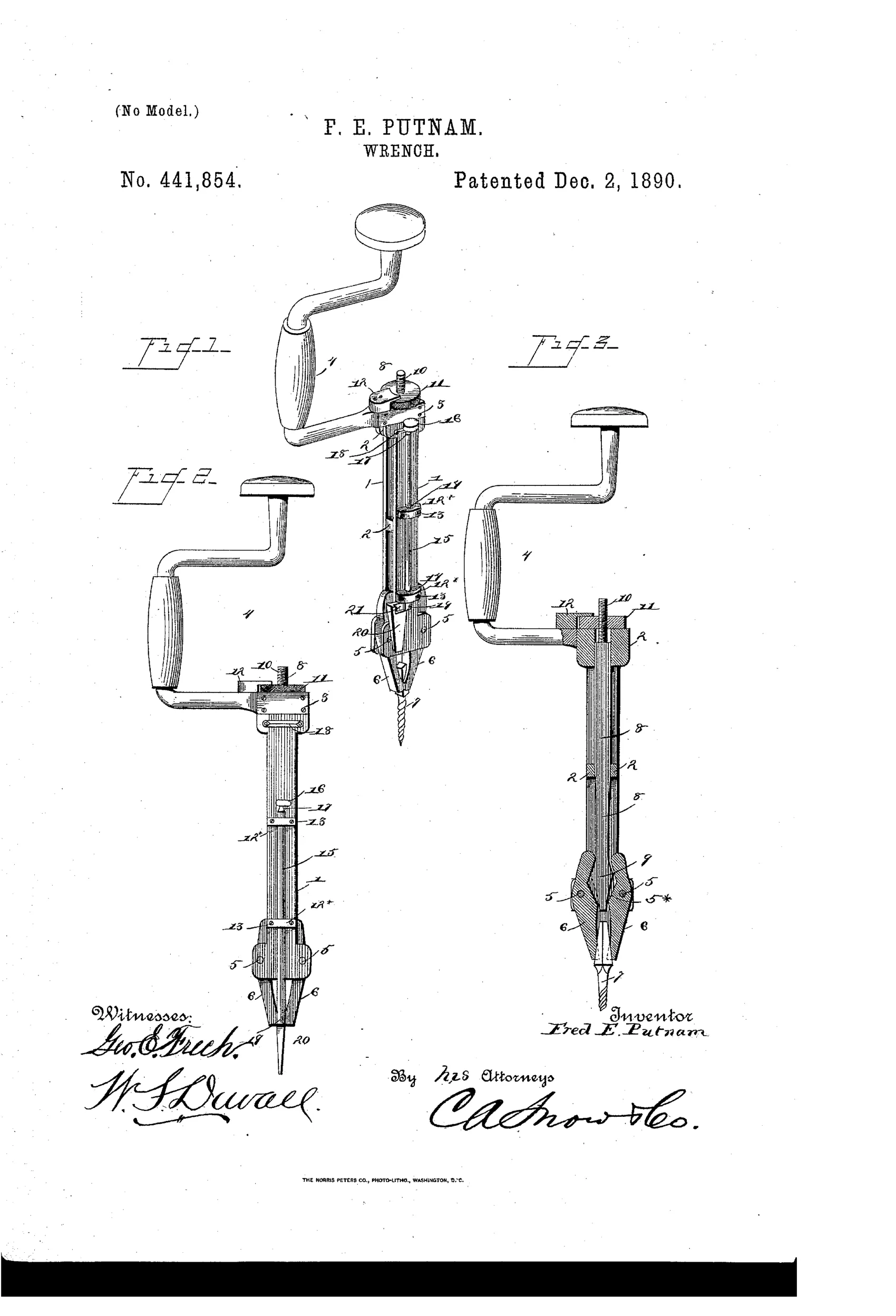
Combination wrench, bit-brace, and screwdriver tool
⚙ How it works
The stock is formed of two spaced plates holding a pair of pivoted rigid jaws whose inner rear faces have oppositely inclined recesses forming an arrow-shaped cavity. A plunger-rod slides longitudinally within the stock, its arrow-shaped head engaging the jaw recesses so that moving the rod spreads or closes the jaws to grip nuts, bit shanks, or a screw-driving blade of various sizes. The rod is operated by a threaded upper end fitted with a milled nut retained by an L-shaped keeper block, and a bifurcated crank handle fits over the stock head to turn the whole assembly like a brace. A separate cylindrical rod carrying a screw-driving blade and cam-disk can be mounted in brackets on the stock and locked or released via a cam-and-rib arrangement, allowing the same jaws to grip and rotate the screwdriver blade as well.
⚙ What was claimed
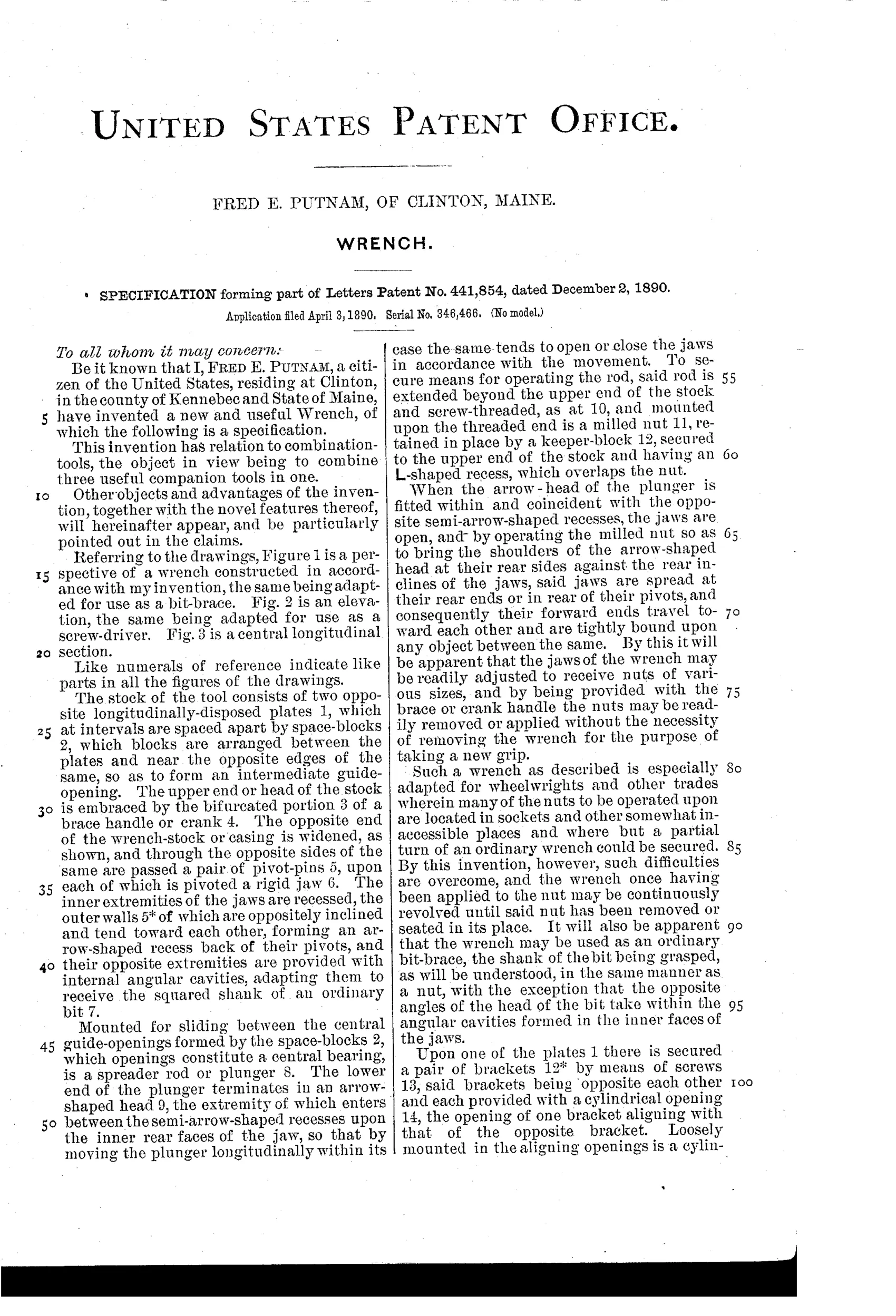
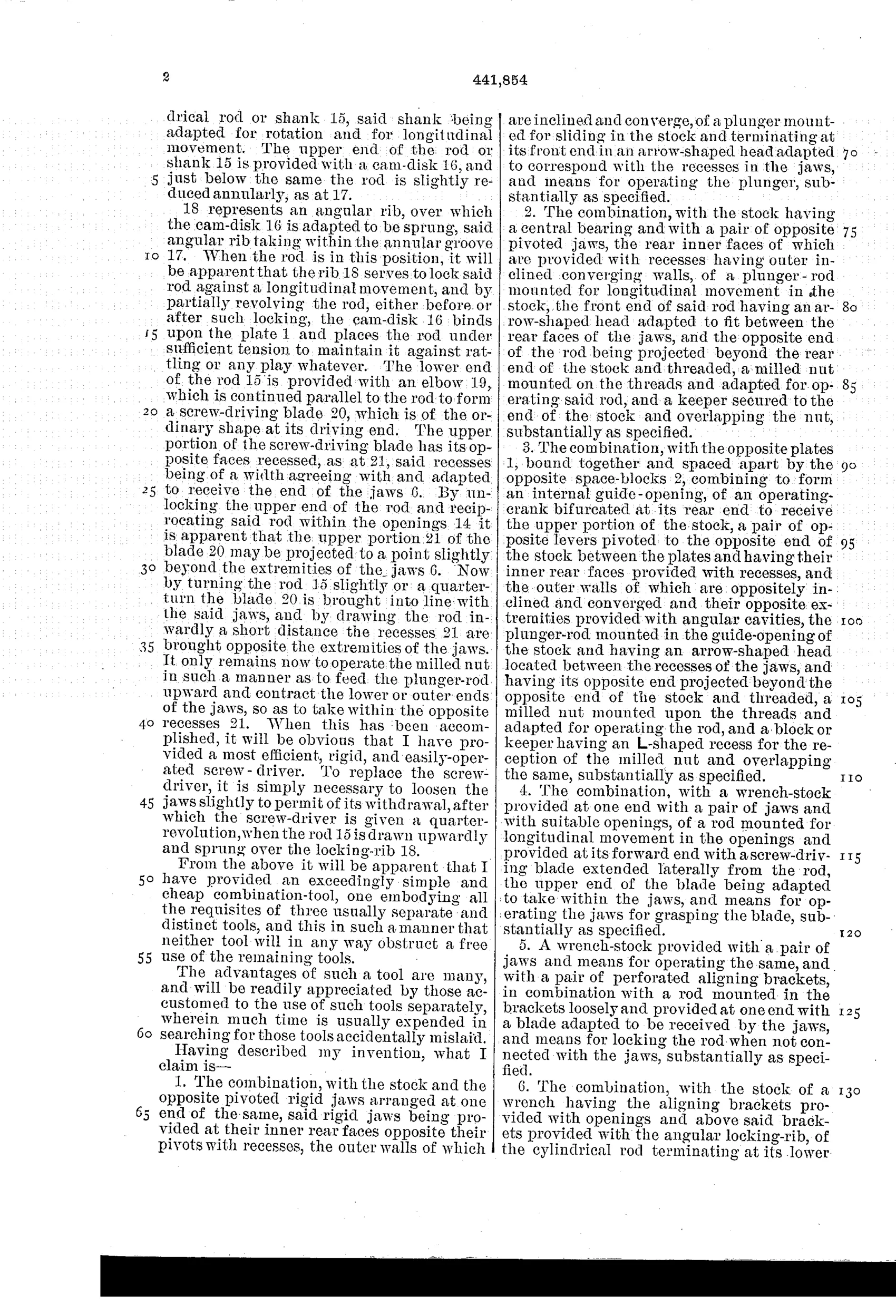
“The combination, with the stock and the opposite pivoted rigid jaws arranged at one end of the same, said rigid jaws being provided at their inner rear faces opposite their pivots with recesses, the outer walls of which are inclined and converge, of a plunger mounted for sliding in the stock and terminating at its front end in an arrow-shaped head adapted to correspond with the recesses in the jaws, and means for operating the plunger, substantially as specified.”
In plain English: A wrench with pivoted jaws having angled recesses at their rear, combined with a sliding plunger tipped with an arrow-shaped head that fits those recesses and, together with a way to move the plunger, spreads or closes the jaws.
⚙ In the inventor’s words
“This invention has relation to combination-tools, the object in view being to combine three useful companion tools in one.”— Fred E. Putnam, from the specification
Fate unknown
No manufactured specimen or catalog listing is documented; a marked example would settle it.
⚙ Commentary
Fred Putnam of Clinton, Maine, filed this in the spring of 1890 with an ambition typical of the era: why sell a man three tools when one will do? The core idea is genuinely neat. Two rigid jaws pivot at the tip of a slotted stock, and their rear faces carry angled recesses forming an arrow-shaped pocket. A plunger rod with a matching arrow head slides down the stock; drive it forward and the jaws close, back and they open. It is a wedge-and-lever grip rather than the screw-adjusted sliding jaw everyone else was refining, and the arrow head bearing on both inclined faces at once is the clever bit — it centers the work as it clamps.
Look at Fig. 3, the section, and you see the price paid: a threaded plunger end, a milled nut, an L-shaped keeper, brackets, and a separate cam-locked rod for the screwdriver blade. That is a lot of small parts to make a tool that is a mediocre wrench, an awkward brace, and a heavy screwdriver. The crank handle also means the wrench cannot swing flat against a nut in a tight spot, which is where wrenches earn their keep.
As a wrench it sits well outside the Coes lineage — this is combination-tool territory, a crowded corner of the 1890s patent record where mechanical ingenuity regularly outran commercial sense. DATAMP records the patent; I know of no marked example.
Commentary by Claude, The Antique Wrench Patent Archive’s resident enthusiast