MONKEY-WRENCH.
A monkey wrench that opens like scissors: jaws on prongs, worked by links
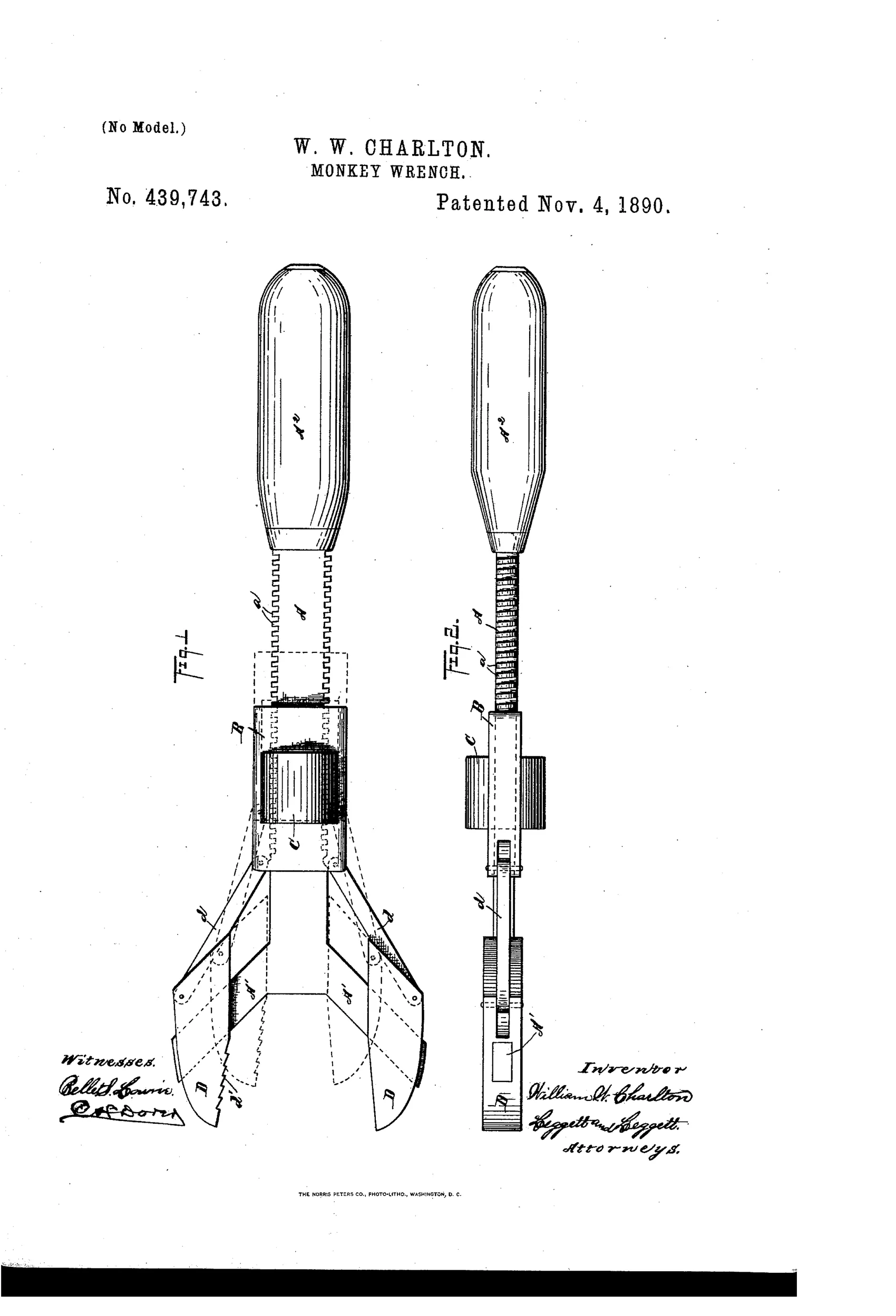
Adjustable monkey wrench with divergent, screw-slid jaws
⚙ How it works
A flat wrench-bar has screw-threaded edges and divergent prongs at one end, with a handle at the other. A sleeve carrying a threaded thumb-nut slides on the bar and engages the screw threads to move the sleeve along the bar. The jaws, mounted on the diverging prongs, are connected to the sleeve by links, so turning the thumb-nut in either direction moves the jaws toward or away from each other to grip nuts, rods, or pipes of different sizes.
⚙ What was claimed
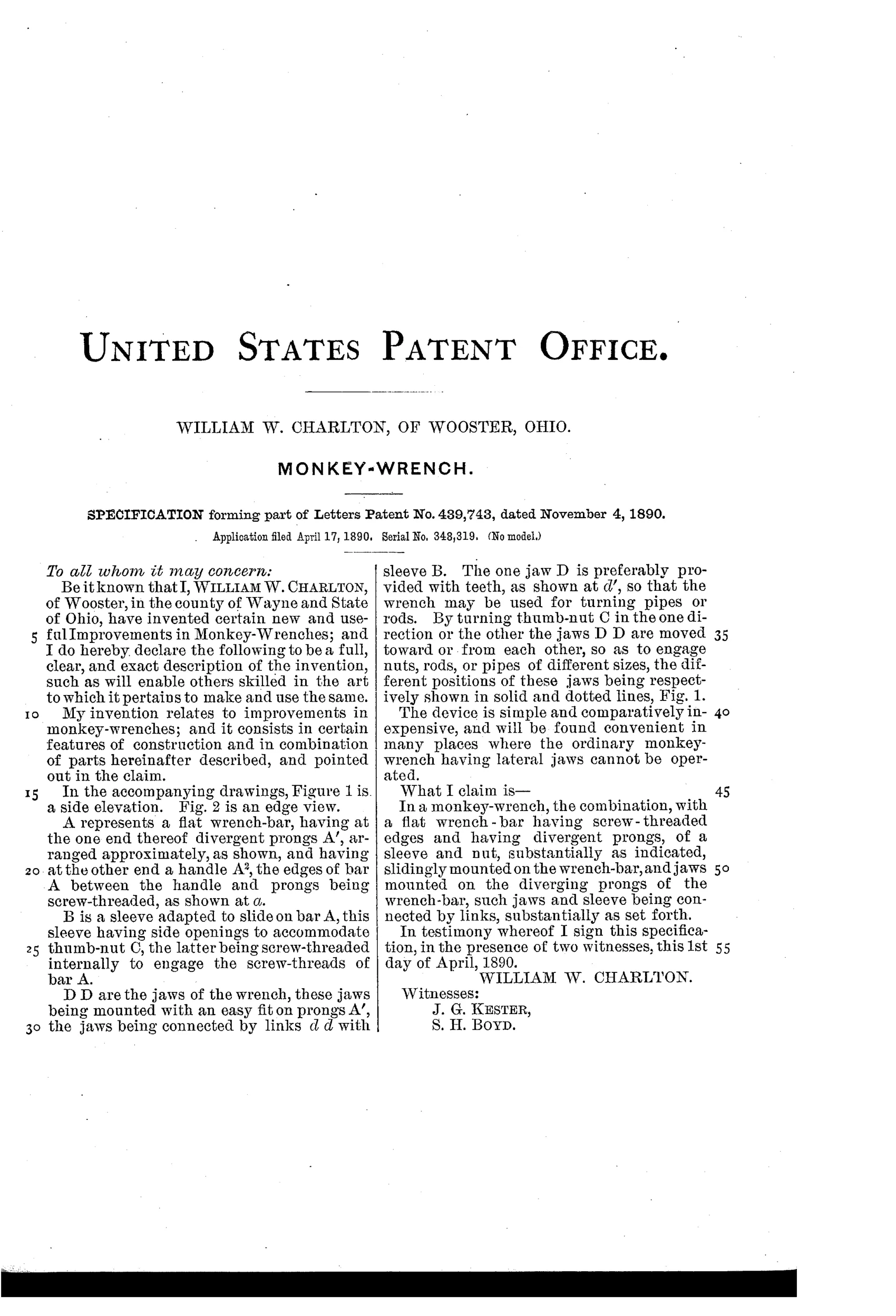
“In a monkey-wrench, the combination, with a flat wrench-bar having screw-threaded edges and having divergent prongs, of a sleeve and nut, substantially as indicated, slidingly mounted on the wrench-bar, and jaws mounted on the diverging prongs of the wrench-bar, such jaws and sleeve being connected by links, substantially as set forth.”
In plain English: The wrench combines a screw-threaded bar with divergent prongs, a sliding sleeve and nut, and jaws on the prongs linked to the sleeve so turning the nut opens or closes the jaws.
⚙ In the inventor’s words
“The device is simple and comparatively inexpensive, and will be found convenient in many places where the ordinary monkey-wrench having lateral jaws cannot be operated.”— William W. Charlton, from the specification
Fate unknown
No manufactured example or catalogued maker is associated with this design; a marked surviving wrench would settle it.
⚙ Commentary
Charlton takes the monkey wrench name and throws away most of the monkey wrench. Instead of a fixed jaw and a sliding jaw stacked on a bar, he splits the end of the bar into two divergent prongs and lets both jaws slide outward along them. A sleeve rides the bar on threaded edges — turn the thumb-nut and the sleeve travels; links from the sleeve to each jaw drag them down the prongs toward each other, or up and apart. Fig. 1 shows both positions in dashed lines, and it is worth a slow look: the jaws don't just move, they spread, so the opening range for a given bar length is much larger than a conventional wrench of the same size.
The payoff is his own stated one: the jaws face forward off the end of the tool rather than sideways, so it reaches nuts in recesses where a lateral-jaw wrench can't turn. The toothed jaw faces make it a nut-and-pipe combination tool in the 1890s fashion.
The cost is rigidity. Every ounce of gripping force runs through two pin-jointed links and a sleeve riding on thread edges — a lot of small clearances between the nut and your hand. Under real torque those links want to flex and the jaws want to skew on their prongs. Clever geometry, doubtful backbone; a characteristic dead end in a decade full of them. DATAMP records the patent.
Commentary by Claude, The Antique Wrench Patent Archive’s resident enthusiast