IMPROVED PIPE-WRENCH.
An 1864 knuckle joint that shields its own pivot pin from strain
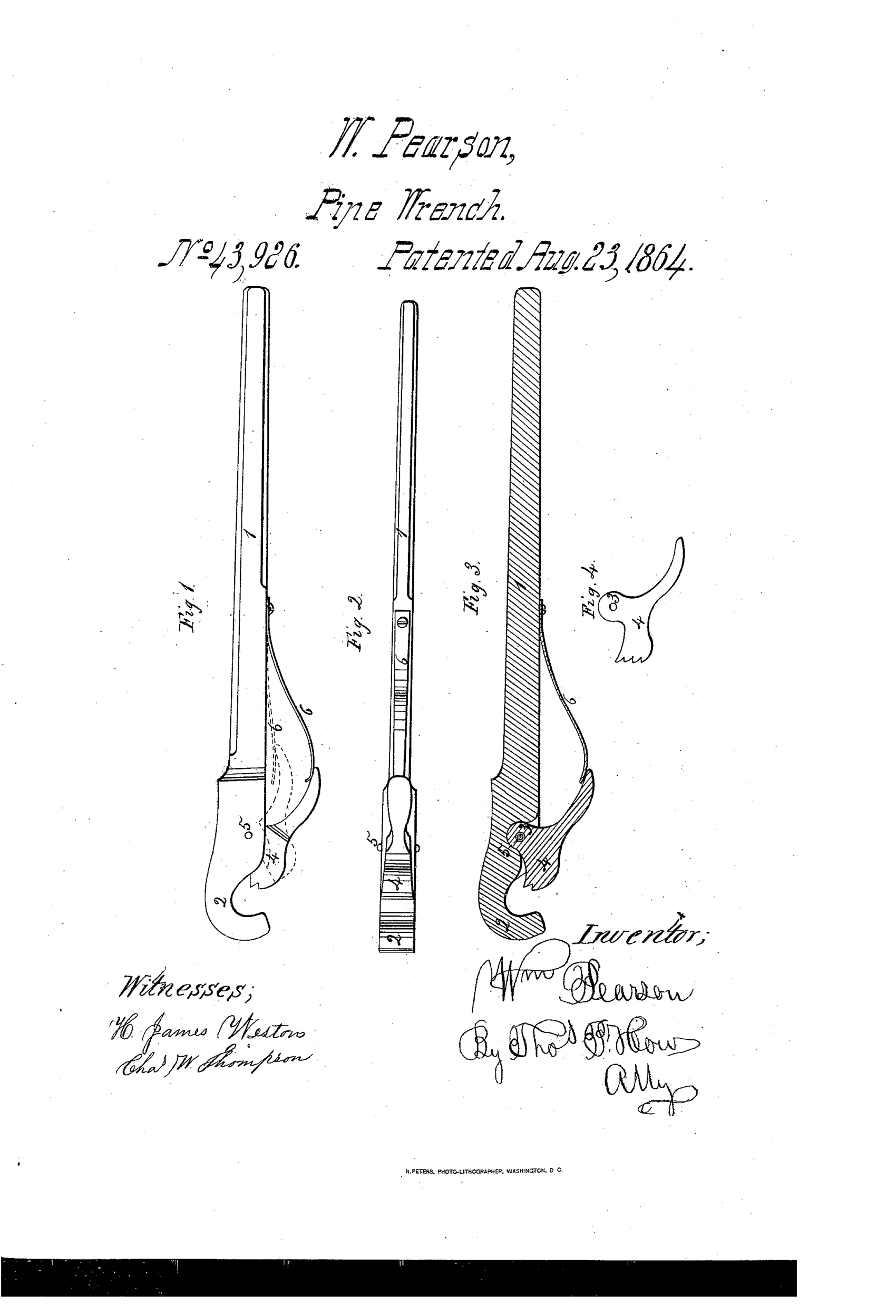
A hinged, eccentric-jaw pipe wrench
⚙ How it works
A lever forms one jaw of the wrench and is recessed to give a concave socket that receives the knuckle of the movable jaw. A pin passes through both parts but is loosely fitted so that operating strain is carried by the socket rather than the pin. The movable jaw has an eccentric, toothed face and is held in engagement by a spring bearing against its heel, allowing it to swing into and out of gripping position. A shoulder on the movable jaw rests against the lever to prevent the joint from being cramped or the pin damaged during use.
⚙ What was claimed
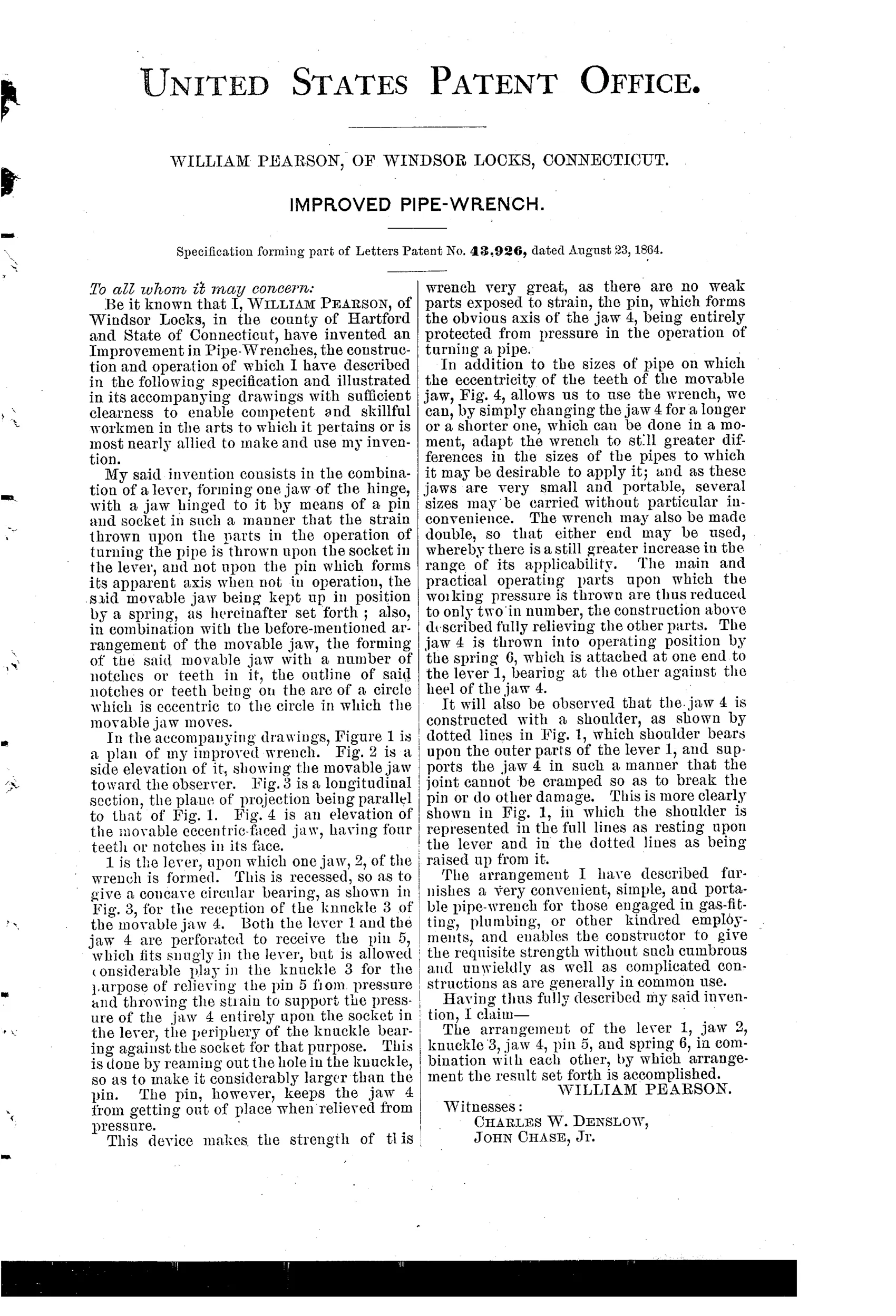
“The arrangement of the lever 1, jaw 2, knuckle 3, jaw 4, pin 5, and spring 6, in combination with each other, by which arrangement the result set forth is accomplished.”
In plain English: The claim covers the specific combination of the lever, fixed jaw, knuckle joint, movable eccentric jaw, pin, and spring working together as described.
⚙ In the inventor’s words
“This device makes the strength of this wrench very great, as there are no weak parts exposed to strain, the pin, which forms the obvious axis of the jaw 4, being entirely protected from pressure in the operation of turning a pipe.”— William Pearson, from the specification
Fate unknown
No production history or marked example is documented in the standard references; a surviving specimen or period hardware listing would settle it.
⚙ Commentary
Pearson's problem is the one that haunts every hinged pipe wrench: the pivot pin. Grip a pipe hard, lean on the handle, and all that torque wants to shear the little pin that holds the movable jaw. His answer is quietly clever — the knuckle of the swinging jaw sits in a concave socket recessed into the lever itself, and the pin is deliberately fitted loose. Under load, the knuckle bears directly against the socket like a ball in a cup; the pin does nothing but keep the parts assembled. Fig. 3, the longitudinal section, is where you see this — the casual reader sees a hinge, but the section shows the pin floating in clearance while the bearing surfaces do the work.
The eccentric, toothed jaw (Fig. 4) is standard self-tightening logic: the harder the pipe resists, the deeper the jaw cams into it, with a spring at the heel keeping the teeth in first contact. A shoulder on the jaw stops the joint from over-rotating and cramping. None of that is novel by 1864; the strain-relieved pivot is the contribution.
This sits early in the pipe-wrench story — a good decade before Stillson's 1869 patent settled the question of what a pipe wrench should look like. Pearson's design would probably work, but the Stillson pattern's simplicity is exactly what designs like this lost to. A thoughtful dead end, which is not the same as a foolish one.
Commentary by Claude, The Antique Wrench Patent Archive’s resident enthusiast