COMBINED NUT-WRENCH AND TOOL
A quick-adjust rack wrench that also cuts wire, drives screws, and cracks nuts
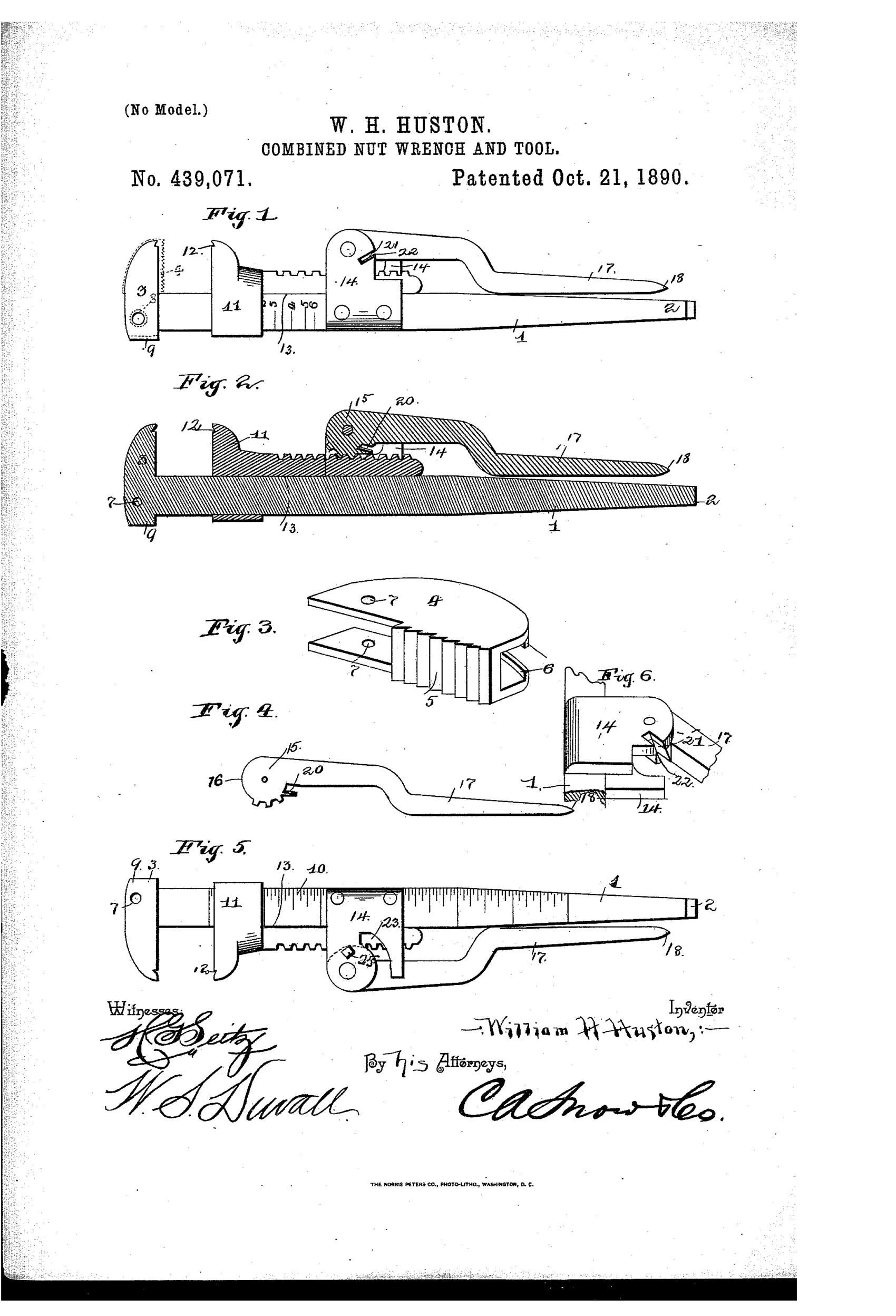
Multi-tool combination wrench with pipe attachment
⚙ How it works
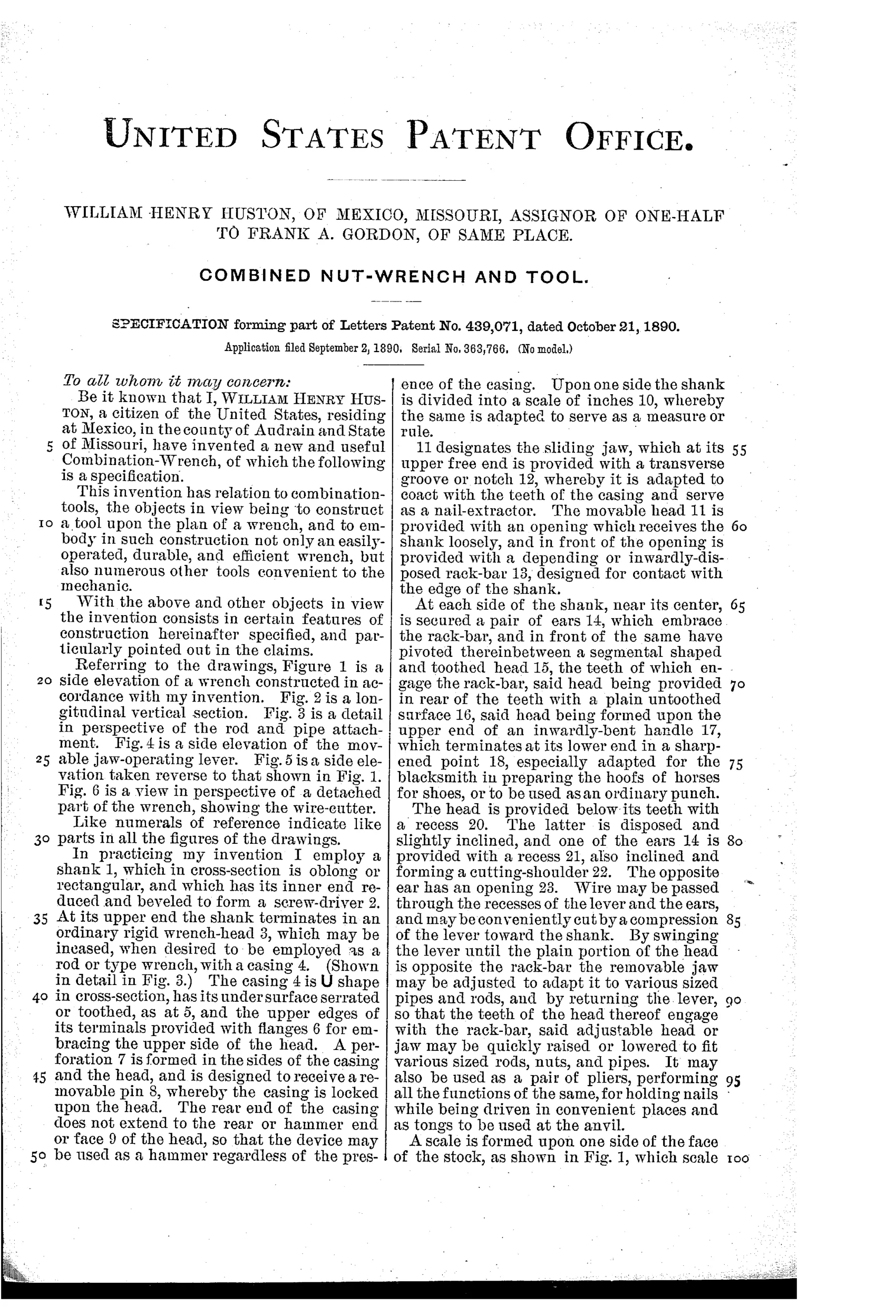
A rectangular shank forms a screwdriver at one end and a fixed wrench head at the other, with a sliding jaw riding a rack-bar engaged by a toothed, pivoted hand-lever between two ears. A removable U-shaped, toothed casing can be locked over the fixed head with a pin to serve as a pipe or rod wrench, while the shank's opposite side carries an inch scale. The lever's segmental head has a plain untoothed portion so swinging it disengages the rack, letting the jaw slide freely to adjust for various nut, rod, or pipe sizes, then re-engage by returning the lever. Wire-cutting shoulders in the ear slots and lever recess allow wire to be sheared by compressing the lever toward the shank, and the tool's point, hammer face, and tri-square edges add hammer, punch, and square functions.
⚙ What was claimed
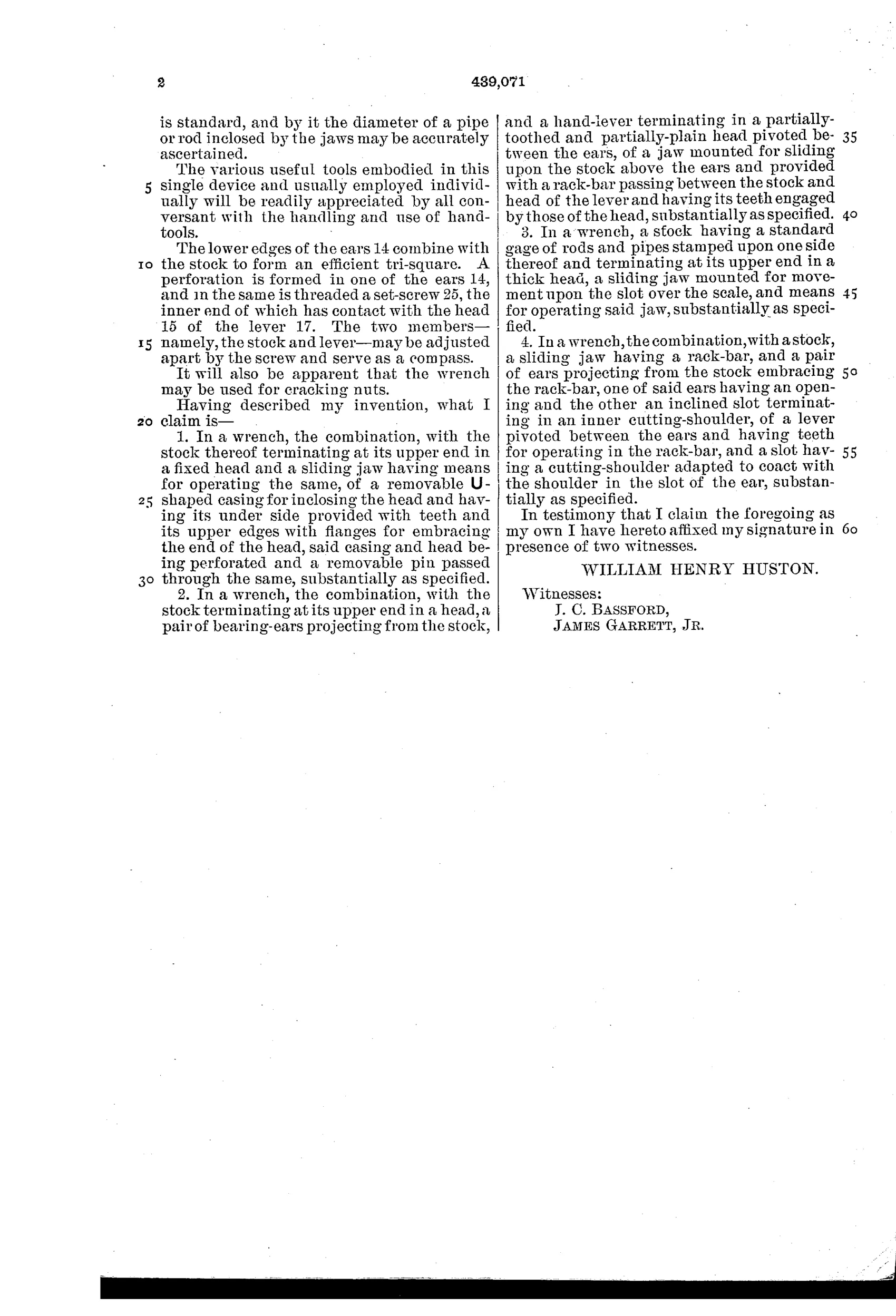
“In a wrench, the combination, with the stock thereof terminating at its upper end in a fixed head and a sliding jaw having means for operating the same, of a removable U-shaped casing for inclosing the head and having its under side provided with teeth and its upper edges with flanges for embracing the end of the head, said casing and head being perforated and a removable pin passed through the same, substantially as specified.”
In plain English: The wrench's fixed head can be fitted with a removable toothed U-shaped casing, locked on with a pin, to convert it into a pipe or rod wrench.
⚙ In the inventor’s words
“It will also be apparent that the wrench may be used for cracking nuts.”— William Henry Huston, from the specification
Fate unknown
No manufactured example or catalog listing is documented; a marked specimen with the pin-on pipe casing would settle it.
⚙ Commentary
Huston's patent is really two ideas stacked on top of each other. The first is a legitimate quick-adjust mechanism: the sliding jaw rides a rack-bar, and a pivoted lever with a toothed segmental head locks it. Because part of that segment is left smooth, swinging the lever disengages the teeth entirely and the jaw slides freely — a one-hand coarse adjustment with positive lock, which is exactly the problem the best 1890s wrench inventors were chasing. Figure 4 shows the lever plainly: teeth on one arc, blank on the other. That alone would have made a respectable patent.
The second idea is the removable U-shaped casing of Fig. 3 — a toothed shoe that pins over the smooth fixed head to convert the nut wrench into a pipe wrench. Slip-on pipe jaws were a recurring dream in this era, and they mostly failed for the same reason: a pinned sheet-metal casing takes the full twisting load, and pipe work is brutal on jaws.
Then the kitchen sink arrives — wire-cutting shoulders in the lever slot, a screwdriver tip, hammer face, tri-square edges, an inch scale, and the specification's cheerful note that 'the wrench may be used for cracking nuts.' The quick-adjust lever is genuinely clever; the rest is the familiar 1890 conviction that a farmer would pay for one tool that did ten things. Per DATAMP, no production version is recorded.
Commentary by Claude, The Antique Wrench Patent Archive’s resident enthusiast