PIPE-WRENCH.
Two flaring slots and a ball-seat nut make the whole adjustment
Self-tightening adjustable pipe wrench
⚙ How it works
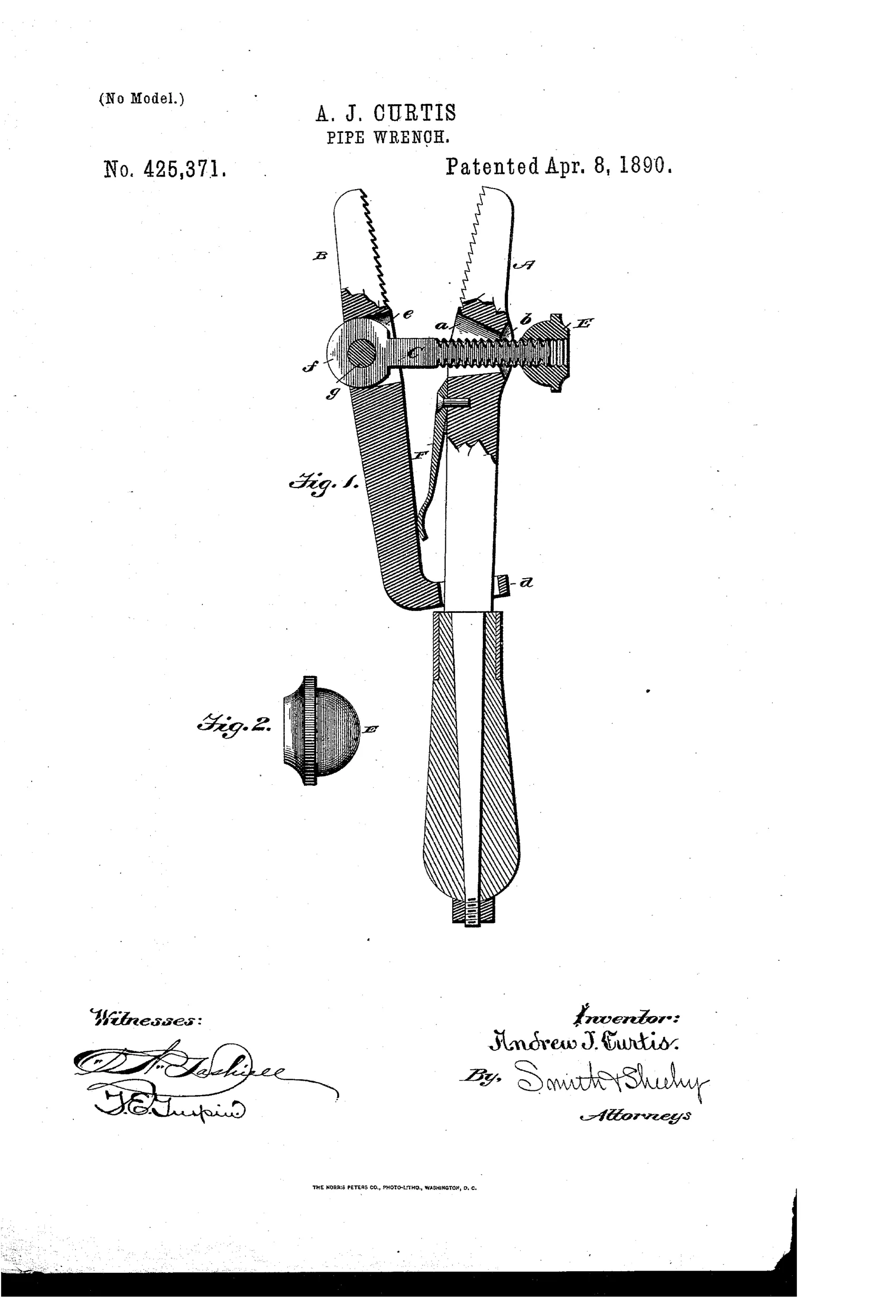
A fixed jaw with a toothed face carries a flaring, tapering slot through which a threaded pivoted lever passes. A sliding jaw, fitted with a loop over the fixed jaw's shank, is connected to this lever by a pivot bolt riding in a similar flaring slot in the sliding jaw. A convex nut threads onto the lever's outer end and seats into a concave countersink on the fixed jaw, so turning the nut draws the jaws together with force proportional to the torque applied. A spring bears against the sliding jaw to normally hold the jaws open, and moving the handle in one direction cams the jaws shut via the eccentric joint while movement in the opposite direction releases them instantly.
⚙ What was claimed
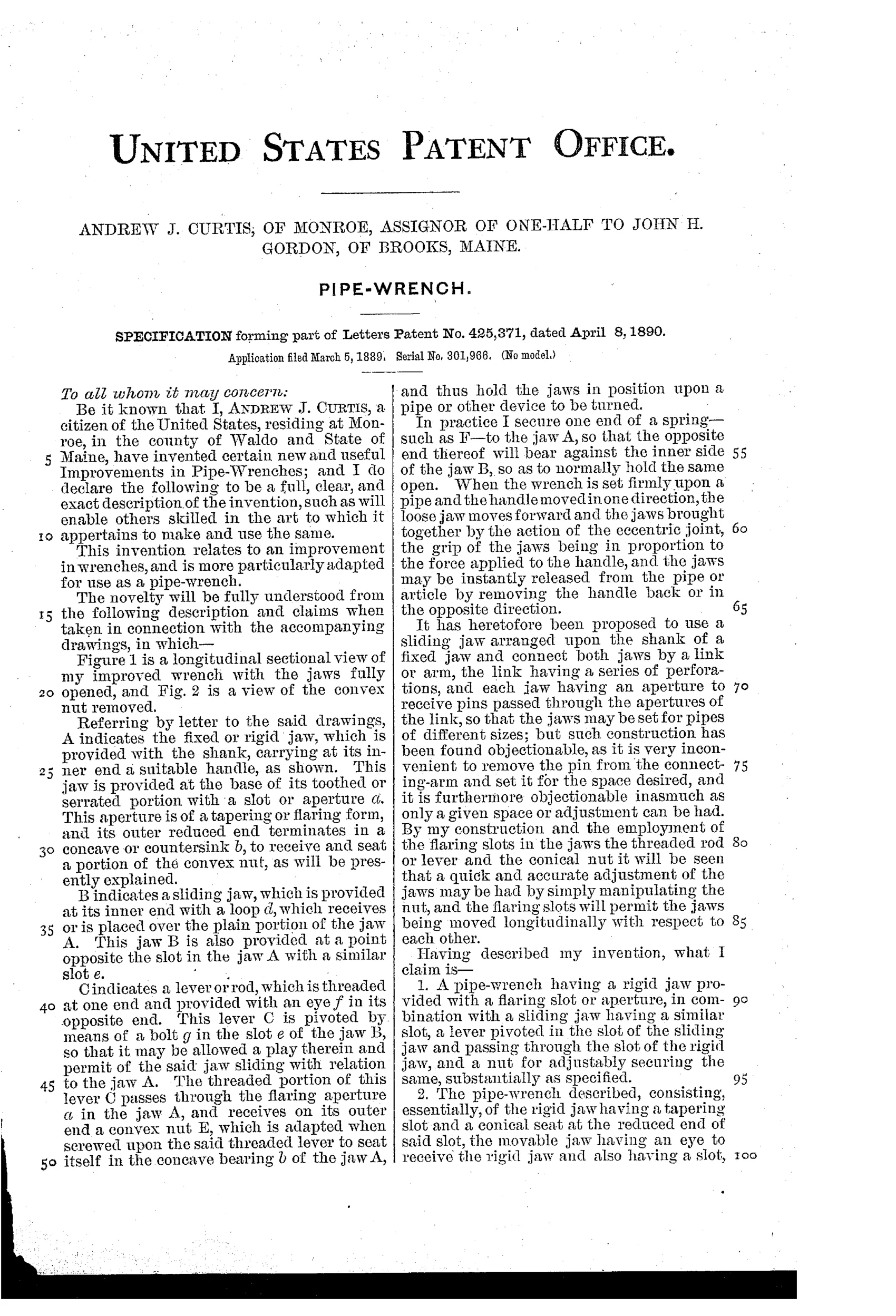
“A pipe-wrench having a rigid jaw provided with a flaring slot or aperture, in combination with a sliding jaw having a similar slot, a lever pivoted in the slot of the sliding jaw and passing through the slot of the rigid jaw, and a nut for adjustably securing the same, substantially as specified.”
In plain English: The wrench has two jaws each with a tapered slot, joined by a pivoting threaded lever and a nut, letting the jaws be quickly adjusted and locked to grip a pipe.
⚙ In the inventor’s words
“By my construction and the employment of the flaring slots in the jaws the threaded rod or lever and the conical nut it will be seen that a quick and accurate adjustment of the jaws may be had by simply manipulating the nut.”— Andrew J. Curtis, from the specification
Fate unknown
No manufactured example matching this design is catalogued in DATAMP or collector references; a marked specimen would settle it.
⚙ Commentary
Curtis's wrench works by geometry rather than gearing. Both jaws carry tapered, flaring slots; a threaded lever passes through both, and a convex nut (Fig. 2, the little acorn-shaped piece) seats into a matching concave countersink on the fixed jaw. Because the nut's face is spherical, the lever can swing to different angles inside the flaring slots while the nut stays fully seated — that ball-and-socket detail is the quiet cleverness here. Loosen the nut, swing the lever, and the sliding jaw's loop carries it up or down the shank to a new pipe size; snug the nut and you're locked.
The self-tightening action is the standard pipe-wrench trick of the era: pull the handle one way and the eccentric joint cams the toothed jaws into the pipe, with a spring holding them open at rest for one-handed placement. Fig. 1's sectional view shows how much of the mechanism lives in that crowded middle zone between the jaws — the spring F, the pivot bolt, the threaded lever all sharing a couple of square inches.
Where it sits in the story: this is 1890, the thick of the quick-adjust rush, five years before Stillson-pattern wrenches had fully swept the field. It's an honest attempt, but each size change means loosening and re-seating a nut — slower in practice than the claim's 'simply manipulating the nut' suggests. A rural Maine patent with a half-interest assigned to a neighbor in Brooks reads like local hope more than factory backing.
Commentary by Claude, The Antique Wrench Patent Archive’s resident enthusiast