WRENCH.
Half-threaded tube and pawl trade the monkey wrench's slow screw for a slide
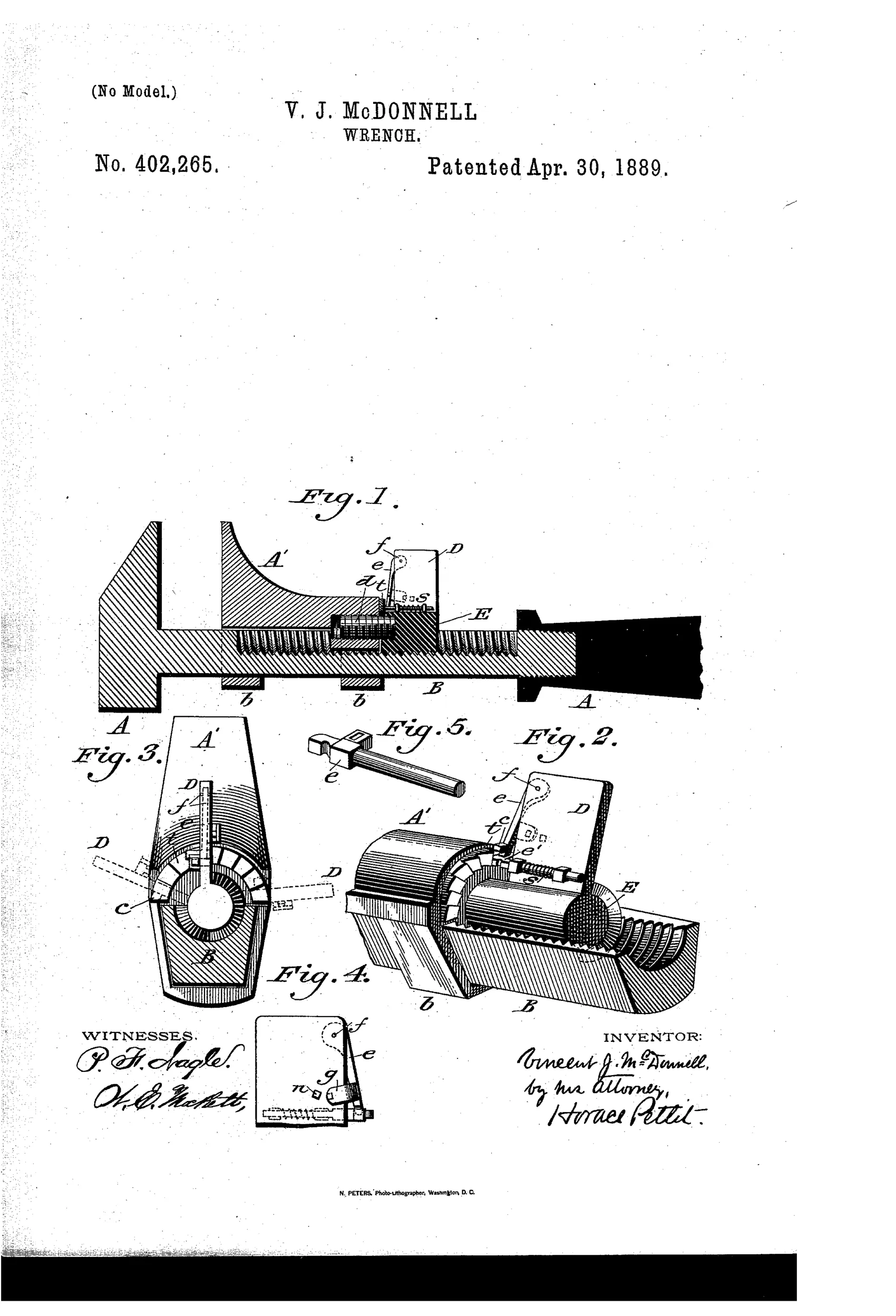
Quick-adjusting monkey wrench with pawl-locking sliding collar
⚙ How it works
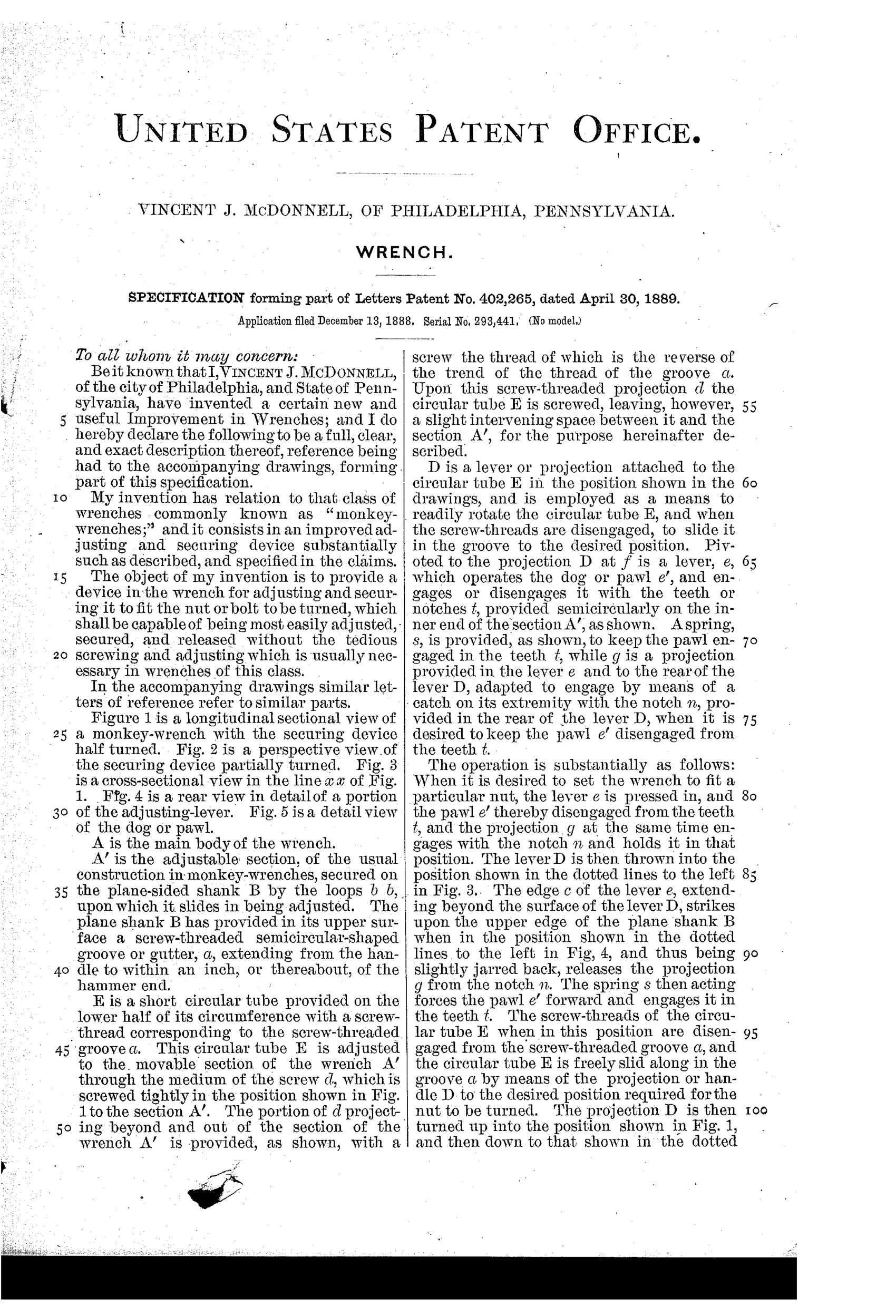
A tubular section E with external screw-threads is fitted around the plane-sided shank B, engaging a semicircular screw-threaded groove a on the shank. A handle D attached to tube E allows the user to disengage the threads and slide the tube freely along the groove to roughly position the adjustable jaw A' for the nut size. A spring-loaded pawl e', operated by lever e pivoted on D, engages notches or teeth t on the adjustable section A' to hold the tube's rotational position; a catch and notch n let the pawl be held disengaged while sliding. Once positioned, turning tube D re-engages the screw threads, which due to opposing thread trends of groove a and screw d, tends to further tighten the jaw onto the nut.
⚙ What was claimed
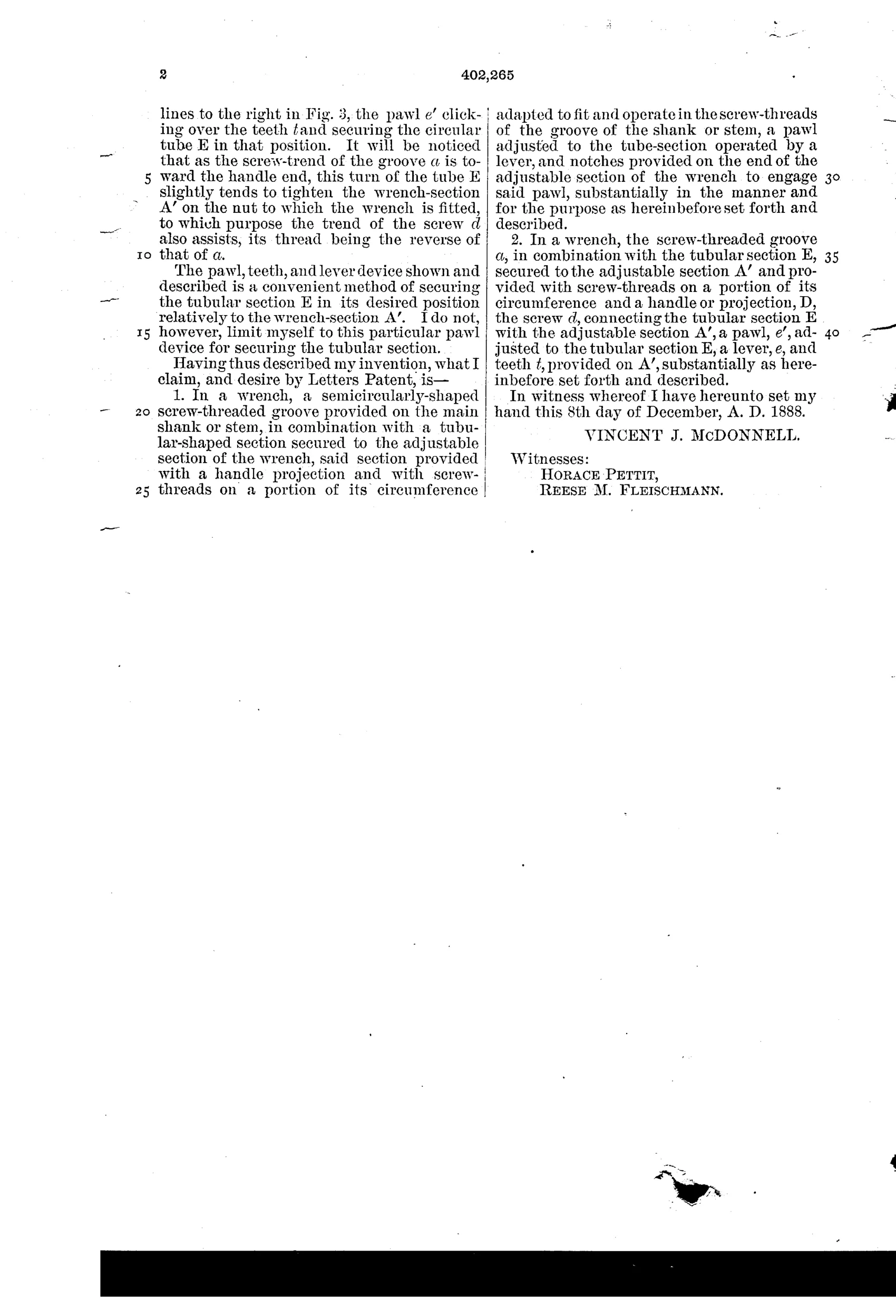
“1. In a wrench, a semicircularly-shaped screw-threaded groove provided on the main shank or stem, in combination with a tubular-shaped section secured to the adjustable section of the wrench, said section provided with a handle projection and with screw-threads on a portion of its circumference adapted to fit and operate in the screw-threads of the groove of the shank or stem, a pawl adjusted to the tube-section operated by a lever, and notches provided on the end of the adjustable section of the wrench to engage said pawl, substantially in the manner and for the purpose as hereinbefore set forth and described.”
In plain English: The wrench combines a threaded groove on the shank with a sliding, threaded tube on the movable jaw that has a handle and a lever-operated pawl locking into notches, letting the user quickly slide and then lock the jaw at the desired width.
⚙ In the inventor’s words
“The object of my invention is to provide a device in the wrench for adjusting and securing it to fit the nut or bolt to be turned, which shall be capable of being most easily adjusted, secured, and released without the tedious screwing and adjusting which is usually necessary in wrenches of this class.”— Vincent J. McDonnell, from the specification
Fate unknown
No manufactured example matching this design is catalogued in DATAMP or the collector literature; a marked specimen would settle it.
⚙ Commentary
The tedium McDonnell names in his specification — spinning a knurled worm through its whole travel to open or close the jaw — was the itch behind dozens of 1880s and 1890s patents. His answer is a shank with a screw thread cut only into a semicircular groove along one side, and a tube on the sliding jaw threaded only on part of its circumference. Rotate the tube a half turn so the threads clear the groove, and the jaw slides freely along the flat of the shank; rotate it back, and you're on the screw for fine adjustment. It's the partial-thread quick-release idea that shows up in vises and later quick-nut clamps, applied to a monkey wrench.
The subtle part is in Fig. 1 and Fig. 4: the lever e on the handle D works a spring-loaded pawl into teeth t on the jaw section, holding the tube's rotational position so it can't drift out of thread engagement mid-pull, with a catch and notch n to park the pawl while sliding. McDonnell also arranges the thread hands of groove and screw so that working load tends to tighten rather than back off — a real consideration, since a half-engaged thread is the mechanism's obvious weak point.
Mechanically it should work, but it asks a lot of the machinist: a helical groove milled into a plane-sided shank, a matching partial internal thread, plus pawl, lever, and spring. Against a plain Coes worm at a fraction of the cost, that was a hard sell, and the field is littered with clever adjusters that never left paper.
Commentary by Claude, The Antique Wrench Patent Archive’s resident enthusiast