IMPROVED SCREW-WRENCH.
A spring-loaded alligator ancestor: squeeze, click, and the teeth find your nut
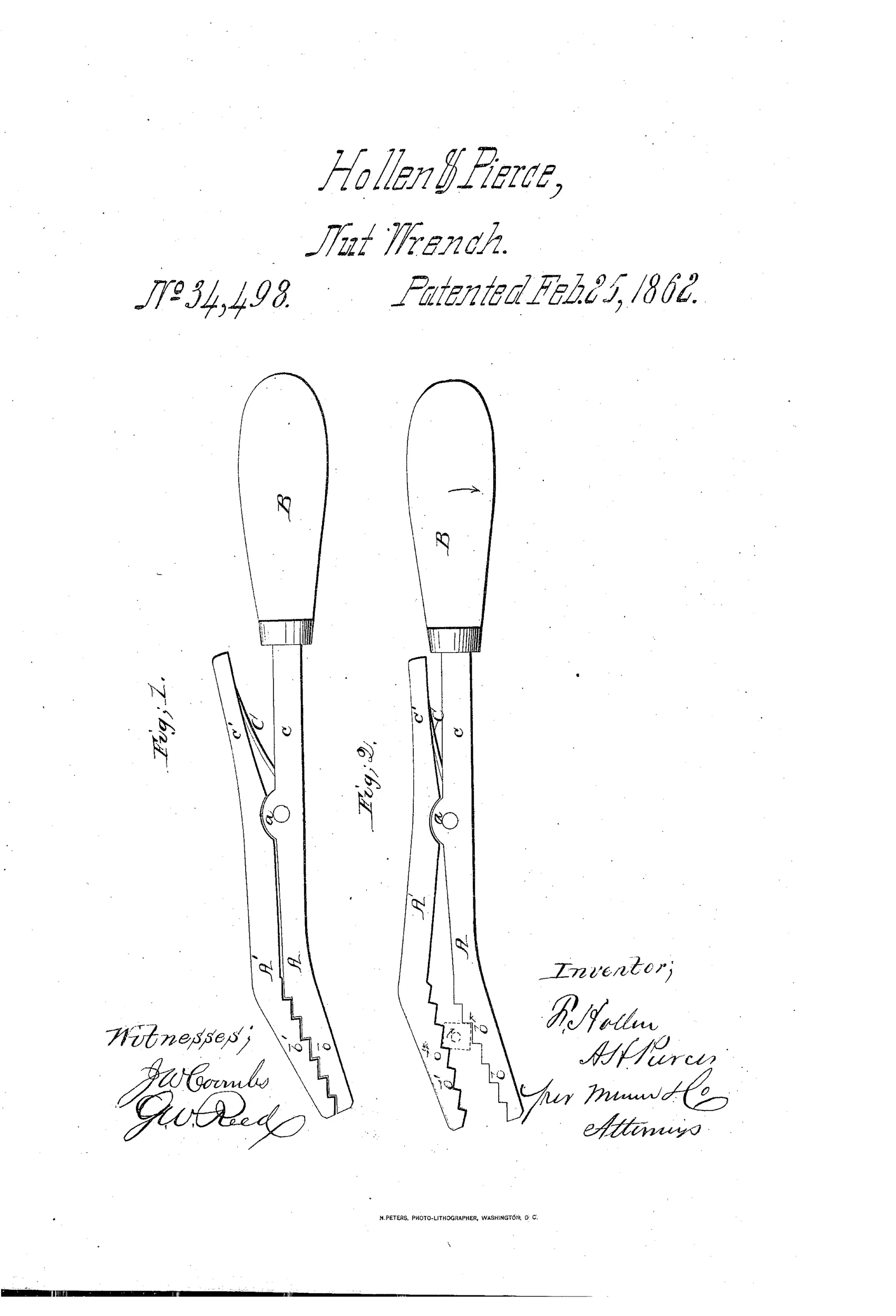
Spring-closed ratchet-jaw wrench for burrs and nuts
⚙ How it works
Two jaws A and A' are joined by a hinge-joint a and bent at about twenty degrees to each other. Each jaw's inner face carries a toothed rack of ratchet-shaped teeth, with the stationary jaw's teeth pointing away from the joint and the movable jaw's teeth pointing toward it, so the teeth interlock when closed. A spring C inserted between the shanks c and c' forces the jaws together, and depressing the movable jaw's shank opens the jaws so a fresh tooth can grip a burr or nut of a different size.
⚙ What was claimed
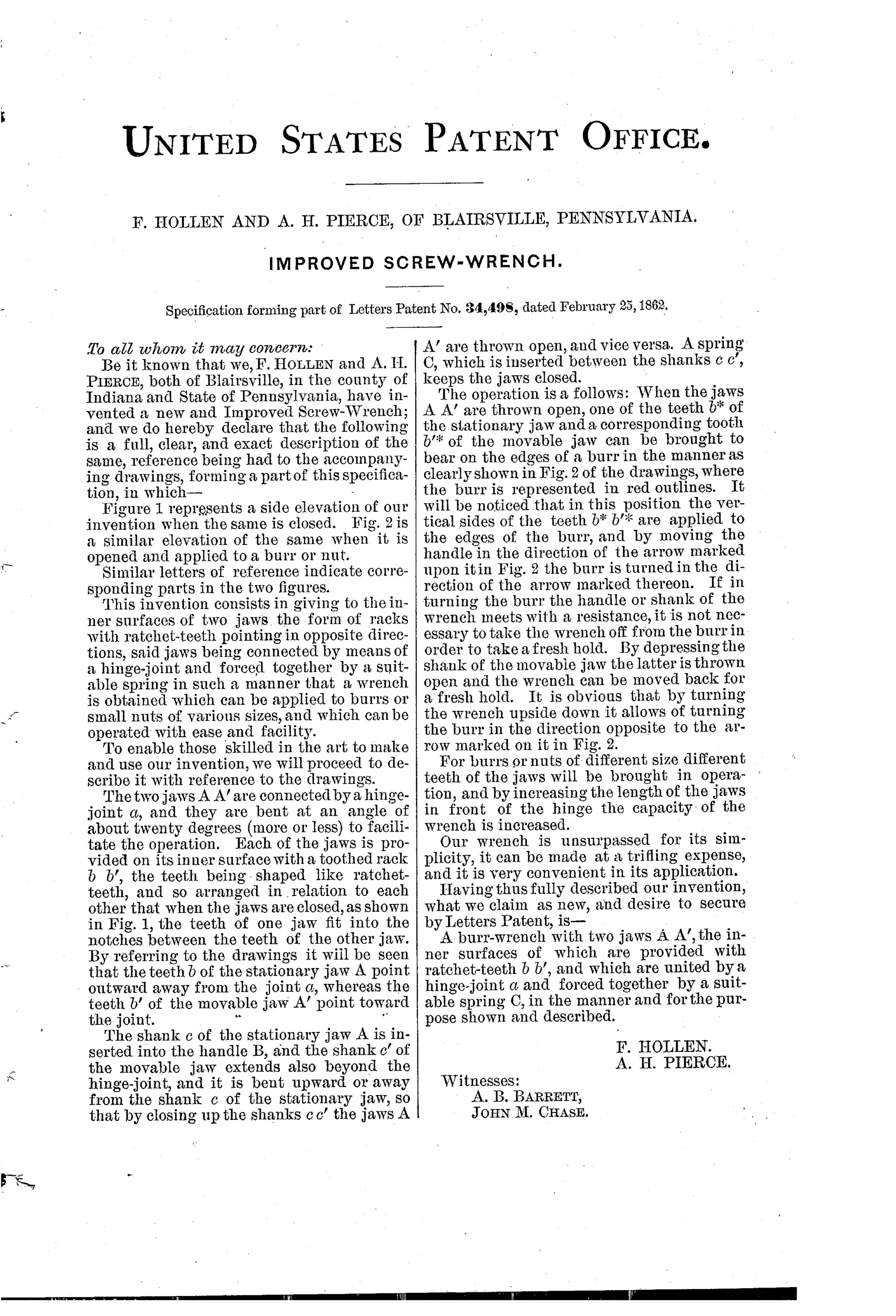
“A burr-wrench with two jaws A A', the inner surfaces of which are provided with ratchet-teeth b b', and which are united by a hinge-joint a and forced together by a suitable spring C, in the manner and for the purpose shown and described.”
In plain English: The claim covers a wrench with two hinged, spring-closed jaws whose inner faces have ratchet-shaped teeth that grip a burr or nut.
⚙ In the inventor’s words
“Our wrench is unsurpassed for its simplicity, it can be made at a trifling expense, and it is very convenient in its application.”— F. Hollen and A. H. Pierce, from the specification
Fate unknown
No marked example or catalogue listing is documented in DATAMP or the standard references; a surviving specimen would settle it.
⚙ Commentary
Hollen and Pierce's 1862 tool is really a pair of self-closing pliers dressed as a wrench, and that's what makes it interesting. There's no screw, no cam, no sliding jaw — just two members hinged at about twenty degrees, faced with opposing ratchet teeth, and a spring between the shanks that snaps them shut. To take a different size nut, you press the movable shank against the spring, let a fresh pair of teeth engage, and pull. Adjustment is literally instantaneous, decades before the quick-adjust craze of the 1880s and 90s.
The clever detail is in the tooth geometry, easy to miss in the drawing: the fixed jaw's teeth point away from the hinge and the movable jaw's teeth point toward it, so under torque the nut wedges deeper into the interlocking racks instead of camming the jaws open. The spring only has to hold position; the load does the gripping. That's the same self-tightening logic the toothed alligator wrench exploited, here made adjustable by the hinge.
The honest weakness is the same as every toothed jaw: those ratchet points bear on the nut's corners, and soft burrs on farm machinery would come away chewed. As a fencerow and wagon-shed tool for stubborn square burrs it would genuinely work; as a machinist's wrench it never had a chance. Their boast that it 'can be made at a trifling expense' rings true — this is blacksmith-simple — but simplicity alone rarely bought shelf space.
Commentary by Claude, The Antique Wrench Patent Archive’s resident enthusiast