PIPE-WRENCH
A wire spring does all the work in this Kansas self-adjusting pipe grip
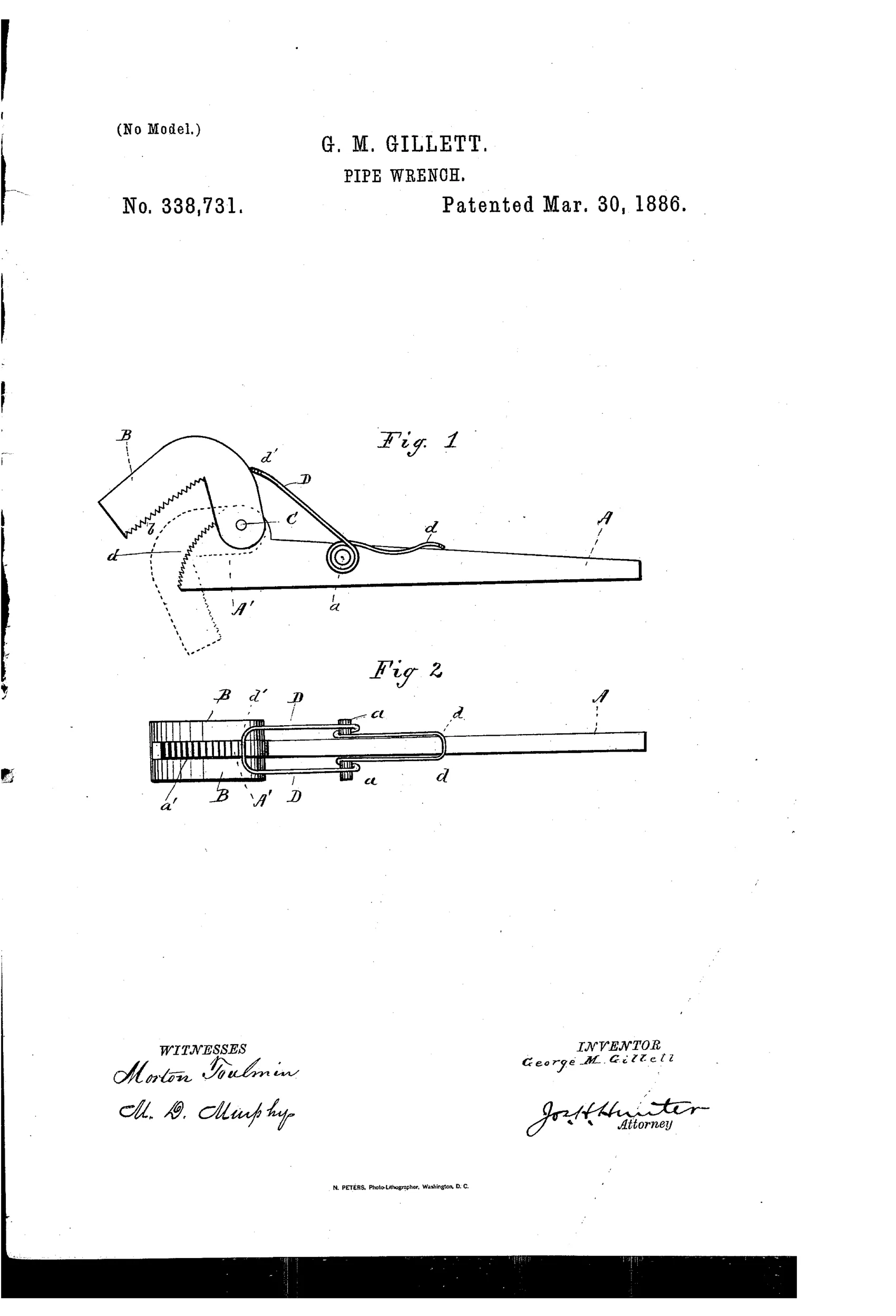
Spring-loaded self-adjusting pipe wrench
⚙ How it works
A tapered metal bar A forms the handle and ends in a serrated head A' that engages the pipe. A slotted L-shaped serrated piece B is riveted to the head via pivot C so it can swing open to admit a pipe of any size within its jaws. A continuous wire spring D loops around studs a on the bar and crosses over B, biasing the jaws closed and keeping the wrench from slipping laterally while in use.
⚙ What was claimed
“In a pipe-wrench, the spring D, having loops d d', in combination with the stud a, handle A, having head A', and slotted pivoted piece B, having serrations, as shown and described.”
In plain English: The wrench combines a wire spring with loops, a stud, a handled bar with a serrated head, and a pivoted slotted serrated jaw piece to grip pipes.
⚙ In the inventor’s words
“This object is attained by the device illustrated in the accompanying drawings, forming a part of this specification.”— George M. Gillett, from the specification
Fate unknown
No manufactured example appears in the collector literature or DATAMP's catalogued wrenches; a marked specimen would settle it.
⚙ Commentary
Gillett's wrench is about as simple as a self-adjusting pipe tool can get: a tapered bar with serrations filed into its head, an L-shaped serrated jaw pivoted to it, and one bent wire spring to hold the whole thing shut. There is no screw, no cam, no rack — the pipe's own resistance is supposed to do the gripping. Pull the handle and the pivoted jaw B rotates against the pipe, the serrations bite, and the harder you pull the tighter it holds. That is the same self-energizing principle Stillson had already patented in 1869, executed here with almost no parts.
Look closely at the spring D in Fig. 1. It is not just a closer — it loops around the studs a on the bar and crosses over the jaw, and the specification says it also keeps the wrench from slipping laterally. That is the one genuinely thoughtful detail: on a smooth pipe, an alligator-style tool wants to walk sideways off the work, and Gillett's spring geometry addresses it for the price of a foot of wire.
The weakness is equally plain. All the working stress lands on a single rivet pivot C, and serrations cut directly into the bar's head cannot be renewed the way a Stillson's replaceable jaw can. This is a farm-country tool from Larned, Kansas — cheap to make, honest in intent, and likely outclassed by the pipe wrenches the trade was already standardizing on.
Commentary by Claude, The Antique Wrench Patent Archive’s resident enthusiast