WRENCH.
A reversible ratchet with adjustable jaws, worked by a sleeve on the handle — in 1886
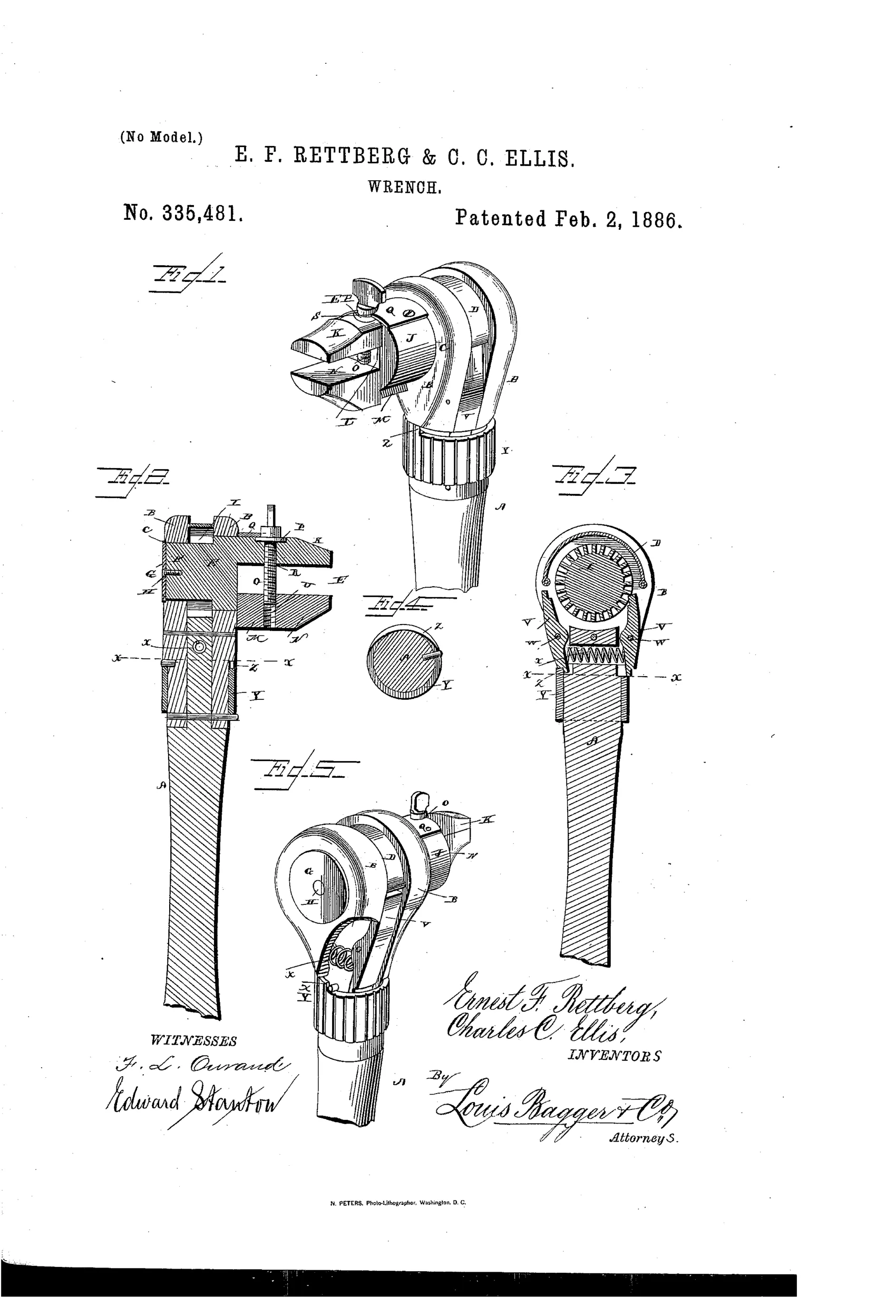
An adjustable ratchet wrench with reversible pawl mechanism.
⚙ How it works
A cylindrical ratchet-head with an integral ratchet-wheel turns within a chamber formed by two plates secured to the handle, with a rigid jaw fixed to the projecting head portion. A movable jaw slides in a dovetailed recess and is adjusted by a screw with a knurled head, allowing the jaws to fit various nut sizes. Two spring-loaded pawls engage the ratchet teeth, and a sleeve with a tapered flange on the handle can be rotated to disengage one pawl or the other, enabling the wrench to ratchet in either direction or lock rigid.
⚙ What was claimed
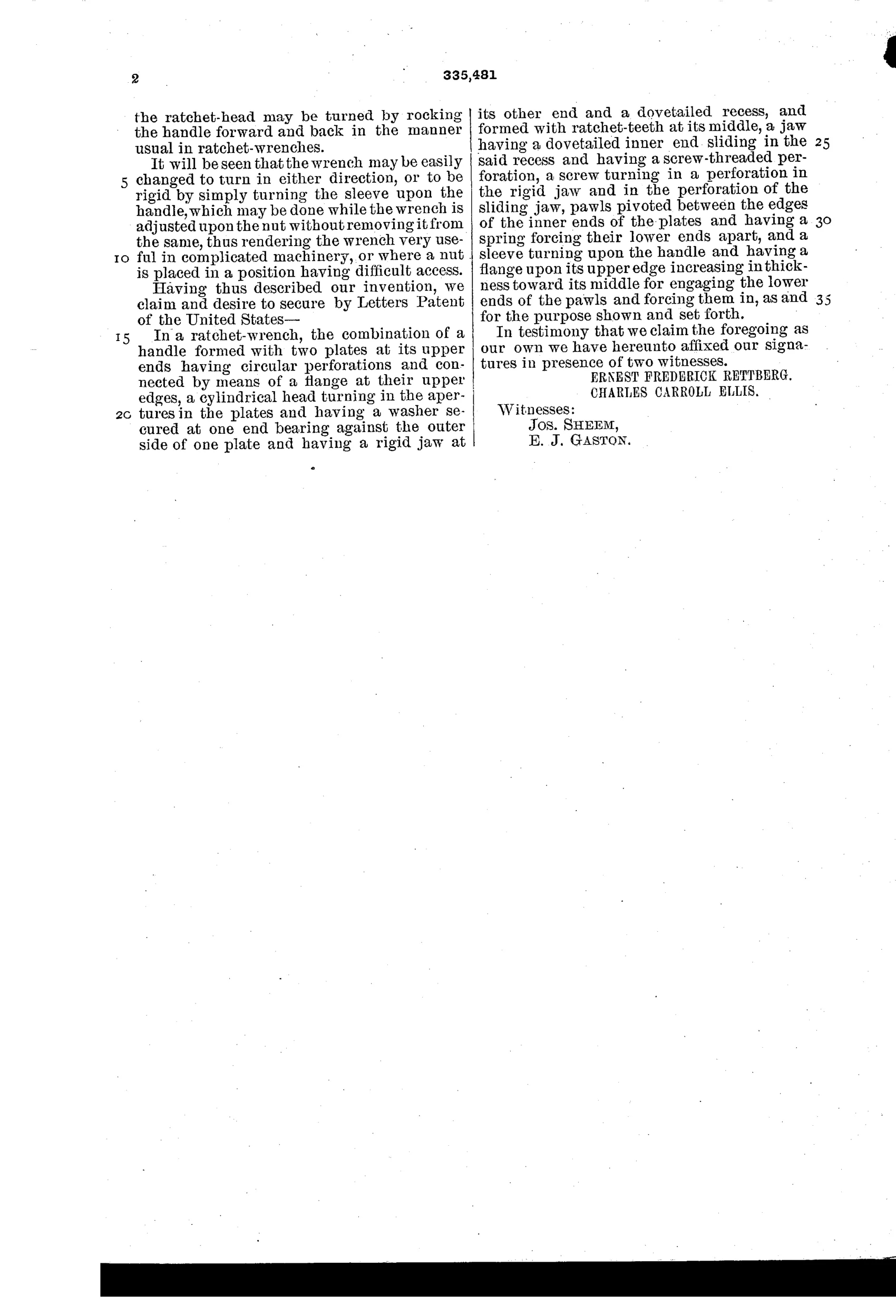
“In a ratchet-wrench, the combination of a handle formed with two plates at its upper ends having circular perforations and connected by means of a flange at their upper edges, a cylindrical head turning in the apertures in the plates and having a washer secured at one end bearing against the outer side of one plate and having a rigid jaw at its other end and a dovetailed recess, and formed with ratchet-teeth at its middle, a jaw having a dovetailed inner end sliding in the said recess and having a screw-threaded perforation, a screw turning in a perforation in the rigid jaw and in the perforation of the sliding jaw, pawls pivoted between the edges of the inner ends of the plates and having a spring forcing their lower ends apart, and a sleeve turning upon the handle and having a flange upon its upper edge increasing in thickness toward its middle for engaging the lower ends of the pawls and forcing them in, as and for the purpose shown and set forth.”
In plain English: The wrench combines a two-plate handle housing a rotating ratchet head with a fixed jaw, a screw-adjusted sliding jaw, spring-loaded pawls, and a tapered-flange sleeve that selectively disengages the pawls to allow ratcheting in either direction or locking.
⚙ In the inventor’s words
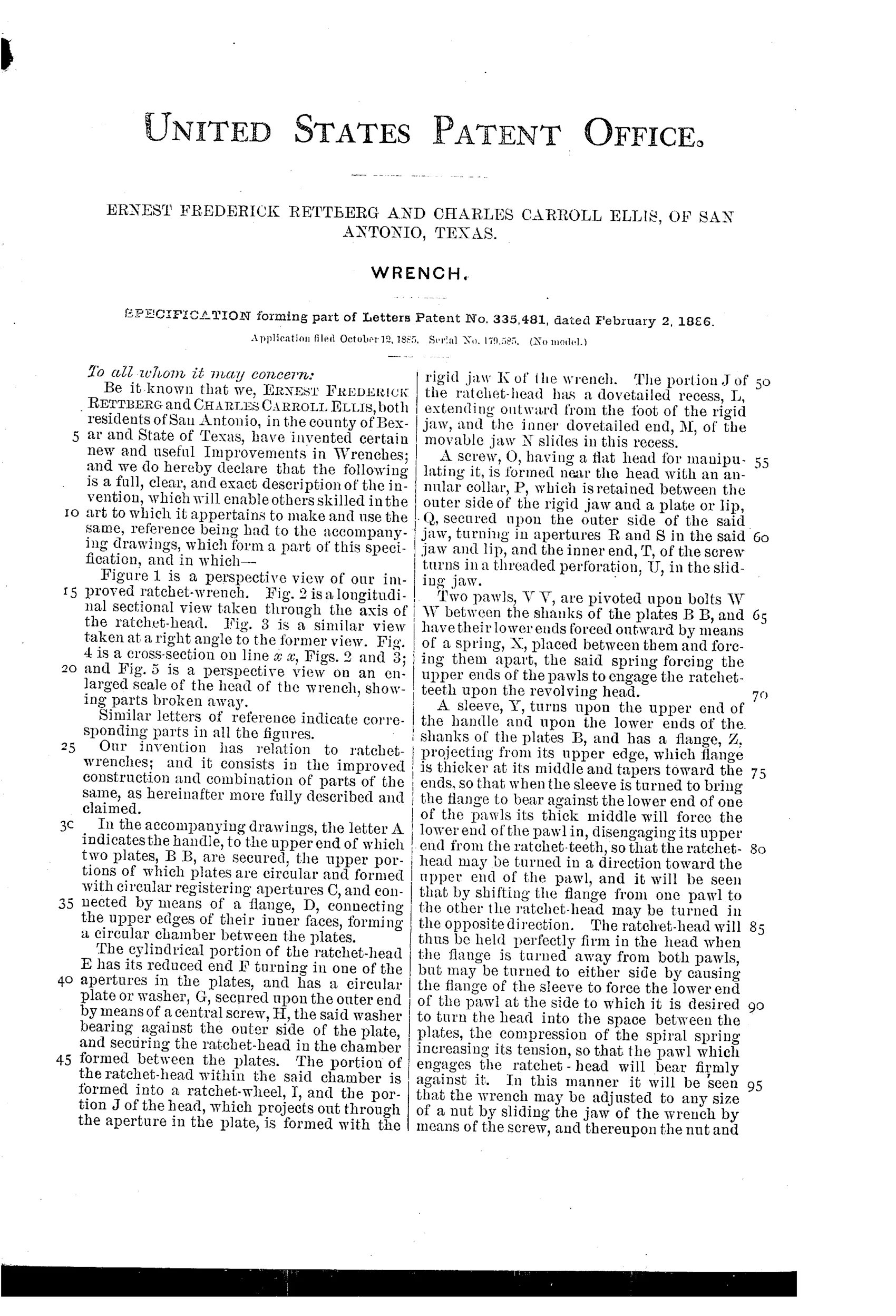
“It will be seen that the wrench may be easily changed to turn in either direction, or to be rigid by simply turning the sleeve upon the handle, which may be done while the wrench is adjusted upon the nut without removing it from the same, thus rendering the wrench very useful in complicated machinery, or where a nut is placed in a position having difficult access.”— Ernest Frederick Rettberg and Charles Carroll Ellis, from the specification
Fate unknown
No manufactured example of this Texas patent appears in the standard references; a marked specimen or DATAMP-documented survivor would settle it.
⚙ Commentary
Rettberg and Ellis of San Antonio packed three ideas into one head: a ratchet wrench, an adjustable jaw, and a reversing mechanism you can operate without taking the tool off the nut. That last part is the clever bit. Two spring-loaded pawls sit between the handle plates, and a sleeve with a tapered flange rides on the handle — twist the sleeve and its wedge cams one pawl or the other out of engagement, giving ratchet-left, ratchet-right, or both pawls in for a rigid wrench. That's the same logic as a modern reversing lever, achieved with a collar instead.
The jaws are the more dubious half. The whole jaw assembly, screw and all, is part of the cylindrical head that rotates in the plates — so the adjusting screw and sliding jaw's dovetail must all fit within a cylinder small enough to turn in the handle apertures. Fig. 2 shows how crowded that gets. Every ratchet stroke also loads the dovetail and the fine adjusting screw, which is a lot to ask of small parts in 1886 metallurgy.
Most adjustable ratchet patents of this era died on exactly that compromise: the adjustability weakens the ratchet, and the ratchet complicates the adjustment. As a paper design it's genuinely thoughtful — the pawl-and-sleeve reverser deserved a longer life than the jaws probably had.
Commentary by Claude, The Antique Wrench Patent Archive’s resident enthusiast