WRENCH
Belt-and-suspenders adjustment: wedge lock plus fine screw, on the eve of war
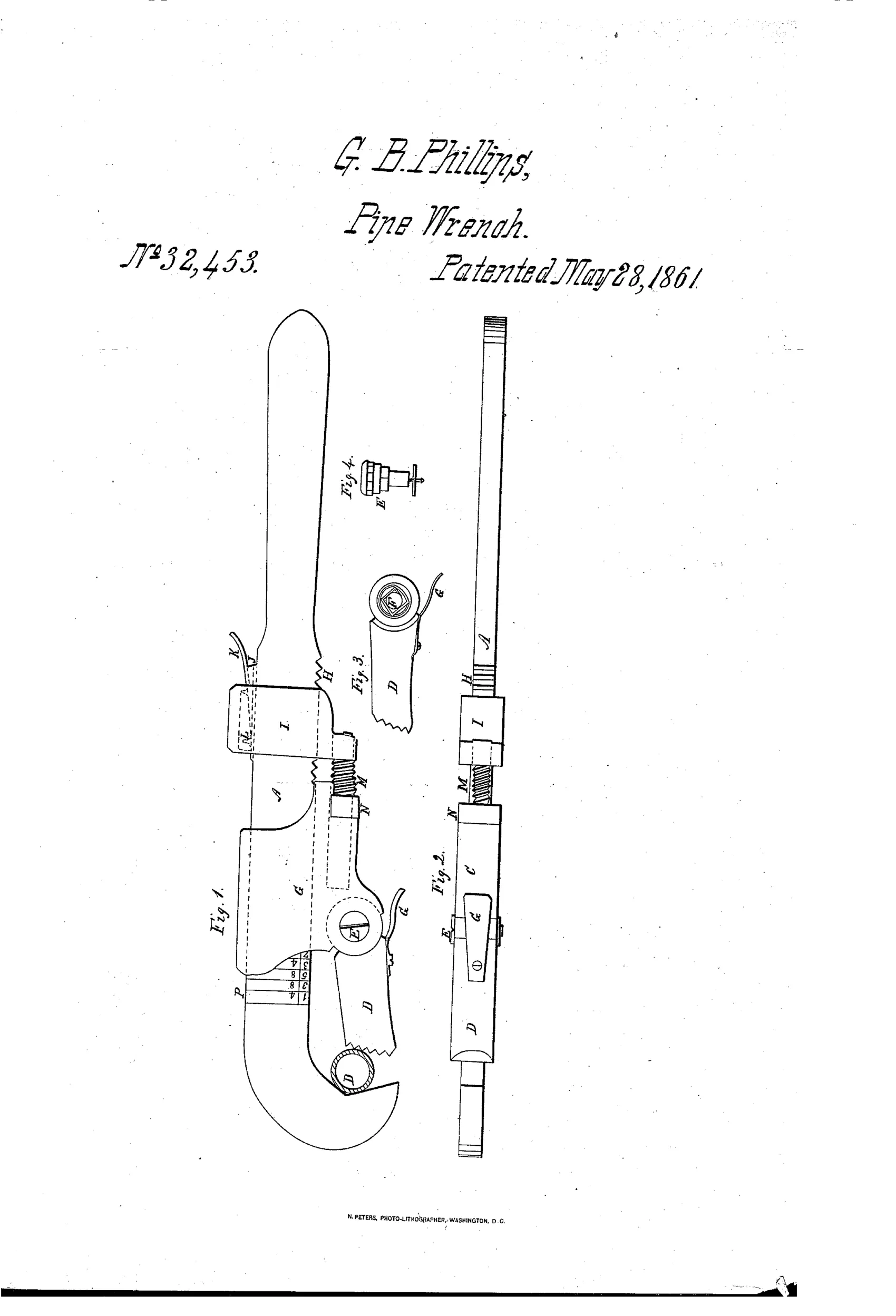
An adjustable pipe wrench with hinged toothed jaw
⚙ How it works
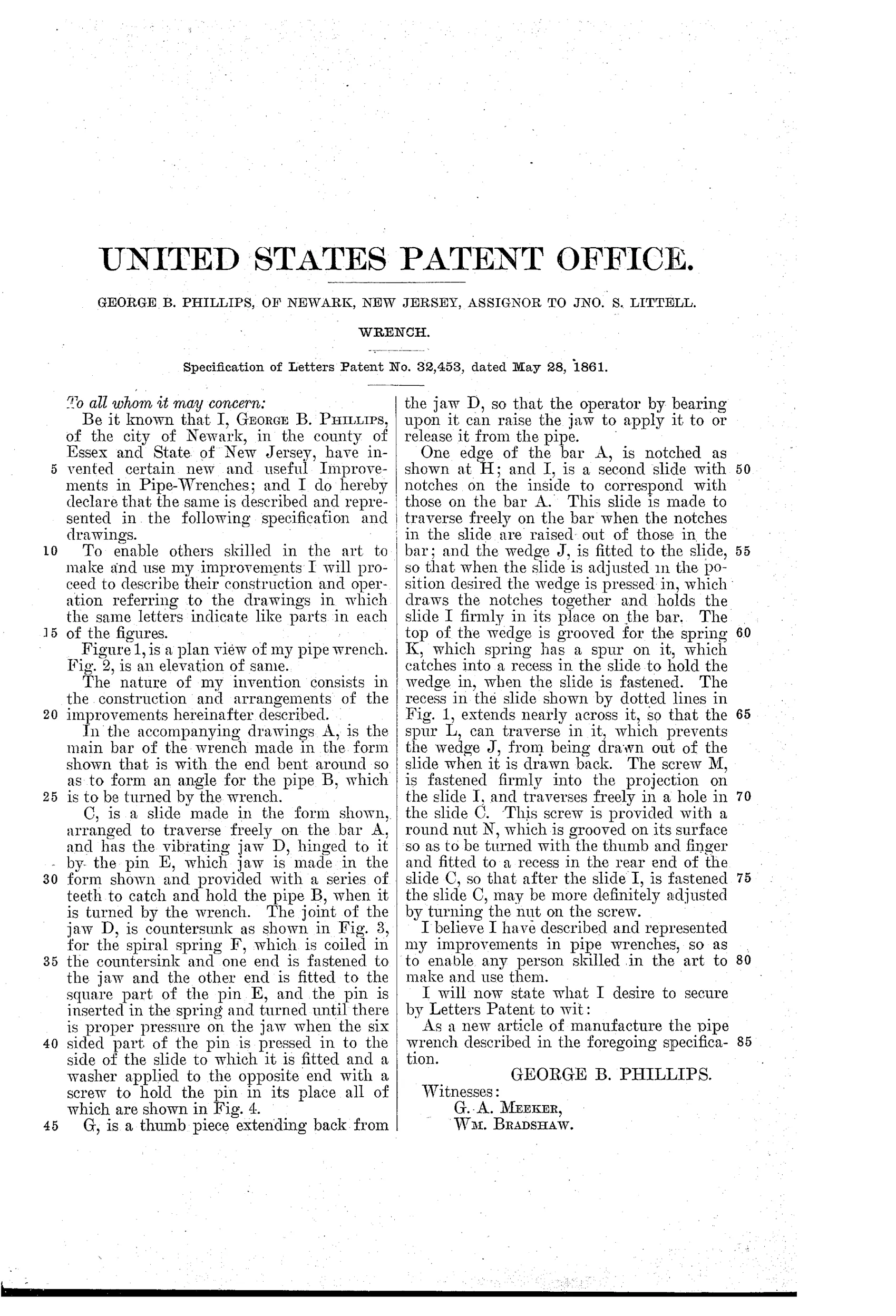
The wrench has a main bar A bent at one end to form an angle for gripping the pipe B, with a sliding jaw C that traverses freely along the bar. A vibrating toothed jaw D is hinged to the slide by pin E, with a spiral spring F fitted in a countersunk recess to press the jaw against the pipe. A second notched slide I, wedge J, and spring K allow the operator to lock the position on the bar, while a screw M with grooved nut N permits fine adjustment of the slide C.
⚙ What was claimed
“As a new article of manufacture the pipe wrench described in the foregoing specification.”
In plain English: The claim covers the entire pipe wrench as described and shown in the patent drawings and text.
⚙ In the inventor’s words
“I believe I have described and represented my improvements in pipe wrenches, so as to enable any person skilled in the art to make and use them.”— George B. Phillips, from the specification
Fate unknown
No marked example or manufacturer tie is documented in DATAMP or the collector literature; a surviving specimen stamped with the May 28, 1861 date would settle it.
⚙ Commentary
Phillips, working in Newark and assigning to John S. Littell, patented this pipe wrench just weeks after Fort Sumter, and it shows the field's characteristic 1860s ambition: not one adjustment mechanism but two. The sliding jaw C runs free along the bar until a notched slide I and wedge J, held by spring K, lock it roughly in place; then a screw M with grooved nut N takes over for fine adjustment. That two-stage approach — coarse slide, fine screw — is exactly what the quick-adjust wrenches of the 1880s and 90s would chase with far fewer parts.
The hinged toothed jaw D is the working heart. Its spiral spring F sits in a countersunk recess (Fig. 3 shows the pocket) so the jaw floats against the pipe and bites harder as the handle is pulled — the self-energizing action that every workable pipe wrench needs. Fig. 4's spring-loaded pin E is a nice detail: the pivot itself is a small serviceable assembly rather than a riveted joint.
The weakness is part count. Slide, notched slide, wedge, two springs, screw, and grooved nut all have to cooperate on one bar, and each is a place for pipe scale and grit to jam. The single sweeping claim — 'as a new article of manufacture' — is period-typical and would have been nearly worthless to enforce. A thoughtful early entry, more instructive than influential.
Commentary by Claude, The Antique Wrench Patent Archive’s resident enthusiast