WRENCH
The pivoted handle turns your grip into the clamping force
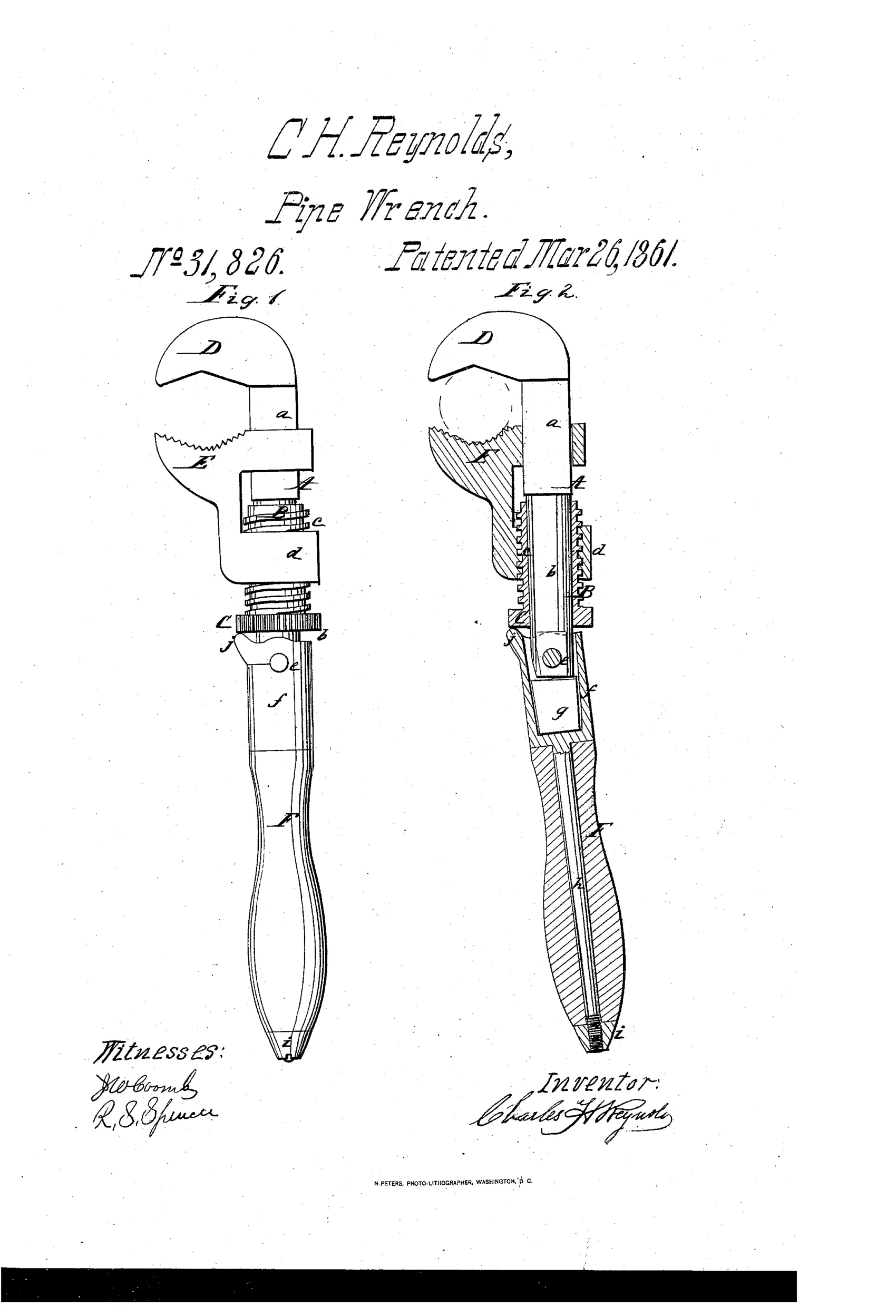
Self-tightening pipe/screw wrench with lever handle
⚙ How it works
A sliding jaw rides on a quadrilateral shank and is advanced or retracted by a threaded collar that engages a nut on the jaw. The collar has limited longitudinal play on a cylindrical portion of the shank and carries a milled thumb wheel at its base. A pivoted lever handle, joined to the shank by a pin and pressed by a rubber spring, bears against the thumb wheel so that turning the handle forces the collar outward, which in turn presses the sliding jaw more firmly against the work. Greater turning force thus produces a firmer grip on the nut or pipe, and the spring returns the handle to its working position when force is released.
⚙ What was claimed
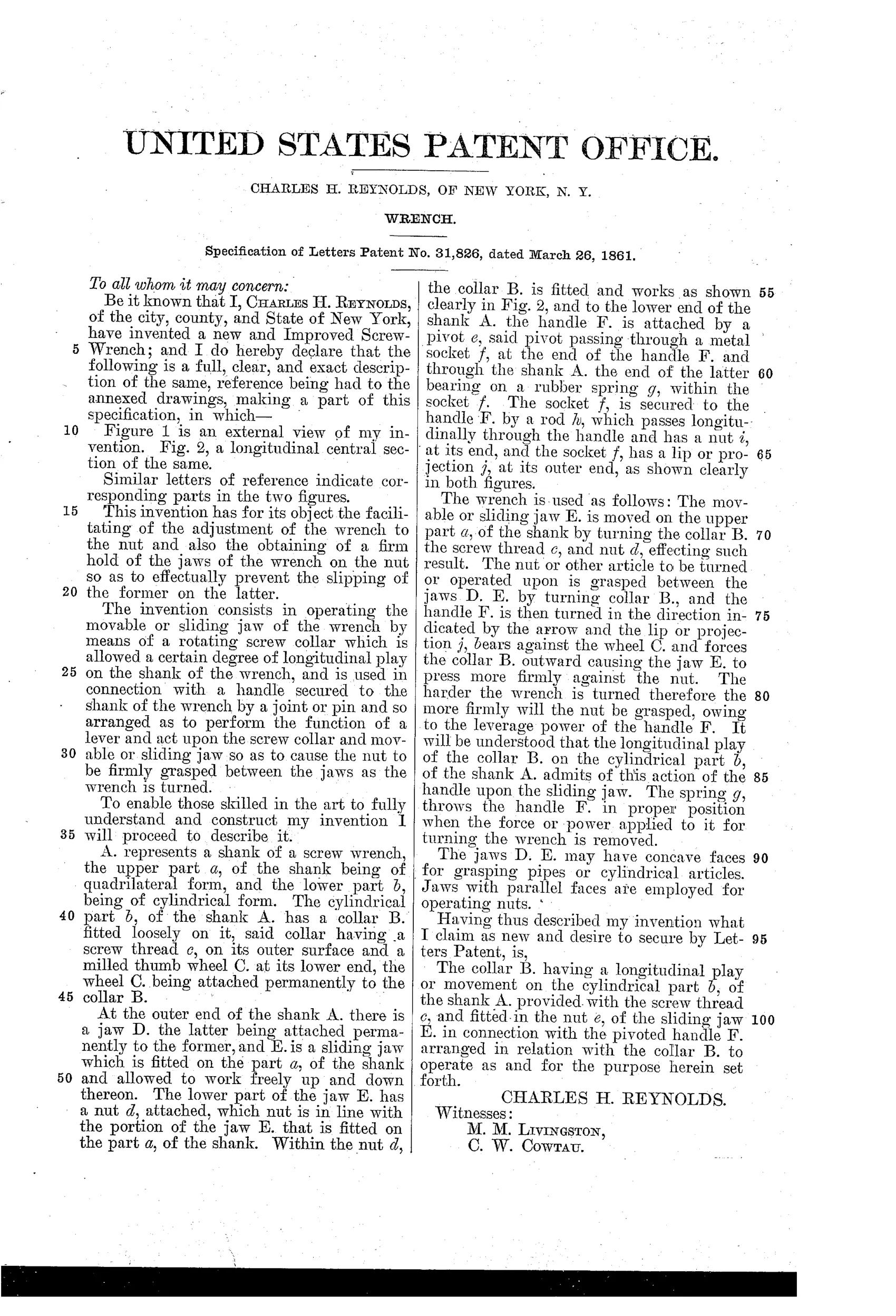
“The collar B. having a longitudinal play or movement on the cylindrical part b, of the shank A. provided with the screw thread c, and fitted in the nut e, of the sliding jaw E. in connection with the pivoted handle F. arranged in relation with the collar B. to operate as and for the purpose herein set forth.”
In plain English: The claim covers a loosely-fitted, longitudinally sliding threaded collar on the wrench shank that engages the sliding jaw's nut, combined with a pivoted handle positioned to push the collar and thereby tighten the jaw as the wrench is turned.
⚙ In the inventor’s words
“The harder the wrench is turned therefore the more firmly will the nut be grasped, owing to the leverage power of the handle F.”— Charles H. Reynolds, from the specification
Fate unknown
No manufactured example or catalog listing is documented in DATAMP or elsewhere to my knowledge; a marked specimen would settle it.
⚙ Commentary
Reynolds's idea here is to make the wrench tighten itself in proportion to how hard you pull on it. The sliding jaw is moved by a familiar threaded collar with a milled thumb wheel — Coes-style adjustment — but the collar is deliberately fitted loose, with a little longitudinal play on a cylindrical section of the shank. The handle isn't rigid: it pivots on a pin, backed by a rubber spring, and its upper end bears against the base of that thumb wheel. Pull on the handle, and the leverage drives the collar forward, which drives the jaw against the pipe. As the patent puts it, "the harder the wrench is turned... the more firmly will the nut be grasped."
Fig. 2 is the one to study. The section shows how much is going on inside what looks, in Fig. 1, like an ordinary screw wrench: the loose collar, the nut on the jaw, the pivot pin, and the spring buried in the handle. That rubber spring is a period tell — 1861 was the heyday of vulcanized-rubber springs in patents, and they hardened and failed in service.
As an 1861 self-tightening pipe wrench, this is early and genuinely thoughtful — the family of levered, self-gripping pipe wrenches that culminates in Stillson's 1869 design was just forming. Reynolds's version adds parts and a squishy handle joint to a job that toothed jaws and a simple pivot would later do better. Interesting ancestor; probable dead end.
Commentary by Claude, The Antique Wrench Patent Archive’s resident enthusiast