WRENCH.
A one-hand quick-adjust wrench from Gold Rush California, twenty years early
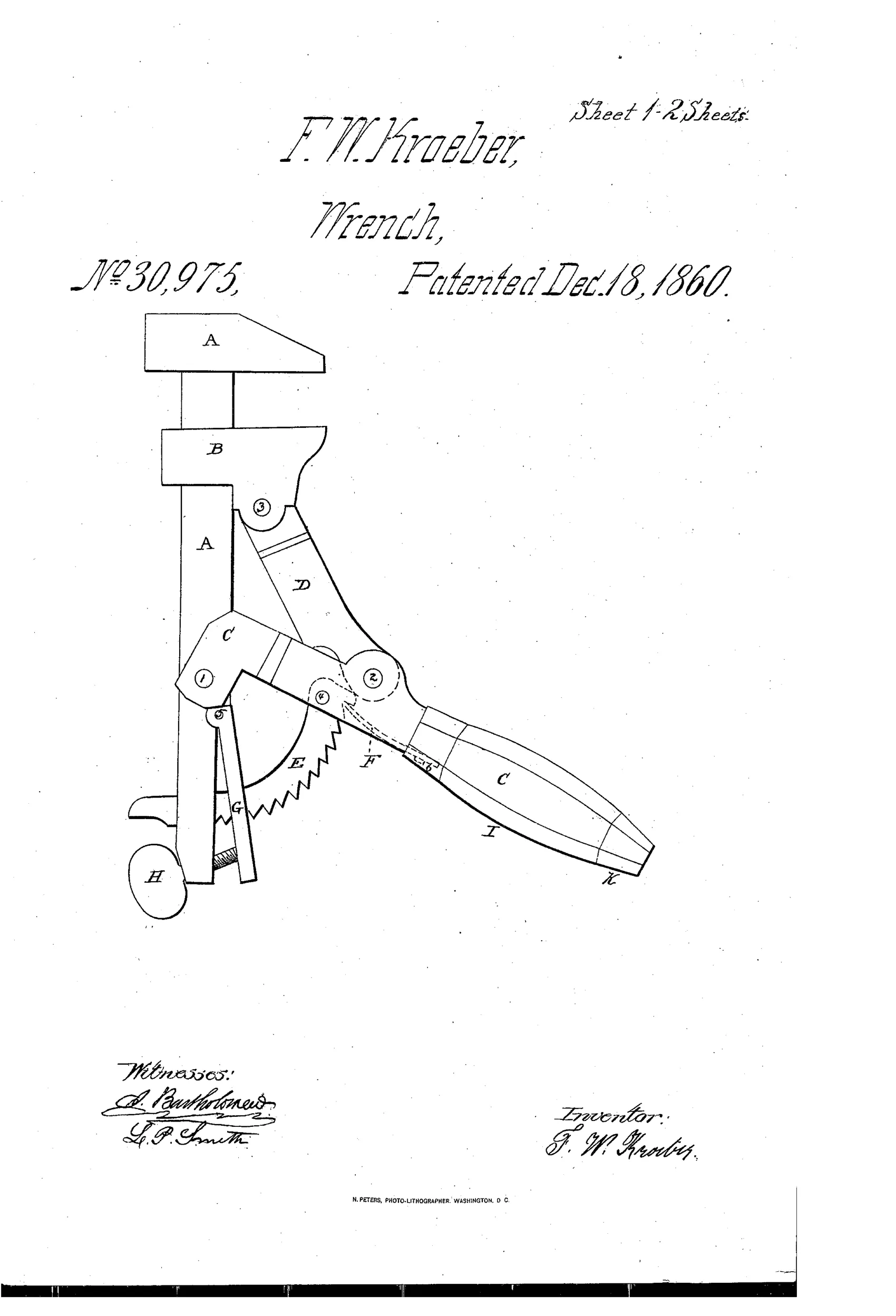
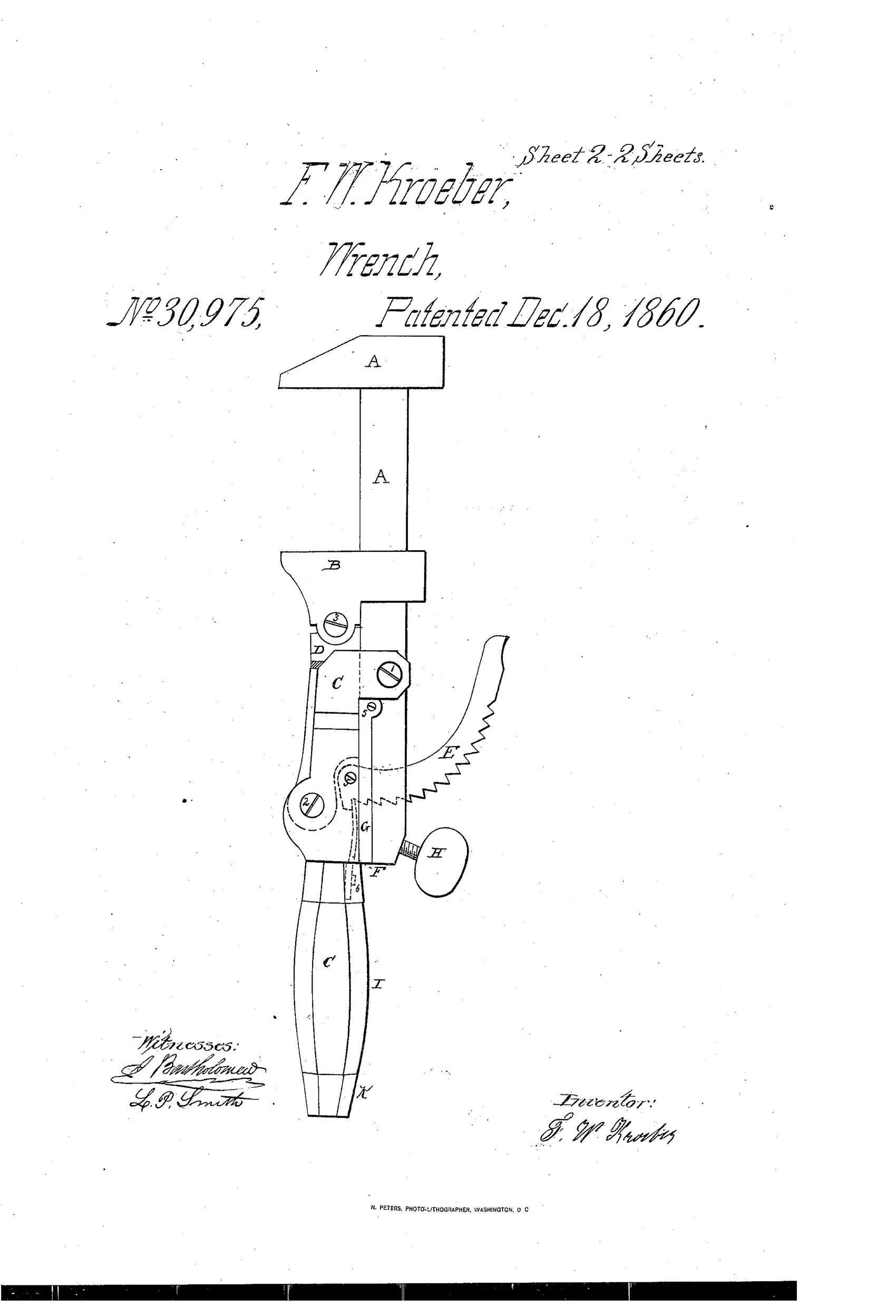
Lever-action monkey wrench with ratchet jaw adjustment
⚙ How it works
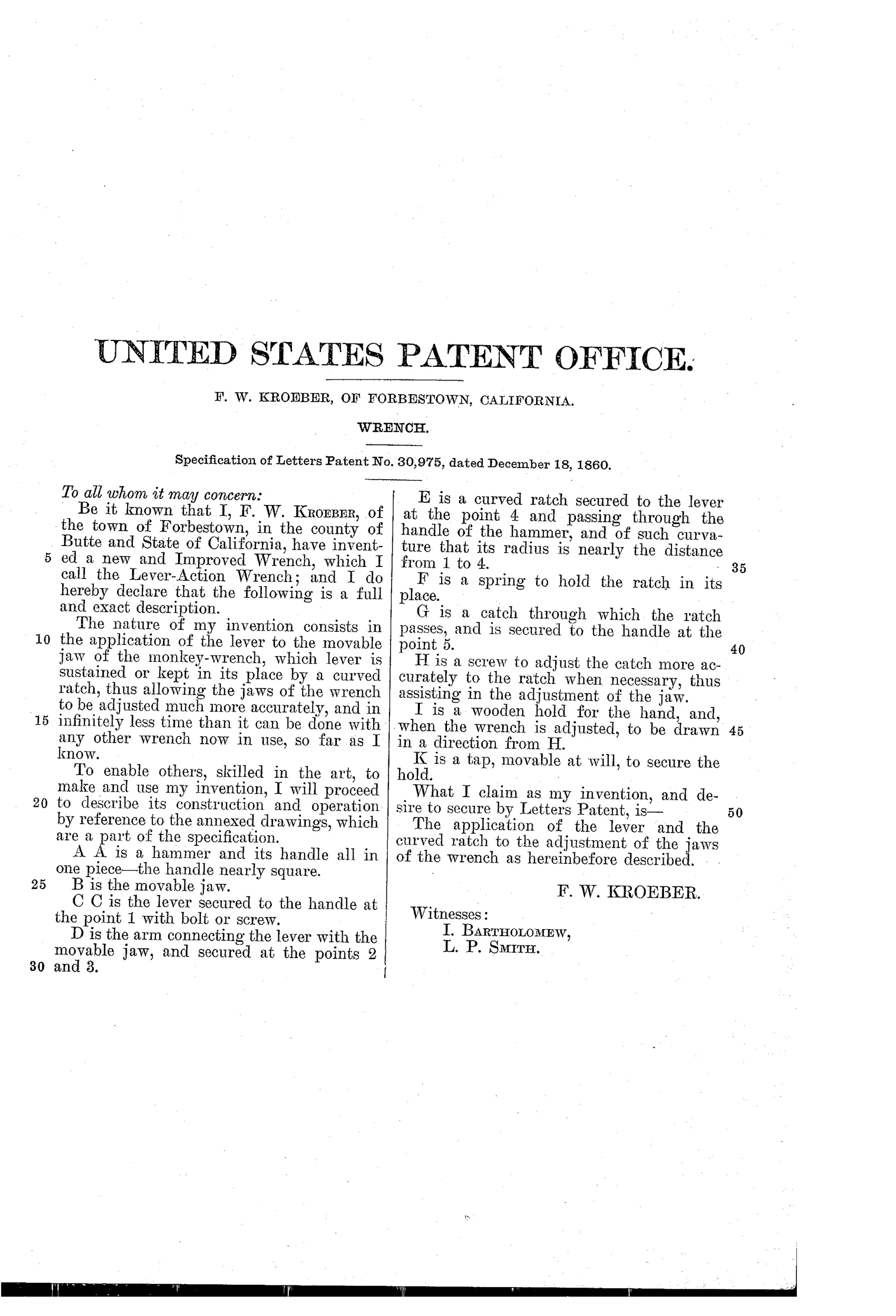
A lever C is pivoted to the handle and connected by an arm D to the movable jaw B, so that squeezing the lever moves the jaw. A curved ratch E, secured to the lever, passes through a catch G on the handle and is held in place by a spring F, locking the jaw at the desired opening. A screw H adjusts the catch's grip on the ratch for fine adjustment, and a movable tap K secures the final hold once the jaw is set.
⚙ What was claimed
“The application of the lever and the curved ratch to the adjustment of the jaws of the wrench as hereinbefore described.”
In plain English: Using a lever combined with a curved ratchet strip to adjust and hold the wrench's jaw is the patented invention.
⚙ In the inventor’s words
“thus allowing the jaws of the wrench to be adjusted much more accurately, and in infinitely less time than it can be done with any other wrench now in use, so far as I know.”— F. W. Kroeber, from the specification
Paper patent — likely never produced
No manufactured example or catalog listing is known, and the mechanism's cost and complexity in 1860 make production implausible; per DATAMP it survives as a patent only.
⚙ Commentary
Kroeber's idea is the one the whole field would chase for the rest of the century: set the jaw by squeezing, not by spinning a knurled worm. Grip the lever C, the arm D drives the movable jaw B down onto the nut, and a curved ratch E slides through a spring-loaded catch on the handle, locking the opening where you left it. Coes's screw was accurate but slow; Kroeber's pitch — his own words — is adjustment 'in infinitely less time than it can be done with any other wrench now in use.' In 1860, from Forbestown, California, that is remarkably ahead of the curve. The great quick-adjust wrenches are mostly an 1880s-90s phenomenon.
The drawing rewards a close look. Notice the belt-and-suspenders locking: the spring F holds the ratch by friction and tooth engagement, a screw H tunes the catch's bite, and a separate tap K clamps everything once set. That triple redundancy is honest — a single spring pawl on a curved ratch would creep under real torque, and Kroeber clearly knew it. But it also means the 'quick' wrench needs a slow final step, which undercuts the pitch.
Add the pivots, links, and that saw-toothed arc hanging off the handle, and you have a wrench costlier and more fragile than a Coes, with a grip cluttered by moving parts. A prophetic dead end: right instinct, premature execution.
Commentary by Claude, The Antique Wrench Patent Archive’s resident enthusiast