IMPROVEMENT IN TUBING-TONGS
Oil-country tongs where the handle's own swing wedges the jaws shut
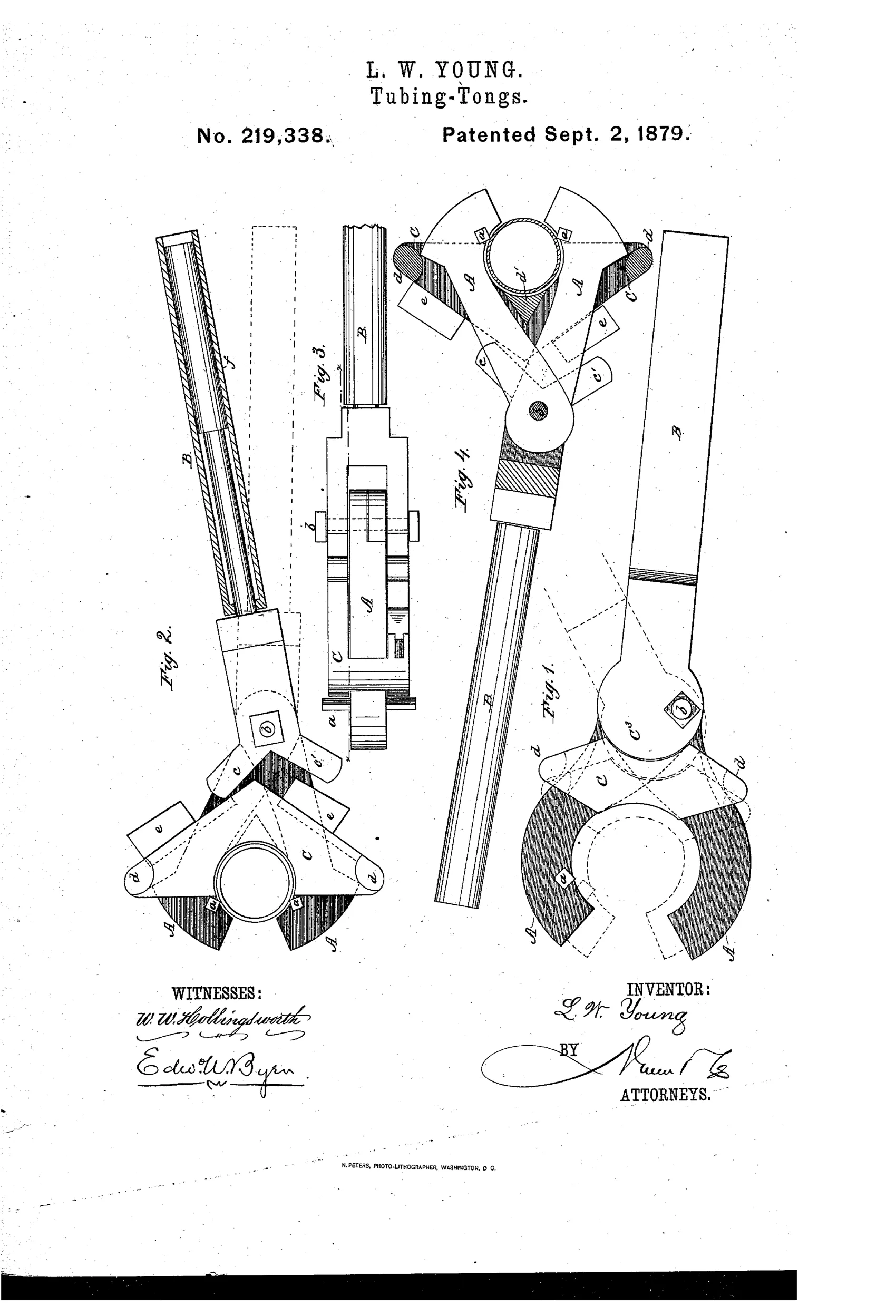
Self-tightening tongs for oil-well tubing pipe
⚙ How it works
A pair of jaws pivoted on a common bolt conform to the round tubing and carry hardened steel bits to bite it. A sliding or oscillating yoke embraces the jaws, and a lever pivoted on the same bolt bears against the yoke through a cam or eccentric projection. When the lever is deflected to one side, the eccentric strikes the yoke and forces it down over the jaws, wedging them together to grip the tube tightly; reversing the lever motion releases the grip. In the two-eccentric version a triangular yoke with a wedge-shaped middle cross-bar is pushed longitudinally to separate the jaws, and adjustable sliding blocks in dovetail grooves on the yoke take up lost motion between the lugs and yoke during reciprocal working.
⚙ What was claimed
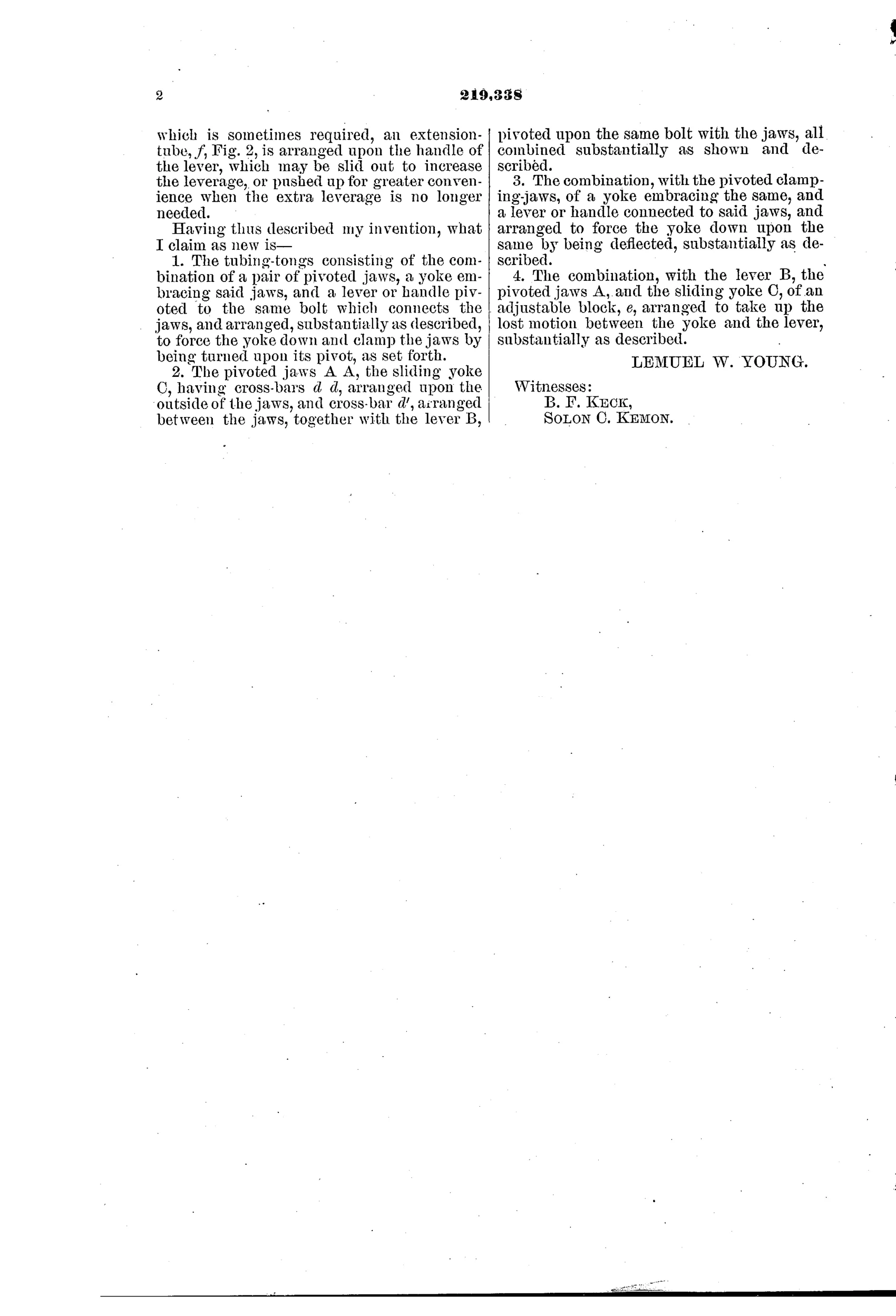
“The tubing-tongs consisting of the combination of a pair of pivoted jaws, a yoke embracing said jaws, and a lever or handle pivoted to the same bolt which connects the jaws, and arranged, substantially as described, to force the yoke down and clamp the jaws by being turned upon its pivot, as set forth.”
In plain English: The tongs combine pivoted jaws, a yoke around them, and a handle sharing the jaws' pivot, so turning the handle forces the yoke down to clamp the jaws onto the pipe.
⚙ In the inventor’s words
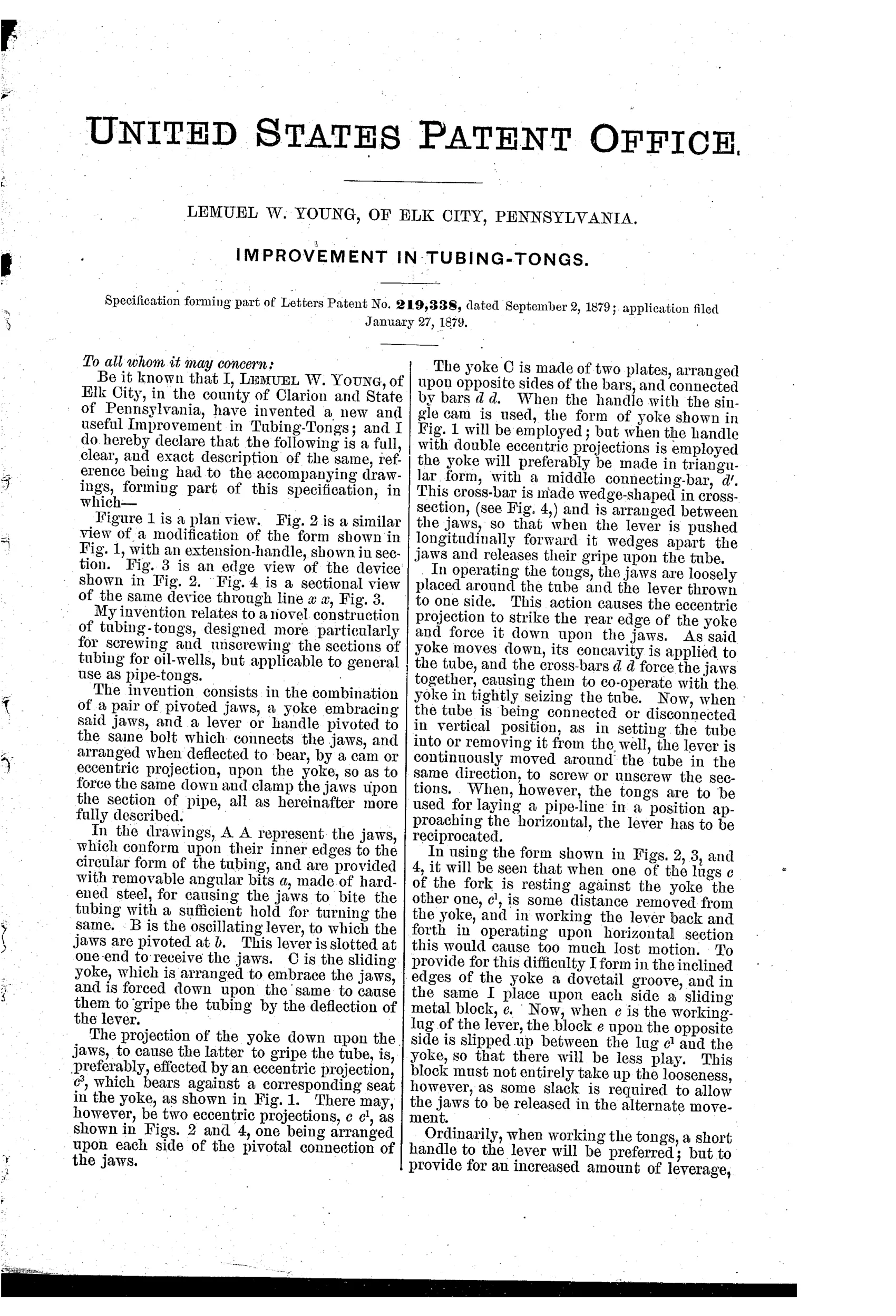
“My invention relates to a novel construction of tubing-tongs, designed more particularly for screwing and unscrewing the sections of tubing for oil-wells, but applicable to general use as pipe-tongs.”— Lemuel W. Young, from the specification
Fate unknown
Oil-field tongs were often made locally in small shops without maker marks; no catalogued example matching this patent is documented, and a marked specimen would settle it.
⚙ Commentary
Young's tongs come out of the Pennsylvania oil fields — Elk City sits in the heart of the 1870s oil region — and they solve the tubing crew's specific problem: hundreds of joints of round pipe to make up and break out, fast, with a tool that grabs the moment you pull on it. His answer is a cam on the handle's pivot. Lever, jaws, and yoke all share one bolt; deflect the handle and its eccentric projection shoves the yoke down over the pivoted jaws, wedging them onto the tube. Pull harder, grip harder — the same self-energizing logic that later made the Stillson pipe wrench famous, here executed with a yoke and cam instead of a tilting jaw.
The drawing rewards a close look. Fig. 1 shows the toothed, hardened bits set into the jaw faces — replaceable cutters, a practical touch for a tool meant to chew pipe daily. The dovetailed sliding blocks on the yoke are the subtler detail: they take up lost motion as the tongs ratchet back and forth on a joint, so the release-regrip cycle stays crisp instead of sloppy.
For wrench collectors this sits at the edge of the category — it's a pipe tong, not a nut wrench — but the cam-actuated yoke clamp is squarely in the family of self-tightening mechanisms the whole field was chasing. Whether an Oil City forge ever hammered these out is another question.
Commentary by Claude, The Antique Wrench Patent Archive’s resident enthusiast