IMPROVEMENT IN MONKEY-WRENCHES
A monkey wrench that moonlights as a pipe shop: dies, cutter, tap included
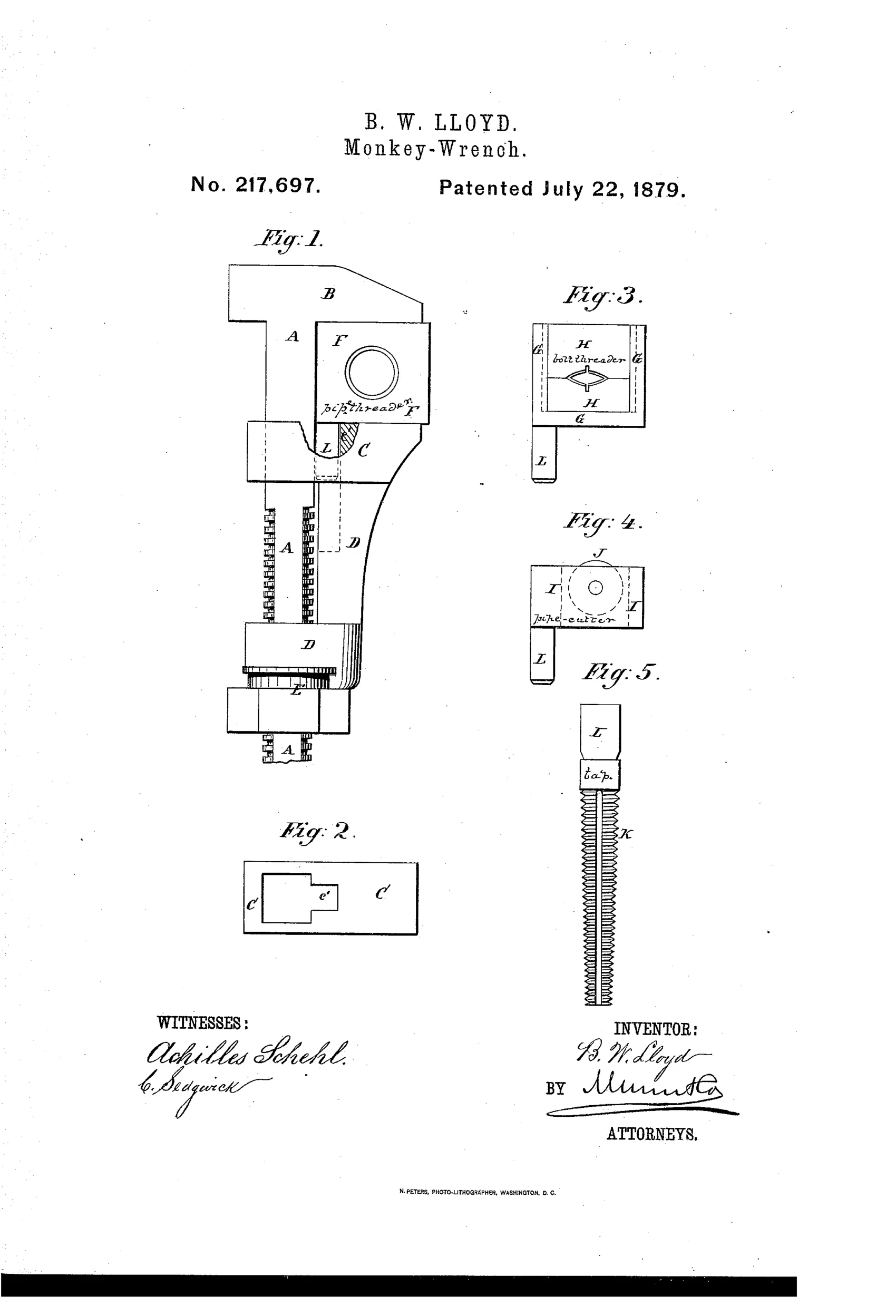
Monkey wrench with interchangeable pipe/bolt-threading and cutting tool attachments
⚙ How it works
The wrench has a shank A with a stationary jaw B and a sliding jaw C mounted on a threaded stem D adjusted by nut E. The sliding jaw C has a socket c' formed at the side of the hole through which the shank passes. Various tool heads—a pipe-threading die F, a bolt-threading die box G with die sections H, a pipe-cutter frame I with rotary knife J, and a nut tap K—each have an arm L shaped to fit into the socket c', allowing the wrench to hold and operate each attachment.
⚙ What was claimed
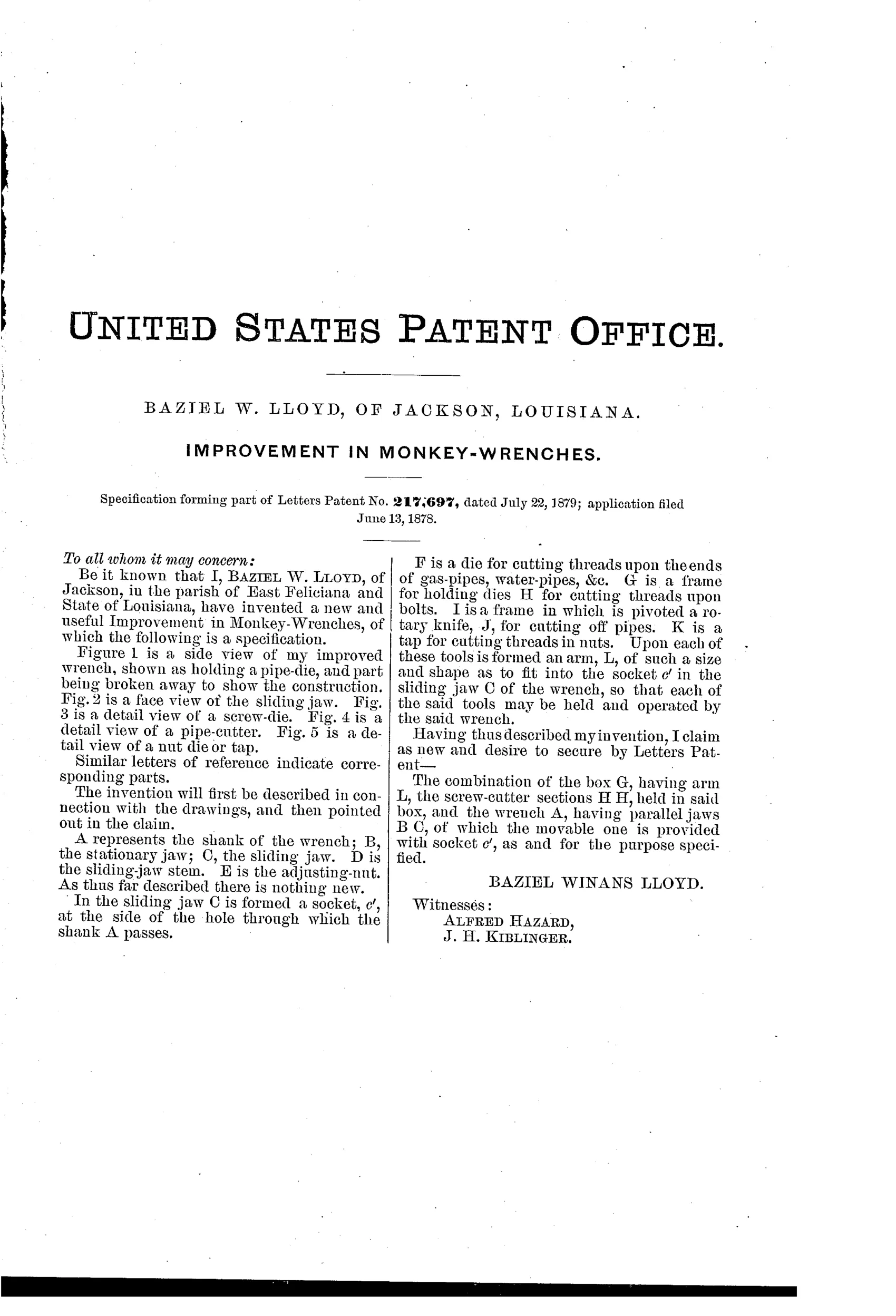
“The combination of the box G, having arm L, the screw-cutter sections H H, held in said box, and the wrench A, having parallel jaws B C, of which the movable one is provided with socket c', as and for the purpose specified.”
In plain English: The invention combines a die box with dies and an attachment arm that fits into a socket on the wrench's sliding jaw, letting the wrench hold and operate the die box.
⚙ In the inventor’s words
“Upon each of these tools is formed an arm, L, of such a size and shape as to fit into the socket c' in the sliding jaw C of the wrench, so that each of the said tools may be held and operated by the said wrench.”— Baziel Winans Lloyd, from the specification
Fate unknown
No manufactured example or catalog listing is documented; a surviving wrench with the side socket and any of the fitted attachments would settle it.
⚙ Commentary
Lloyd's idea is disarmingly simple: cut a socket into the side of the sliding jaw, then give every accessory — pipe-threading die, bolt-threading die box, rotary pipe cutter, nut tap — a matching arm L that plugs into it. The wrench itself is unremarkable, a stock parallel-jaw monkey wrench adjusted by nut E on a threaded stem. All the invention lives in that little rectangular socket c', shown plainly in Fig. 2, which turns the wrench handle into the drive bar for a whole kit of threading tools.
The mechanical logic is sound as far as torque goes: a threading die needs a long lever, and a wrench handle is exactly that. The weak point is the joint itself. A die box hanging off one side of a sliding jaw, retained only by the fit of the arm in the socket, puts the cutting load well off the wrench's centerline. Every turn tries to rack the sliding jaw on its shank. Dedicated die stocks put the die in the middle of two handles for good reason.
This sits in the crowded 1870s tradition of combination tools — farmers and country plumbers wanted one purchase to do five jobs. Most such patents, like this one from Jackson, Louisiana, far from the Worcester wrench factories, stayed on paper. DATAMP records the patent; the hardware trade seems not to have.
Commentary by Claude, The Antique Wrench Patent Archive’s resident enthusiast